

Crete is Greece’s largest and most self-contained island — a destination significant enough to feel like its own country, with its own distinct dialect, cuisine, music, and fierce pride in a cultural identity that predates Classical Greece by thousands of years. The Minoan Palace of Knossos (the oldest palace complex in Europe, 3,700 years old), the White Mountains with their iconic Samaria Gorge trek, the pink sand beaches of Elafonisi, the Venetian harbour of Chania, and the extraordinary Cretan food culture (arguably Greece’s finest regional cuisine) make Crete one of Europe’s richest island destinations. Here’s your complete guide to what to wear in Crete.
Crete Weather: When to Visit
Crete is one of Europe’s sunniest islands — over 300 days of sunshine per year — with a warm Mediterranean climate that extends the beach season from May through October. Summer (June–August) is peak season: hot (28–35°C), dry, and intensely sunny, with the Meltemi wind providing cooling relief on exposed coasts but creating rough sea conditions for some beach days. August is the busiest and most expensive month. Spring (April–May) and Autumn (September–October) are the most pleasant seasons for sightseeing and hiking — mild temperatures (18–26°C), fewer crowds, and the landscape at its greenest (spring) or most golden (autumn). Winter (November–March) is mild and green (10–17°C), ideal for hiking in the White Mountains and experiencing authentic Cretan village life without tourists. The Samaria Gorge (Europe’s longest gorge) is open May to October only.
What to Wear in Crete: Clothing Guide
Beach Essentials
Crete’s beaches range from the iconic pink-sand sweep of Elafonisi in the south-west to the turquoise pebbled waters of Balos Lagoon, the organised beach clubs of Elounda in the east, and the party beach scene of Platanias near Chania. Beach dress is entirely casual and appropriate at all beach areas. Topless sunbathing is common and generally accepted on Crete’s beaches.
- 2–3 swimsuits or bikinis for daily beach use
- Beach cover-up dresses or sarongs for walking between beach and taverna
- A rashguard or UV shirt for extended snorkelling sessions
- Flip-flops for the beach and reef sandals for rocky beach entries
Chania & Rethymno: Old Town Exploring
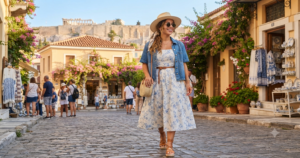
Chania’s Venetian harbour — with its Ottoman lighthouse, converted mosque, and labyrinth of medieval alleyways containing excellent restaurants, leather shops, and olive wood artisans — is Crete’s most beautiful urban area. Rethymno, midway between Chania and Heraklion, has a similarly spectacular old town with a Venetian harbour and Venetian fortezza above the city. Both towns are suitable for relaxed walking in casual summer clothes; the cobbled narrow streets and occasional steep sections make flat shoes or sandals far more practical than heels.
- Lightweight sundresses for Chania and Rethymno old town exploring
- Comfortable flat sandals — cobblestones and stepped alleys are common in Cretan old towns
- A light evening layer for Chania harbour restaurant dining (the sea breeze is refreshing but cool in evenings)
Samaria Gorge Hike
The Samaria Gorge — a 16km trek through the White Mountains from the Omalos plateau to the village of Agia Roumeli on the Libyan Sea — is one of Europe’s great one-day hikes. The route descends 1,227m through increasingly narrow gorge walls to the famous Iron Gates (the gorge narrows to just 3–4 metres at its narrowest point) before emerging at the sea. The hike is not technically difficult but requires good physical condition, proper footwear, and preparation. The gorge is one-way; return is by ferry to Hora Sfakion and bus back to Chania.
- Waterproof hiking boots or trail runners with excellent ankle support (the gorge path involves significant rocky terrain and knee-descent on loose stone)
- Moisture-wicking hiking clothing — the gorge is hot at the top and cool in the shaded lower section
- A small day pack with at least 3 litres of water (water points in the gorge are spaced; carry more than you think you need)
- Trekking poles (optional but enormously helpful for the steep descent)
Knossos & Archaeological Sites
The Palace of Knossos — the administrative and ceremonial centre of Minoan civilisation, with some walls standing 3–4 storeys — is entirely outdoors with minimal shade. Heraklion’s Archaeological Museum (one of the world’s great museums of ancient art, housing all the major Minoan artefacts) is the essential companion visit. Comfortable walking shoes, sun protection, and a wide-brim hat are essential for Knossos; the museum is air-conditioned and can be visited at any heat of day. Book both tickets online in advance; combined tickets save money.
Cretan Evening & Restaurant Culture
Crete’s food culture is extraordinary — ranked among the world’s finest Mediterranean diets, with dakos barley rusks with fresh tomato and feta, slow-cooked lamb with stamnagathi wild greens, fresh fish grilled with Cretan olive oil, and local varieties of honey, cheese (graviera, mizithra), and wine (Liatiko and Vidiano grapes). Restaurant dining in Crete is relatively casual — smart casual covers almost everything, from a harbour-front taverna in Chania to Heraklion’s excellent contemporary restaurant scene. The evening volta (stroll) is a Cretan tradition; dress smartly for the evening promenade.
- Smart casual evening outfits — a sundress and flat sandals work perfectly for both beach town tavernas and urban restaurant evenings
- A lightweight cardigan or linen jacket for evenings (coastal Crete can be breezy after sunset)
Crete Packing Essentials
- SPF 50 sunscreen (Crete’s summer UV is extreme; apply before leaving the hotel and reapply after swimming)
- Reef-safe sunscreen for snorkelling in Crete’s marine areas
- A wide-brim sun hat for outdoor archaeological site visits and beach days
- Good-quality sunglasses with UV protection
- Reusable water bottle (Crete’s tap water quality varies — some areas are excellent, others less so; bottled water is widely available and affordable)
- Motion sickness tablets if taking the boat from Agia Roumeli to Hora Sfakion after the Samaria Gorge (the Libyan Sea can be choppy)
Crete Outfit Mistakes to Avoid
- Attempting the Samaria Gorge in sandals: This is Crete’s most common tourist mistake. The gorge’s rocky descent is genuinely demanding on footwear; sandals or flat-soled trainers cause blisters, ankle twists, and miserable experiences on the steep initial descent. Proper hiking shoes or trail runners are the minimum.
- Not bringing a cover-up for Orthodox churches: Crete’s Orthodox churches — including the impressive Arkadi Monastery near Rethymno — require covered shoulders and knees. A scarf or sarong carried in your day bag allows spontaneous church visits without embarrassment.
- Visiting Knossos without sun protection: The Palace of Knossos is almost entirely outdoors with very little shade. Visiting in midsummer without a hat, sunscreen, and water bottle makes what should be a spectacular experience into a heat endurance test.
- Only packing beach clothes: Crete is far more than beaches — the island’s gorge hiking, archaeological sites, Venetian old towns, and extraordinary food culture all reward appropriate clothing beyond swimwear. Pack at least one or two layers for Samaria Gorge and the cooler evenings.
Planning more of the region? See our guide on what to wear in Rhodes.
Crete FAQ
What is the best area to stay in Crete?
Chania is the most beautiful and atmospheric base for western Crete — ideal for access to Elafonisi, Balos Lagoon, the Samaria Gorge, and the Venetian old town itself. Heraklion suits visitors prioritising Knossos and the Archaeological Museum, with good transport links. The Elounda and Plaka area in eastern Crete has some of the island’s most upscale boutique hotels and stunning boat access to Spinalonga island (the former Venetian and Ottoman fortress and the last active leprosy colony in Europe, 1903–1957). First-timers are generally best served by Chania for the combination of old-town beauty, beach access, and proximity to the island’s finest natural landscapes.
How do I get around Crete?
Crete is a large island (260km east to west) that rewards car rental for independent exploration. KTEL buses connect the main towns (Chania, Rethymno, Heraklion, Agios Nikolaos) efficiently and affordably. Taxis are available in all towns. For the Samaria Gorge, local tour operators run day trips from Chania including transport to the trailhead and the ferry return from Agia Roumeli. Hiring a car for at least half your stay unlocks the inland villages, the White Mountain passes, and the secluded south coast beaches that buses don’t reach.
Is Crete good for solo female travellers?
Crete is excellent for solo female travellers — one of Greece’s most welcoming and safe destinations. Greek culture is deeply hospitable, and Crete’s strong tradition of philoxenia (love of strangers) means solo travellers are typically looked after rather than left isolated. The main tourist areas are well-policed and safe. Standard common sense applies in busy resort nightlife areas (Malia and Hersonissos have party-tourist reputations that come with related safety considerations). Trekking the Samaria Gorge solo is completely normal and safe during operating hours when many other hikers are on the trail.

Pingback: Crete Packing List: What to Pack for Greece's Largest Island (2025) - Vacation Style Guide