
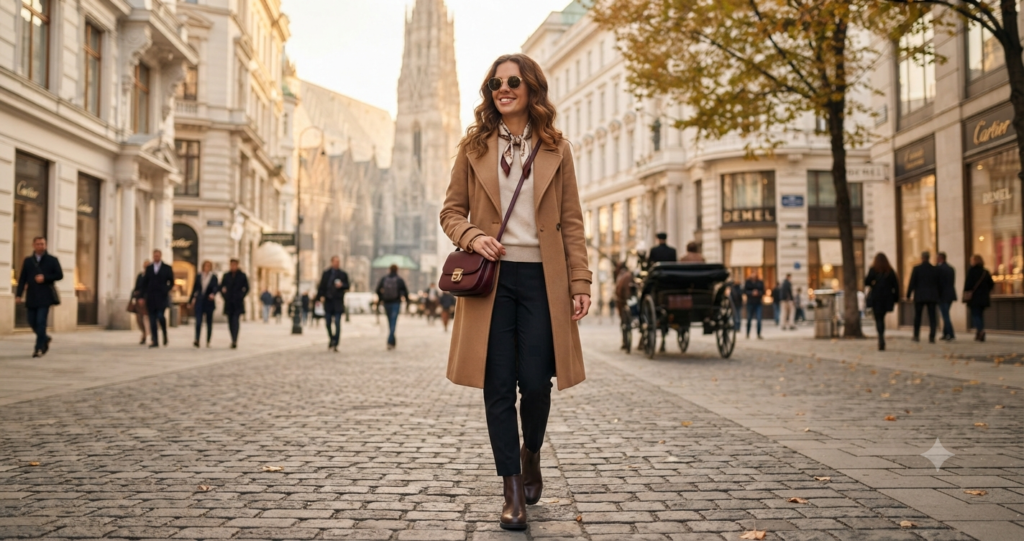
Vienna is the Habsburg Empire’s greatest gift to the world — a capital of extraordinary cultural density where Klimt’s Kiss hangs in the Belvedere, Mozart’s manuscripts fill the Mozarthaus, the Vienna Philharmonic plays in an opera house that is itself a work of art, and the coffee house tradition (UNESCO-recognised as intangible cultural heritage) invites you to sit for hours over a Melange and a slice of Sachertorte. Packing for Vienna rewards a polished, European approach — the city’s dress culture is smart casual at minimum, opera visits require formal dress, and the Viennese themselves set a high bar for elegant everyday presentation. Here’s your complete guide to what to wear in Vienna.
Vienna Weather: What to Pack by Season
Vienna has a continental climate with four distinct seasons. Spring (April–May) is one of Vienna’s finest periods — mild (12–20°C), the Prater’s chestnut trees in blossom, and the Ringstrasse at its most beautiful. A light jacket and layers are appropriate. Summer (June–August) is warm to hot (22–30°C), occasionally humid, with outdoor Heuriger (wine garden) culture at its peak and long evenings perfect for terrace dining. Autumn (September–October) is golden and beautiful — the Viennese wine harvest (Heuriger season peak) and cooler temperatures (12–20°C) make it another excellent season. Winter (November–March) is cold (0–5°C), grey, and occasionally snowy — Vienna’s Christmas markets (Christkindlmarkt at the Rathausplatz and Schönbrunn are the finest) are extraordinary in December. A proper warm coat, scarf, hat, and waterproof boots are necessary for winter Vienna.
What to Wear in Vienna: Clothing Guide
Vienna’s Style Culture
Vienna has a distinctly formal, Old World elegance in its fashion culture that distinguishes it from other European capitals. The Viennese dress well — not flashily, but with classic European quality: good wool coats, leather shoes, structured bags, and clothes that are well-fitted and in excellent condition. Trainers and sportswear are increasingly accepted in casual contexts, but Vienna’s restaurants, museums, and cultural venues reward a slightly more polished approach than, say, Berlin or Amsterdam. The rule of thumb: dress one level up from what you’d wear in a comparable venue at home.
- A quality coat or structured jacket — the single most important Vienna garment for spring, autumn, and winter
- Well-fitted trousers or jeans in dark washes
- Smart tops and blouses in neutral or classic colours
- A versatile blazer that elevates casual outfits for museum visits and restaurant evenings
- Classic leather ankle boots or loafers — the Vienna shoe par excellence
Vienna Opera & Concert Halls
Vienna’s cultural institutions — the Vienna State Opera (Wiener Staatsoper), the Musikverein (home of the Vienna Philharmonic), the Burgtheater, and the Konzerthaus — have traditional dress expectations that vary by event and seat. Premium evening performances at the Staatsoper traditionally attract formal dress (evening gowns, cocktail dresses, suits), particularly on opening nights and galas. Regular performances at the Staatsoper and Musikverein suit cocktail dress or smart evening attire. Standing room tickets (Stehplatz) at the Staatsoper — one of classical music’s great affordable experiences — are more casually dressed, but smart casual is still appropriate. The Volksoper and smaller concert venues are less formal.
- A cocktail dress or elegant midi dress for Vienna State Opera and Musikverein evening performances
- Smart evening trousers with a silk blouse as an alternative to a dress
- Dressier flat sandals, court shoes, or low heels for evening cultural venues
- A small elegant evening bag
Everyday Vienna: Museums & Cafés
Vienna’s extraordinary concentration of world-class museums — the Kunsthistorisches Museum, the Belvedere (home of Klimt’s Kiss), the Leopold Museum, the Natural History Museum, and the Vienna Museum — makes museum visiting the city’s dominant daytime activity. Museum interiors are cool and well-heated; comfortable walking shoes and smart casual clothing work perfectly. Vienna’s coffee house culture — the Café Central, Café Landtmann, Café Schwarzenberg — is a UNESCO-recognised tradition; the Viennese take their coffee seriously and the coffee houses themselves are architecturally spectacular.
- Smart casual daytime outfits — quality jeans or trousers, a good top, a structured jacket or cardigan
- Comfortable leather shoes or quality trainers for long museum days
- A tote bag or structured day bag for museum essentials (a coat check is available at major museums for large bags)
Shoes for Vienna
- Classic leather ankle boots — the most versatile Vienna shoe (appropriate for museums, cafés, restaurant evenings, and moderate winter weather)
- Quality leather loafers or flat shoes for spring and summer city exploring
- Waterproof boots with a warm lining for winter Vienna (snow and wet pavements make waterproofing genuinely necessary)
- Dressier court shoes or block-heeled sandals for opera and concert evenings (Vienna’s smooth indoor surfaces are far more heel-compatible than cobblestone cities)
Vienna Packing Essentials
- Vienna City Card (covers all public transport and gives discounts at museums — excellent value for multi-day visits)
- Opera and concert tickets booked in advance (Vienna Staatsoper tickets sell out months ahead for popular performances; check wiener-staatsoper.at; standing room tickets go on sale 80 minutes before each performance for €3–10)
- Warm layers for autumn and winter (Vienna’s wind tunnel Ringstrasse and the exposed Naschmarkt market can be cold in October–March)
- A compact umbrella (Vienna has significant year-round rainfall)
- Comfortable insoles or quality shoes (Vienna involves significant walking — the Ringstrasse circuit is 5.6km)
What to Wear for Vienna’s Top Experiences
Vienna State Opera
The Vienna State Opera is one of the world’s great opera houses — both architecturally (a neo-Renaissance masterpiece on the Ringstrasse, completed in 1869) and musically (the Vienna Philharmonic plays in the orchestra pit). A performance here is a genuine bucket-list cultural experience. For evening performances, dress elegantly — a cocktail dress, elegant midi, or smart evening trousers. For the legendary standing room (Stehplatz), smart casual is accepted but standing room regulars (the Vienna opera Stehparterre is a dedicated group who attend virtually every performance) often dress as formally as seated patrons. Queue for standing room tickets at the side entrance approximately 80 minutes before curtain.
Schönbrunn & Belvedere Palaces
Schönbrunn Palace — the Habsburg summer residence with 1,441 rooms and formal gardens stretching to the Gloriette hilltop monument — and the Upper Belvedere (where Klimt’s Kiss and Judith hang, alongside Austria’s finest collection of Viennese Secessionist art) are Vienna’s two must-visit palace complexes. Both involve significant outdoor walking in the formal gardens; comfortable shoes and weather-appropriate layers are practical. The palace interiors are heated in winter; the gardens are cold. Pre-book timed entry for the imperial apartments at Schönbrunn in peak season.
Naschmarkt: Vienna’s Market Street
The Naschmarkt — Vienna’s 1.5km street market running between the Karlsplatz and Kettenbrückengasse U-Bahn stations — is the city’s finest food market, selling Austrian cheeses and charcuterie alongside Turkish, Greek, and Middle Eastern produce, fresh fish, spices, and the best falafel in Central Europe. Saturday mornings see the Naschmarkt extended by a large flea market. Casual, comfortable clothing suits the market perfectly; flat shoes are practical on the market’s varied surfaces. The market runs Monday–Saturday and gets busy by mid-morning.
Heuriger: Vienna Wine Garden Culture
The Heuriger — Vienna’s unique wine garden tradition, where local vintners open their estates to serve their own new wine alongside cold buffets of Austrian food — is one of the city’s most distinctive and enjoyable experiences. Heurigen are concentrated in the wine-growing villages on Vienna’s outskirts: Grinzing, Sievering, Neustift am Walde, and most famously Grinzing and Heiligenstadt (where Beethoven wrote his Heiligenstadt Testament). The atmosphere is relaxed and communal; smart casual or even slightly dressed-down casual fits perfectly. Heurigen are typically busiest Friday and Saturday evenings and Sunday afternoons.
Vienna Outfit Mistakes to Avoid
- Dressing too casually for Vienna’s cultural venues: Vienna’s museums, coffee houses, and restaurants expect more than tourist casual. Trainers, shorts, and casual t-shirts work fine for exploring, but feel out of place at the Café Central, the Kunsthistorisches Museum restaurant, or a Belvedere evening opening. A blazer carried in your bag upgrades any outfit instantly.
- Not booking Opera tickets in advance: Vienna Staatsoper tickets for popular performances sell out months ahead. Check the schedule at wiener-staatsoper.at when planning your trip; if main tickets are sold out, standing room (Stehplatz) tickets are sold in person 80 minutes before each performance for €3–10 — a genuinely extraordinary value.
- Underestimating winter cold: Vienna winters are genuinely cold — temperatures regularly drop below freezing from December through February, with wind chill from the Ringstrasse’s wide streets making it feel even colder. A proper insulated coat, hat, gloves, and scarf are necessary rather than optional for any December–February Vienna visit.
- Paying tourist prices at Sachertorte: The Hotel Sacher’s famous Sachertorte is excellent but expensive; the Café Landtmann and Café Schwarzenberg serve equally good versions at lower prices, while Demel (the Imperial confectioner, historically in a long-running legal dispute with the Sacher about the “original” recipe) offers an excellent alternative with a beautiful historic café interior.
Vienna FAQ
What is the best time to visit Vienna?
May and September–October are Vienna’s finest months for visitors — mild weather, fewer crowds than summer, the cultural season in full swing (the Staatsoper and Philharmonic pause their main season July–August), and the Viennese at their most resident. December is extraordinary for the Christmas markets but very cold and crowded; book accommodation months in advance. July and August are warm but the opera season pauses; the summer music festival (Vienna Summer of Music) fills some of the gap, and outdoor concerts in the Schönbrunn Palace gardens are a summer highlight.
How many days do I need in Vienna?
Three to four days covers Vienna’s major highlights well: the Kunsthistorisches Museum and the Belvedere on Day 1, Schönbrunn Palace on Day 2, a morning opera performance or concert plus the Naschmarkt and Museumsquartier on Day 3, and a day trip to the Vienna Woods or the Klosterneuburg monastery on Day 4. Vienna is also easily combined with Bratislava (1 hour by bus), Budapest (2.5 hours by fast train), and Salzburg (2.5 hours by train) for a Central European multi-city itinerary.
What currency does Austria use?
Austria uses the Euro (€). Vienna is more expensive than its Central European neighbours (Budapest, Prague, Bratislava) but comparable to other Western European capitals and generally less expensive than London, Paris, or Zurich. Contactless card payment is widely accepted in Vienna restaurants, museums, and shops; cash is occasionally preferred at smaller markets, coffee houses, and the Naschmarkt. The Fiaker (traditional horse-drawn carriage rides around the Ringstrasse) price must be agreed in advance — always confirm the exact price before beginning a ride.
Pingback: Vienna Packing List: What to Pack for Austria (2025) - Vacation Style Guide