
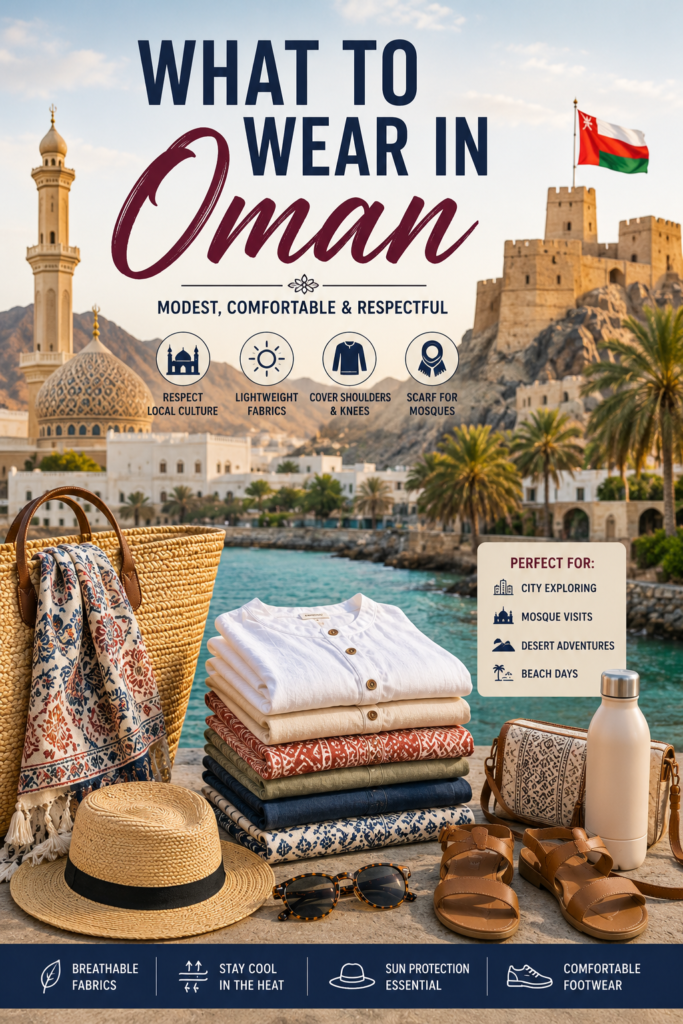
Oman is one of the Middle East’s most rewarding travel destinations — a country of dramatic desert landscapes, ancient forts, turquoise wadis, and a warm, welcoming culture. As a predominantly Muslim and culturally conservative country, Oman has clear expectations around dress that are important to understand before you pack. This guide covers exactly what to wear in Oman respectfully and stylishly, whether you’re exploring Muscat’s souks, camping in the Wahiba Sands, or kayaking a turquoise wadi.
Quick Answer: What to Wear in Oman
Oman is a Muslim country where modest dress is expected but not strictly enforced for tourists in most areas. The general rule: cover shoulders and knees in public spaces, souks, and religious sites. Loose, breathable fabrics are ideal for the heat. At beach resorts and hotel pools, swimwear is acceptable. The Omani people are gracious hosts who appreciate visitors who respect local customs.
Oman Weather & Climate
Oman has a desert climate with extreme heat from June through September (temperatures regularly exceed 104°F/40°C in the interior). The best time to visit is October through April, when temperatures are pleasant (65–85°F). The Dhofar region in the south gets a monsoon season (khareef) from June to September, bringing cooler, misty conditions uniquely different from the rest of Oman.
What to Wear in Oman: By Activity & Location
Muscat City Sightseeing (Mutrah Souk, Old Muscat, Sultan Qaboos Grand Mosque)
In Muscat’s public areas, souks, and markets, dress modestly: shoulders and knees covered, loose-fitting clothing. A flowy linen maxi dress or wide-leg trousers with a long-sleeve top is both modest and practical in the heat. Loose fabrics allow air circulation — vital at 85–95°F. The Sultan Qaboos Grand Mosque has stricter requirements: women must cover their hair, arms, and legs completely. The mosque provides abayas for visitors who aren’t appropriately dressed, but wearing your own shows respect.
- Loose maxi dress (no spaghetti straps)
- Wide-leg linen trousers + long-sleeve linen top
- Lightweight scarf/shawl (for mosques and souks)
- Closed-toe sandals or comfortable walking shoes
- Crossbody bag
Wadi Exploring (Wadi Shab, Wadi Bani Khalid)
Oman’s wadis — rocky gorges with stunning turquoise pools — are highlights of any visit. Getting to the swimming pools often requires hiking over rocks and wading through water. Wear quick-dry athletic clothing: a long-sleeve rash guard or t-shirt and shorts that cover the knee (or tights) is appropriate for both the physical activity and local sensibilities. Water shoes protect your feet on slippery rocks.
- Quick-dry t-shirt or long-sleeve rash guard
- Quick-dry shorts at or below the knee, or leggings
- Water shoes with grip (essential — rocks are slippery)
- Lightweight backpack with water
- Change of clothes for after
Desert Safari & Wahiba Sands Camping
A night in the Wahiba Sands desert is unmissable — golden dunes at sunset, starlit skies, and traditional Omani camp hospitality. Wear loose, light layers: the desert is hot by day but can be surprisingly cool at night. Long sleeves protect against sun, sand, and evening chill. A headscarf keeps sand out of your hair during dune rides.
- Loose linen trousers (protects against sand)
- Long-sleeve lightweight top or tunic
- Lightweight scarf (head and sand protection)
- Flat shoes or trainers (heels sink in sand)
- Warm layer for evening (temperatures can drop to 60°F)
- Sunglasses with UV protection
Resort & Hotel Pool Areas
At international hotels, beach resorts, and private pool areas, normal swimwear is perfectly acceptable. Bikinis and one-pieces are standard at hotel pools in Muscat, Salalah, and Musandam. The key is to cover up the moment you leave the pool or beach area.
- Bikini or one-piece at the pool/beach
- Cover-up dress or sarong when leaving pool area
- Resort sandals
Nizwa Fort & Souq
Nizwa is Oman’s most traditional city, known for its Friday goat market, silver souk, and magnificent fort. This is an area where more conservative dress is particularly appreciated. Cover completely — arms, legs, and neckline — and you’ll be welcomed warmly. The Nizwa Friday market is an early morning experience worth setting an alarm for.
- Full-coverage maxi dress or abaya-style dress
- Long-sleeve top (required)
- Loose trousers or full-length skirt
- Lightweight scarf
- Comfortable closed-toe shoes
What NOT to Wear in Oman
- Tank tops or sleeveless tops in public spaces, souks, or historical sites (cover shoulders)
- Shorts above the knee in city centres and markets (resorts are the exception)
- Tight-fitting or revealing clothing — loose and modest is the standard
- Swimwear outside of resort/hotel pool areas
- Loud, revealing party outfits — even in upscale Muscat restaurants, understated elegance is preferred
Best Fabrics for Oman’s Heat
Fabric choice is critical when modest coverage is required in extreme heat. Linen is the gold standard — breathable, lightweight, and covers well. Rayon/viscose is another excellent option, draping beautifully and staying cool. Lightweight cotton works but can get heavy when sweaty. Avoid polyester blends, which trap heat. Light colors (white, cream, pale blue) reflect the sun.
Oman Packing List for Women
- 3–4 maxi or midi dresses (loose, with sleeves or straps + cardigan)
- 2–3 pairs of wide-leg linen trousers
- 3–4 long-sleeve lightweight tops or tunics
- 2 lightweight cardigans or kimonos
- 2 swimsuits (for resort pools)
- Lightweight scarves (multiple uses — modesty, sun, hair)
- Comfortable flat walking shoes or sandals
- Water shoes for wadi adventures
- Warm layer for desert camping
- Sunglasses (polarized recommended)
What Should Men Wear in Oman?
Most guides to Oman focus on women’s dress, but men have their own modesty expectations. Shorts are fine at resort pools and private beaches, but swap them for lightweight trousers or chinos in souks, cities, and anywhere near a mosque — bare knees on men draw the same disapproving looks as on women. Sleeveless tops and tank tops are best avoided outside the beach; a breathable cotton or linen short-sleeve shirt is the standard uniform for sightseeing.
For the Sultan Qaboos Grand Mosque specifically, men need full-length trousers (not shorts, not cropped pants) and a shirt that covers the shoulders — sleeveless tops aren’t permitted for men either. Closed-toe shoes matter more for men than the packing lists suggest: wadi rocks and desert dune ridges are hard on sandals, and a proper trail shoe or lightweight hiking boot will get far more use than flip-flops once you’re outside Muscat.
Salalah & the Khareef Season: A Different Oman Entirely
Everything above assumes the hot, dry Oman most visitors picture. Southern Oman — the Dhofar region around Salalah — flips that completely for about ten weeks a year. From roughly late June to early September, monsoon winds off the Arabian Sea wrap the Dhofar mountains in cool mist and steady drizzle (locally, the khareef). Temperatures drop to 68–77°F (20–25°C), waterfalls appear, and the hills turn green — it’s Oman’s biggest domestic holiday season, and most first-time international visitors have no idea it’s happening.
Pack for khareef like a mild, wet spring day, not a desert trip: a proper light rain jacket or windbreaker (it drizzles for days at a stretch, so a travel umbrella alone won’t cut it), a warm layer for evenings such as a fleece or cardigan, and closed, grippy walking shoes rather than sandals — coastal paths and mountain trails get muddy and slick. The same modesty rules apply here as in Muscat: shoulders and knees covered, loose-fitting fabric. Outside khareef (October–May), Salalah is warm, dry, and sunny — pack exactly as you would for Muscat, plus swimwear for its beaches, which are quieter and less developed than the north’s.
What Do Omanis Wear? Understanding Local Dress
Seeing what Omanis actually wear makes it easier to judge your own outfits. Omani men typically wear the dishdasha, an ankle-length, collarless robe — usually crisp white, though muted browns and greys appear in cooler months — often paired with a kummah (an embroidered cap) or a musar (a wrapped turban) for business and formal occasions, and sometimes a khanjar, the curved ceremonial dagger, on national holidays. Omani women commonly wear an abaya, a loose black over-garment, frequently with a hijab and occasionally a face covering, though dress varies a lot by generation and setting — younger, urban Omani women dress more variably in public, and colourful embroidered dresses are common at home and for celebrations.
You’re never expected to wear Omani national dress as a visitor, and doing so can read as costume rather than respect. What actually matters — and what locals notice — is coverage: loose-fitting clothing over tight, longer hemlines over short, and shoulders covered over bare. Get that right and the specific garment matters far less.
Book Your Oman Experience
🌟 Browse Oman tours on Viator — desert safaris, wadi trips, Muscat city tours, and dhow cruises.
🏨 Find hotels in Oman on Booking.com — from Muscat luxury resorts to desert camps in the Wahiba Sands.
Frequently Asked Questions
Do women have to cover their hair in Oman?
Hair covering is required for women visiting mosques (including the Sultan Qaboos Grand Mosque). In public generally, hair does not need to be covered for tourists, though a scarf is always appreciated near religious sites and traditional markets.
Can women wear shorts in Oman?
Shorts are acceptable at hotel pools and beach resorts. In public areas, souks, cities, and historical sites, women should cover their knees. Knee-length shorts are tolerated in more tourist-friendly areas of Muscat, but longer is always safer and more respectful.
What to wear for a Sultan Qaboos Grand Mosque visit?
Women must cover their hair, arms (to the wrists), and legs (to the ankles). No tight-fitting clothing. The mosque provides abayas at the entrance, but wearing your own respectful clothing is preferred. Arrive 15–20 minutes before opening for photography before crowds arrive.
Is Oman safe for solo female travellers in terms of dress?
Yes — Oman is considered one of the safest countries in the Middle East for solo female travellers. Dressing modestly (covered shoulders and knees) means you’ll attract very little attention and will be treated with great respect by Omani people.
What should men wear at the Sultan Qaboos Grand Mosque?
Full-length trousers and a shirt covering the shoulders — shorts and sleeveless tops aren’t permitted for men, same as for women. Closed-toe shoes are fine; you’ll remove them before entering the prayer hall.
Can I wear a bikini in Oman?
Only within private resort or hotel pool and beach areas. On public beaches, a one-piece swimsuit or bikini worn with a light cover-up is the more comfortable and respectful choice — Omani families use public beaches too.
What’s the dress code for restaurants and hotels in Muscat?
Smart casual. International hotel restaurants and Muscat’s upscale dining spots don’t require covered shoulders or knees the way souks and religious sites do, but swimwear and beachwear are still not appropriate at dinner.
Do I need to pack a headscarf for Oman?
Yes, if you plan to visit the Sultan Qaboos Grand Mosque or any working mosque — a lightweight scarf that covers your hair is required for women there. Outside religious sites, it’s not required, but useful to have for dusty souks or as sun protection.