
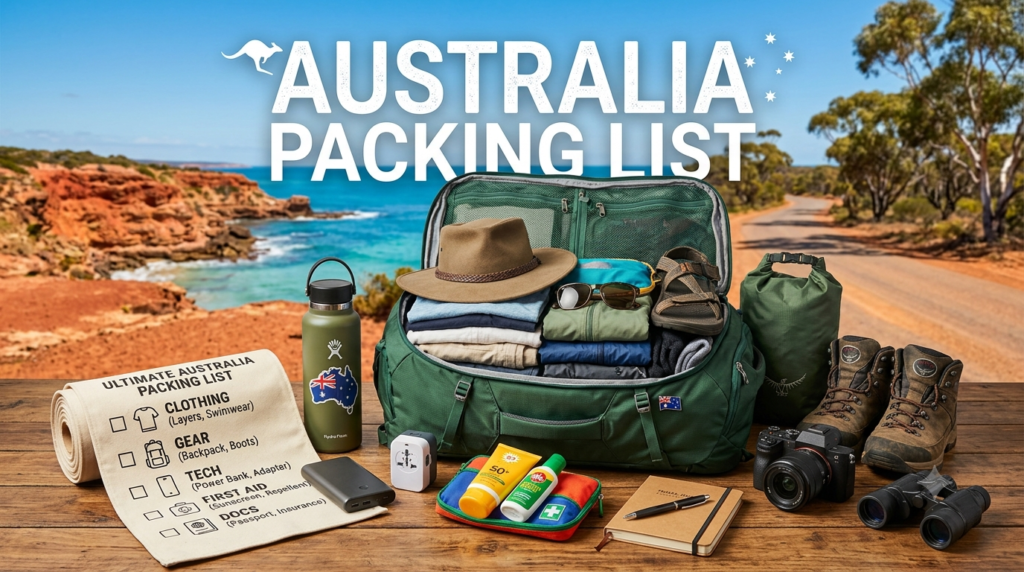
Australia’s vast distances, extreme climate zones, and world-class outdoor experiences demand smart, sun-focused packing. From the Great Barrier Reef to the Outback to Melbourne’s fashion-forward streets, this complete Australia packing list covers every item you need for a safe and stylish Australian adventure.
The Essential Australia Packing List
Sun Protection — Australia’s #1 Packing Priority
- SPF 50+ sunscreen (x2–3 large tubes) — Australia has the world’s most intense UV radiation. Apply daily to all exposed skin, reapply every 2 hours. Reef-safe formula essential for Great Barrier Reef visits. Sunscreen is expensive in Australia; bring a large supply from home.
- Wide-brimmed sun hat — Full brim (not a cap) to protect face, ears, and neck. An Akubra or wide straw hat is iconic and functional. Non-negotiable for any outdoor activity.
- UV-protective sunglasses — UV400 certified with polarised lenses. Australia’s glare from sun, sand, and water is intense.
- UPF 50+ sun shirts / rash guards (x2) — For beach, snorkelling, and any extended outdoor activity. Provides better protection than sunscreen alone.
- Aftersun lotion or aloe vera gel — Inevitable for most travellers; bring a good-sized bottle.
Clothing — Tops
- Lightweight cotton T-shirts (x5–6) — The Australian daily staple. Light colours in breathable cotton are best for the heat.
- Linen shirts (x2) — For warmer states and casual evenings. Both men and women benefit from linen in Australian heat.
- Long-sleeve UV-protective shirt (x1–2) — For outdoor activities, reef visits, and outback exploration. Thin fabric, UPF rated.
- Smart casual top or blouse (x1–2) — For Melbourne restaurants, Sydney harbour dining, and winery visits.
- Light cardigan or denim jacket — For Melbourne’s unpredictable weather and air-conditioned interiors anywhere in Australia.
- Fleece or warm layer — For Tasmania, the Snowy Mountains, or winter visits to southern states (June–August).
Clothing — Bottoms
- Lightweight cotton or linen shorts (x3–4) — The Australian outdoor essential. Quick-dry fabric is ideal.
- Light linen or cotton trousers (x2) — For city exploring, winery visits, and evenings. Comfortable in the heat and smart enough for restaurants.
- Sundresses or skirts (women) (x2–3) — Flowing sundresses are perfect for Australian cities and beach towns.
- Jeans or smart trousers (x1) — For Melbourne and Sydney evenings. Avoid heavy denim in tropical north (Darwin, Cairns).
- Active/hiking trousers — Quick-dry, sun-protective for Uluru, Blue Mountains, or Kakadu hiking.
Beach and Water Essentials
- Swimsuits / bikinis (x2–3) — Multiple suits so one is always dry. Australia’s beach culture is central to daily life.
- Swim trunks (men) (x2)
- Rash guard / swim shirt — For reef snorkelling and extended beach sessions. Boards with inbuilt SPF protection.
- Beach cover-up or sarong — For moving from beach to café or restaurant.
- Reef-safe waterproof sandals or water shoes — For reef walking and rocky beach access.
Footwear
- Flip-flops / thongs — The official shoe of Australia. Beach, pool, and casual daily use. “Thongs” is the Australian term — don’t be confused.
- Comfortable walking sandals — With arch support for city walking in Sydney, Melbourne, and Brisbane.
- Clean trainers or walking shoes — For city days, winery visits, and light walking. Good grip for Sydney’s hilly terrain.
- Waterproof hiking boots — Essential for Blue Mountains, Grampians, Kakadu, or any serious bushwalking. Closed-toe footwear protects against snakes and wildlife in the bush.
Outback and Bush-Specific Essentials
- Long-sleeve sun shirt — Full coverage is essential at Uluru and in the outback where temperatures and UV are extreme.
- Insect repellent with DEET — Flies and mosquitoes in the outback are relentless. A high-DEET repellent (40%+) is most effective. The famous Outback hat with fly net is useful around Uluru.
- Closed-toe boots — For walking in the Australian bush and outback where ground temperatures exceed 70°C and wildlife hazards are real.
- Light fleece or jacket — Desert nights drop dramatically in temperature. Uluru can be near 0°C at night in winter despite scorching daytime heat.
- Hydration system — A hydration bladder or large insulated water bottle (1.5L+). Dehydration is a serious risk in the outback; carry more water than you think you need.
Wildlife and Nature Safety
- Insect repellent (x2) — For mozzies across Australia, especially in tropical north and around water at dusk.
- After-bite cream — For inevitable mosquito and sandfly bites.
- Snake-bite bandage — If doing remote bush hiking. Australian snakes include some of the world’s most venomous species. Carry and know how to use compression bandages.
- Stinger suit (optional) — For snorkelling in northern Queensland from October to May when box jellyfish are active. Available to rent at most reef tour operators.
Documents and Money
- Passport (valid 6+ months)
- Australian ETA or eVisitor visa — Most nationalities require a visa. Apply online through the Australian Government’s ImmiAccount portal before travel. ETA (subclass 601) is for passport chip holders from eligible countries.
- Travel insurance documentation — Australia’s healthcare is excellent but expensive for visitors. Comprehensive travel insurance with medical coverage is essential.
- Credit cards — Australia is largely cashless. Visa and Mastercard are accepted almost everywhere. Contactless payments are standard.
- AUD cash — For markets, small cafés, tipping (tip culture is less established than in the US), and remote areas.
Electronics
- Travel adapter — Australia uses Type I plugs (angled three-pin). A universal adapter is recommended.
- Portable power bank — For long outback days and beach trips away from power.
- Unlocked smartphone — Australian SIM cards from Telstra, Optus, or Woolworths Mobile are available at airports and supermarkets. Telstra has the best outback and rural coverage.
- Waterproof camera or GoPro — For the Great Barrier Reef, Sydney Harbour, and wildlife encounters.
- Car charger — If hiring a car for road trips; essential for long drives between destinations.
Health and Toiletries
- All personal toiletries — Australia has excellent pharmacies (Priceline, Chemist Warehouse) but bringing your preferred products saves time and money.
- Prescription medications (full supply) — Bring documentation for controlled medications. Australian Customs requires declaration of some medications.
- Antihistamine — For insect bites, plant reactions, and wildlife encounters.
- Oral rehydration sachets — For heat exhaustion recovery and hydration management in hot climates.
Australia Packing List by Region
Sydney and New South Wales
Summer (Dec–Feb): lightweight everything, full sun protection kit, swimwear, beach cover-up. Winter (Jun–Aug): add a light jacket and jeans for evenings in Sydney (temperatures around 12–16°C at night). Year-round: comfortable walking shoes for Sydney’s hills and coastal walks.
Melbourne and Victoria
Year-round layering is essential. Pack a denim jacket, light waterproof jacket, and an umbrella regardless of season. Melbourne’s fashion culture rewards slightly smarter casual dressing than other Australian cities. Comfortable walking shoes for the CBD laneways.
Cairns and the Tropical North
Tropical heat year-round (25–35°C). Pack ultra-light fabrics only. Rash guards and reef-safe sunscreen for the Great Barrier Reef. Stinger suit or hire one locally (Oct–May). Insect repellent for evenings.
Uluru and the Red Centre
Full sun protection kit including long-sleeve shirts. Closed-toe boots for walking. A fleece for cold evenings and pre-dawn sunrise viewings. Fly net hat strongly recommended in warmer months. Large water supply for every day out.
What to Leave at Home
Never go barefoot outdoors in the bush or outback — ground heat and wildlife are real hazards. Don’t pack heavy fabrics or dark colours for tropical-north visits. Skip impractical fashion footwear for any outdoor activity. Leave expensive jewellery at home. Don’t underestimate sunscreen quantity — you’ll use far more than at home.