
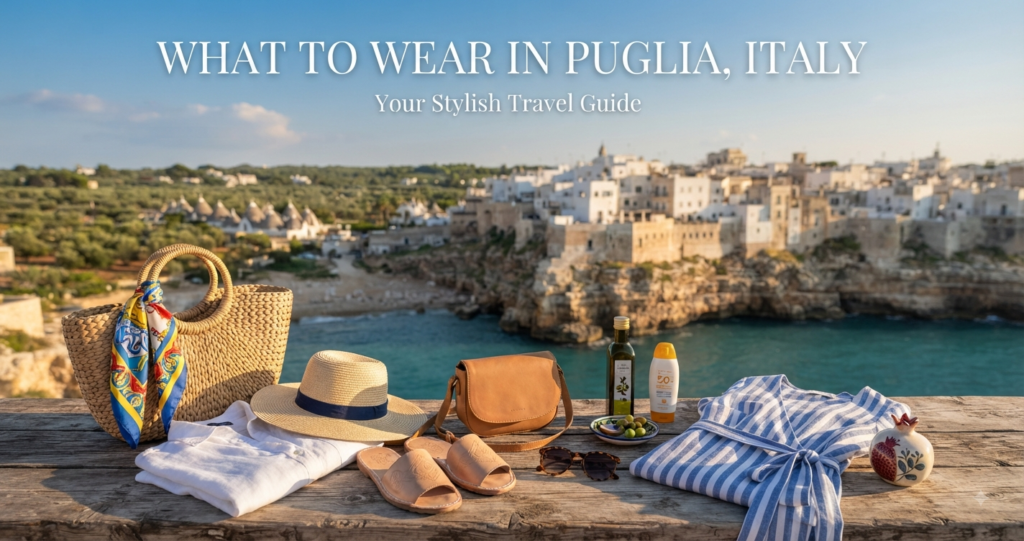
Puglia — the heel of Italy’s boot — is having a major moment. With trulli houses in Alberobello, Baroque Lecce, the Adriatic beaches of Polignano a Mare, and some of Italy’s finest burrata, this southern region is captivating travellers who’ve done Rome and Tuscany.
Puglia Climate: Hot, Sunny & Arid
- Peak summer (Jul–Aug): Very hot, up to 38°C — ultralight fabrics essential
- Shoulder season (May–Jun, Sep–Oct): 22–28°C, the ideal time to visit
- Winter (Dec–Feb): Mild but rainy, 8–14°C
What to Wear in Puglia in Summer
- Linen everything: Linen dresses, linen trousers, linen shirts — the only fabric that breathes properly in this heat
- Loose, flowing silhouettes: Air circulation is everything — avoid tight synthetic fabrics
- White and light neutrals: Reflects heat, looks stunning against Puglia’s whitewashed buildings
- Swimwear: Puglia has spectacular beaches (Peschici, Vieste, Torre dell’Orso) — pack at least 2 sets
Dress Code for Puglia’s Historic Sites
Puglia has extraordinary churches — the Baroque churches of Lecce and the Basilica di San Nicola in Bari are must-visits.
- Covered shoulders and knees required in all churches
- Always carry a light scarf or shawl
- Men: long trousers or knee-length shorts for church visits
The Trulli of Alberobello: What to Wear
- Comfortable flat shoes or sandals — cobblestones make heels dangerous
- A sundress or linen set makes for beautiful trulli photos
- Keep a scarf handy if you want to enter any of the trulli churches
Evening Style in Puglia
Puglia evenings are all about the passeggiata — the Italian evening stroll. Locals dress up, even in small towns.
- Women: Flowy maxi dress, elegant linen trousers with a silk blouse, or a pretty midi dress; flat sandals or wedges
- Men: Linen trousers, polo or button-down shirt; loafers or clean leather sandals
Puglia Packing Essentials
- Lightweight linen outfits (3–4 day looks)
- 2 swimwear sets + beach sarong/coverup
- Flat comfortable sandals for sightseeing
- One dressy outfit for evening dining
- Light scarf for churches and cooler evenings
- Wide-brim sun hat + high-SPF sunscreen
Puglia is deeply authentic, unhurried, and breathtakingly beautiful. Dress to respect its traditions while embracing the joyful southern Italian approach to life.
Puglia’s Relaxed, Sun-Bleached Style
Puglia’s whitewashed towns like Ostuni and the trulli of Alberobello call for a lighter, more rustic aesthetic than the glitz of the Amalfi Coast — think linen, raffia bags, and espadrilles rather than statement resortwear. It’s one of the more laid-back regions of Italy to dress for.
Coastal Towns vs. Historic Centers
Beach days in Polignano a Mare or the Salento coast call for standard swim-and-cover-up packing, but wandering the historic centers of Lecce or Ostuni in bare swimwear is not well received — keep a cover-up or light dress on hand for transitioning between the two.
Packing FAQ
Is Puglia very hot in summer? Yes, July and August regularly hit the low 90s°F — breathable natural fabrics matter more here than in northern Italy. What about the trulli towns? Alberobello and Ostuni involve a lot of walking on uneven stone streets, so comfortable flat shoes are worth prioritizing over sandals. Do I need a car to get around Puglia? Yes, in most cases. Public transport connects the main towns but is limited and slow, and many of the best beaches and countryside masserie are only practical to reach by rental car. Are Puglia’s beaches sandy or rocky? Both, depending on the coast. The Adriatic side (Gargano, Torre dell’Orso) has more sandy beaches, while much of the Salento coast is rockier, so water shoes are worth packing if you’re spending time on that side of the region.
What should I wear for an olive oil or wine tasting in Puglia? Comfortable closed-toe shoes for walking through groves or vineyards, and a smart-casual outfit for the tasting itself — many masserie combine tastings with a nicer lunch, so something a step above beach clothes works best.
Is Puglia’s Salento coast dressier than the rest of the region? Slightly, particularly in beach clubs around Gallipoli and Otranto, but overall Puglia stays more relaxed and less see-and-be-seen than the Amalfi Coast or Sardinia’s glitzier resorts.
Beach and Outdoor Essentials for Puglia
A few practical extras round out a Puglia packing list beyond clothing. High-SPF sunscreen (50+) is worth prioritizing given how intense the UV is in southern Italy, along with a wide-brim sun hat and a reusable water bottle for the heat. A compact beach towel and a light daypack cover both coastal walks and trips into the trulli villages. If your itinerary includes the Gargano National Park or any of Puglia’s hiking trails, pack real walking shoes rather than relying on the flat sandals that work fine for town; the terrain there is rougher than Puglia’s cobblestone centers. On the Salento coast specifically, many beaches are rocky rather than sandy, so water shoes are genuinely useful for getting in and out of the water comfortably.
Practical Items Easy to Forget for Puglia
A rental car is close to essential for exploring Puglia properly, since many of the best beaches, masserie, and hilltop towns are poorly served by public transport. Carry some cash, since many countryside restaurants and local markets still prefer it over cards, and download offline maps before heading into rural areas, where mobile signal can be patchy. Insect repellent is worth packing too, particularly for evening dining outdoors at an agriturismo or masseria, where countryside insects are more noticeable after dark than in the coastal towns.
What Not to Pack for Puglia
Skip heavy synthetic fabrics entirely — Puglia’s dry summer heat makes anything that doesn’t breathe genuinely uncomfortable by midday, and linen or cotton will serve you far better than performance fabrics designed for cooler climates. Leave stiletto heels behind; the historic centers of Lecce, Ostuni, and Alberobello are paved in uneven stone and cobbles that make heels impractical for anything beyond a short walk between a taxi and a restaurant. A heavy raincoat is also unnecessary for most of the year, since Puglia’s summers are reliably dry — a light layer for occasional evening breezes is enough.
Gargano Peninsula and the Adriatic Coast
The Gargano Peninsula, in Puglia’s north, has a wilder, more forested coastline than the flat, sun-bleached Salento region further south, and its beach towns like Vieste and Peschici lean slightly more casual and family-oriented than Salento’s beach-club scene. Boat trips to sea caves along the Gargano coast are a popular excursion, so pack a swimsuit under your clothes and a light cover-up for the crossing, along with sturdy sandals for the rockier coves in this part of the region.
Puglia Beyond the Summer Crowds
May, June, and September offer a genuinely different Puglia experience: daytime temperatures in the comfortable mid-70s to low-80s°F rather than the intense mid-90s of July and August, smaller crowds in Alberobello and Ostuni’s whitewashed centers, and sea temperatures still warm enough for swimming through most of September. Pack the same linen-forward wardrobe, but add a light layer for cooler evenings, which arrive more noticeably in shoulder season than during peak summer. Olive harvest season (October-November) brings a quieter, more rural side of Puglia worth experiencing if your trip allows, though beach days become less reliable by then.