Nepal is one of the world’s most extraordinary destinations — home to eight of the world’s ten highest mountains including Everest and Annapurna, the medieval city of Kathmandu with its palaces and temples, the spiritual significance of Lumbini (birthplace of the Buddha), and trekking routes that are among the most dramatic and rewarding on earth. Packing for Nepal requires careful thought: the altitude range is extreme (Kathmandu at 1,400m; Everest Base Camp at 5,364m), the temperature range is equally extreme (Pokhara at 28°C; EBC at -15°C at night), and the cultural requirements of temple visits and mountain trekking are very different. This Nepal packing list for women covers all of it.
Nepal Weather & Trekking Seasons
- Pre-monsoon / spring (March–May): Peak trekking season. Rhododendron forests bloom at altitude (March–April). Clear mornings with some afternoon cloud build-up. May gets hot at lower elevations. The main Everest summit window is in May.
- Monsoon (June–September): Heavy rainfall below 3,000m. Above 3,000m (trans-Himalayan regions: Mustang, Dolpo, Upper Manang) the monsoon is blocked by the Himalayan rain shadow — making this a good season for these specific areas. Leeches are a significant concern on lower trails in the monsoon.
- Autumn (October–November): The most popular and generally considered the best trekking season. Exceptionally clear views, moderate temperatures at altitude, stable weather. October in particular has outstanding visibility.
- Winter (December–February): Cold at altitude — Everest Base Camp and Annapurna Circuit high passes may be blocked by snow. Lower treks (Poon Hill, Ghorepani) are possible with appropriate gear. Kathmandu is cold (3–12°C) but clear and relatively uncrowded.
Nepal Packing List for Women
Trekking Layers (Everest Base Camp, Annapurna Circuit)
The layering system for Nepal’s high-altitude trekking is non-negotiable — temperatures can change 20°C between a sunny afternoon at 3,000m and the same evening at camp, and Everest Base Camp nights reach -15 to -20°C even in October. The standard trekking layer system:
- Base layer (2 sets): Merino wool or high-quality synthetic long-sleeved top and thermal leggings. Merino wool is preferred — it manages odour better across multi-day treks where laundry is limited.
- Mid-layer: A fleece or lightweight down jacket for warmth when stopped at altitude.
- Outer layer: A waterproof and windproof shell jacket — not just a rain jacket. Wind at altitude is penetrating and a hard shell significantly extends your comfort range.
- Down jacket: Essential for above 4,000m in any season. A good-quality down jacket worn over the base and mid-layers is what keeps you warm in teahouses and at camp.
- Trekking trousers: Quick-dry, stretchy trekking trousers that allow full range of movement on steep trail sections. Zip-off trousers convert to shorts for lower elevations in warm conditions.
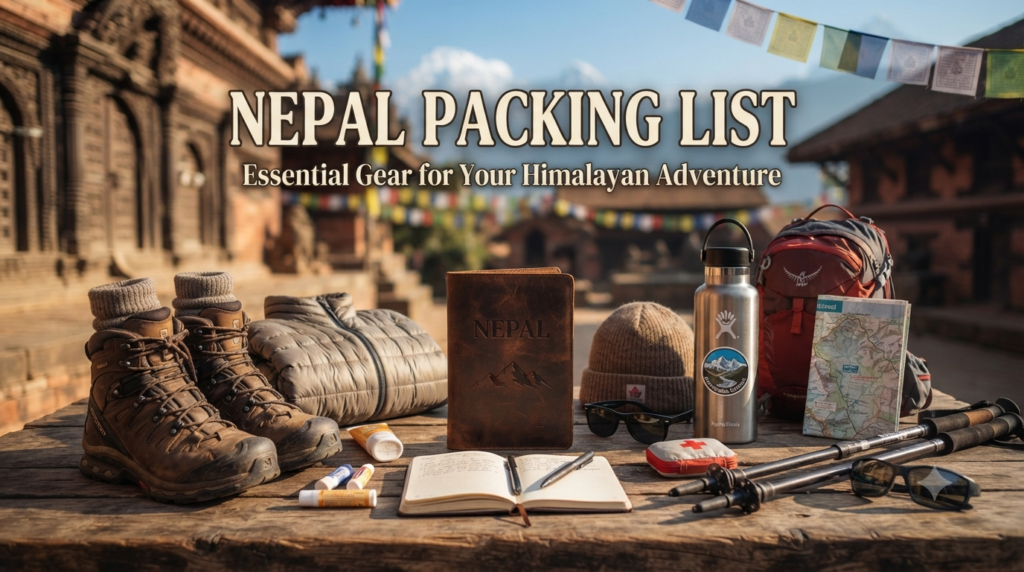
- Warm hat, neck gaiter, and trekking gloves: Essential above 4,000m; comfortable to carry for lower elevations.
Footwear for Trekking
- Waterproof hiking boots with ankle support: The most important purchase for Nepal trekking. EBC and Annapurna trails involve rocky, steep, and potentially snow-covered terrain. Gore-Tex lining for stream crossings and wet conditions. Break them in before your trip — new boots cause severe blisters on multi-day treks.
- Lightweight camp shoes: Teahouse flip flops or lightweight sandals for wearing in lodges and around camp — your boots need to rest and your feet need air.
- Trekking pole: Not optional for serious treks — significantly reduces knee stress on long descents and improves stability on rocky terrain and scree.
Kathmandu & Cultural Visit Clothing
- 2–3 casual outfits for Kathmandu and Pokhara (smart casual; Nepal is modest in its aesthetic)
- 1 lightweight shawl or wrap (Pashupatinath Temple, Boudhanath Stupa, and all Hindu and Buddhist temples require modest dress)
- Easy slip-on shoes for temple visits (shoes removed at most sacred sites)
Nepal Activity Guide: What to Wear
Everest Base Camp Trek (14–17 days)
The classic Everest Base Camp trek flies from Kathmandu to Lukla (2,840m) and ascends through Namche Bazaar (3,440m), Tengboche (3,860m), Dingboche (4,410m), and Lobuche (4,940m) to Everest Base Camp (5,364m). The complete layering system described above is required. Key additional items: sunglasses with full UV protection and side shields (UV intensity at 5,000m is severe), SPF 50+ sunscreen and SPF lip balm, a good headlamp for teahouse mornings and evenings, and altitude sickness medication (Diamox) if prescribed by your doctor. The Khumbu Icefall and Everest herself are visible from Kala Patthar (5,545m) — the most rewarding viewpoint on the trek.
Boudhanath Stupa & Pashupatinath Temple, Kathmandu
Boudhanath — one of the world’s largest Buddhist stupas and a UNESCO World Heritage Site — is surrounded by Tibetan refugee communities, monasteries, and excellent cafés. Respectful but casual dress is appropriate; shoes are not removed at Boudhanath (it’s a public space you walk around). Pashupatinath Temple is one of the most sacred Hindu sites in the world and restricts non-Hindu visitors from entering the main temple complex. The cremation ghats on the Bagmati River are open to all — dress modestly and observe quietly. Kathmandu’s Durbar Square (another UNESCO site) is open to all; modest dress appropriate.
Poon Hill Trek (4–5 days, beginner-friendly)
The Poon Hill trek (Ghorepani Poon Hill circuit) is Nepal’s most accessible classic trek for those without previous high-altitude experience. Maximum elevation: 3,210m (Poon Hill viewpoint). The reward is one of the finest Himalayan panoramas accessible without technical climbing — Annapurna, Dhaulagiri, and Machapuchare (the sacred Fish Tail mountain) at sunrise. Moderate layering required: warm base layer, fleece mid-layer, waterproof shell, down jacket for the 4am summit push. Waterproof hiking shoes (not necessarily full boots for this shorter trek). 4–5 days from Nayapul.
Common Nepal Packing Mistakes
- Under-layering for altitude: The temperature drop with altitude in Nepal is more severe than most trekkers expect. Even in October, nights at 4,000m+ require a serious down jacket. The most common cold-weather gear mistake is relying on a single mid-layer without a quality down jacket.
- New boots on a multi-day trek: Breaking in hiking boots before a 14-day trek is essential. New boots and long trekking days equal severe blisters on days 3–5. Wear your boots hiking for at least 40–60 hours before the trek itself.
- Not acclimating properly: Acute Mountain Sickness (AMS) is a real risk above 3,000m and can become life-threatening if ignored. The EBC route is designed with acclimatisation days built in — follow the schedule. “Climb high, sleep low” is the standard principle. Don’t rush the acclimatisation schedule regardless of how well you feel.
Nepal Packing FAQ
Can I rent trekking gear in Kathmandu?
Yes — Thamel (Kathmandu’s tourist district) has hundreds of gear shops selling and renting trekking equipment. Rental trekking poles, down jackets, sleeping bags, and boots are all available at reasonable rates. Quality varies; inspect rentals carefully. Genuine Kathmandu gear shops also sell North Face, Arc’teryx, and Mammut — some authentic, some very convincing copies. For boots in particular, buying or bringing your own from home and breaking them in is strongly recommended over rental.
Do I need a guide for EBC?
As of 2023, Nepal requires all trekkers in national park areas (including the Sagarmatha National Park for EBC) to hire a licensed guide. Solo trekking without a guide is no longer legally permitted on the main trekking routes. A licensed guide significantly enhances the experience — they provide safety information, manage teahouse bookings, communicate in Nepali where needed, and offer cultural context. Porters (who carry your pack — strongly recommended to limit your load to reduce altitude sickness risk) are hired separately or through the guide agency.
Is Nepal safe for female solo travellers?
Nepal is generally considered very safe for solo female travellers, particularly on the established trekking routes where teahouse culture means you’re rarely truly alone. Guides and porters from reputable agencies are vetted and trusted. Kathmandu’s Thamel district is very tourist-friendly, though standard precautions apply for late-night movement. The main trekking routes (EBC, Annapurna, Poon Hill) have a strong solo female trekker tradition — many women complete these routes annually without issues. The mandatory guide requirement (since 2023) also adds an additional layer of safety for solo trekkers.