
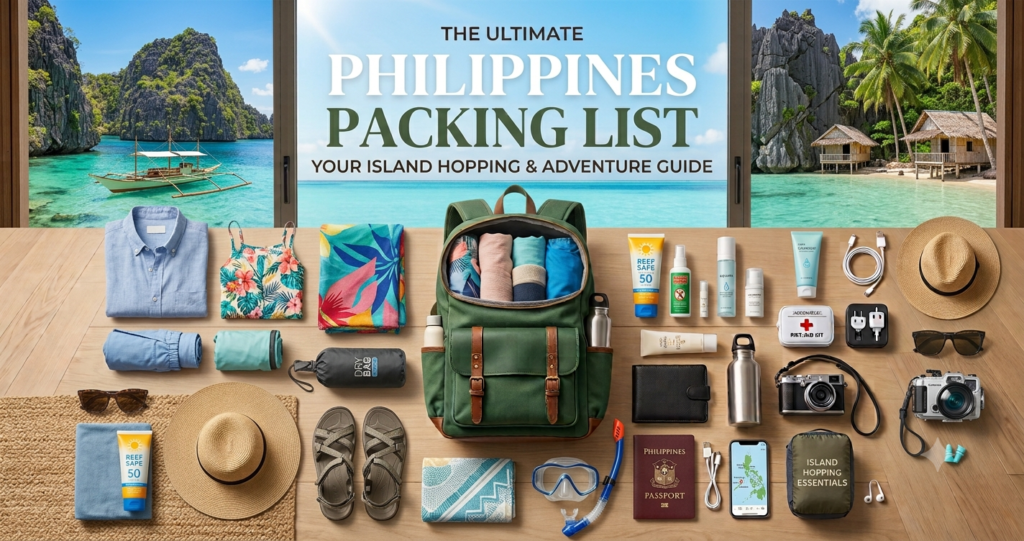
The Philippines is Southeast Asia’s most island-rich destination — an archipelago of 7,641 islands spanning tropical turquoise seas, volcanic rice terraces carved over 2,000 years into Ifugao mountainsides, world-class diving on Tubbataha Reef, and the chocolate hills of Bohol rising in perfect geometric rows across the Visayan plain. Packing for the Philippines means preparing for intense tropical heat and humidity, island-hopping adventures between pristine beaches, deeply Catholic church culture (Filipinos attend Mass weekly and churches host significant community events), and the vibrant, surprisingly fashion-conscious culture of Manila. Here’s your complete guide to what to wear in the Philippines.
Philippines Weather: When to Visit
The Philippines has two main seasons: dry season (November–May) and wet season (June–October). The dry season, particularly December through April, offers the most reliable beach weather — low humidity, clear skies, and calm seas ideal for island hopping. Palawan’s best season is November–April; El Nido and Coron’s lagoon tours require calm conditions. The Visayas region (Cebu, Bohol, Siargao, Boracay) is generally drier than Palawan but still has regional variation. Siargao — the Philippines’ surf capital — has its best waves August through November (peak typhoon season elsewhere). The Philippines lies within the typhoon belt; June to October carries typhoon risk, with August and September the most active months. Always check conditions before inter-island ferry travel during typhoon season.
What to Wear in the Philippines: Clothing Guide
Beach & Island Hopping
The Philippines’ most famous experiences are beach-centred — the island-hopping lagoon tours of El Nido and Coron, the white-sand perfection of Puka Shell Beach on Boracay, the sardine runs of Moalboal, and the crystal caves of Hundred Islands. Beach dressing here is relaxed and entirely appropriate; swimsuits, cover-ups, and flip-flops are the standard on the island circuit.
- 2–3 swimsuits or bikinis — you’ll be in and out of the water constantly on island-hopping tours
- A rashguard or UV swim shirt (Philippines’ equatorial UV is intense; rashguards are standard protective wear for Filipino boat tours)
- 3–4 lightweight beach cover-up dresses or kaftans
- A sarong (serves as a beach blanket, cover-up, and — in an emergency — a church modesty wrap)
- Quick-dry shorts for boat days and island exploring
Catholic Church & Filipino Cultural Modesty
The Philippines is one of Asia’s most deeply Catholic countries — approximately 80% of the population is Roman Catholic, and churches are the architectural and social centres of every Philippine town. The Baroque churches of UNESCO World Heritage recognition (San Agustín Church in Manila, Paoay Church in Ilocos Norte, and others) are active places of worship, not merely tourist sites. Covered shoulders and knees are required for entry, and respectful quiet is expected. Beyond churches, Filipino culture in general values modesty and conservatism in dress outside of beach areas; revealing beachwear is inappropriate in markets, towns, and non-beach restaurants.
- A lightweight scarf or sarong for church shoulder coverage
- At least one set of knee-covering, shoulder-covering clothing for church visits and town exploring
- Modest casual clothing for markets, non-beach restaurants, and transport hubs
Manila: Urban Fashion & Going Out
Manila — particularly the Bonifacio Global City (BGC) and Makati districts — is far more sophisticated and fashion-conscious than most visitors expect. BGC has excellent shopping malls, rooftop bars, and a restaurant scene that rivals Singapore’s for quality. Filipino fashion culture is vibrant; locals dress stylishly for evenings out. Manila’s heat (30–35°C year-round) means lightweight but polished clothing is the right approach — the combination of heat and high humidity makes heavy fabrics unbearable.
- Smart casual outfits for Manila restaurants and BGC’s rooftop bar scene
- A linen blazer or structured jacket for Manila’s air-conditioned malls and upscale restaurants
- Dressier flat sandals for Manila evenings (the heat makes heels a commitment)
Shoes for the Philippines
- Flip-flops or reef sandals for beaches and boat tours
- Water shoes for rocky beach entries, reef walking, and boat tour landings on coral-edged shores
- Comfortable walking sandals for Manila, Cebu City, and town exploring
- Trainers or lightweight hiking shoes for the Bohol Chocolate Hills and Batad rice terraces hike
Philippines Packing Essentials
- Reef-safe SPF 50 sunscreen (Philippines has some of Asia’s finest coral reefs; chemical sunscreen is harmful to coral ecosystems — mineral/reef-safe sunscreen is increasingly required at marine protected areas)
- DEET insect repellent (dengue fever is present throughout the Philippines; mosquito protection is important especially at dawn and dusk)
- Motion sickness tablets (inter-island bangka boats and ferries can be rough in choppy conditions)
- Reusable water bottle with filter (tap water is not reliably safe in the Philippines; bottled water is affordable and widely available, but a filter bottle reduces plastic waste on islands)
- Waterproof dry bag for island-hopping boat tours (bangka wooden outrigger boats often get spray and sometimes take on water)
- A light rain jacket or poncho for wet season travel and afternoon tropical downpours
What to Wear for the Philippines’ Top Experiences
El Nido & Coron, Palawan: Island Hopping
El Nido in northern Palawan is the Philippines’ most photographed destination — limestone karst towers rising from turquoise lagoons, hidden beaches accessible only through narrow cave entrances at low tide, and some of the clearest water in Southeast Asia. Island-hopping tours (Tours A, B, C, and D) leave from El Nido town each morning and return by late afternoon. The day involves swimming, snorkelling, and climbing into bangka wooden boats repeatedly. A rashguard is strongly recommended — hours of sun exposure on open water without full-body coverage results in serious sunburn even for those who tan easily. A dry bag for your phone and valuables is essential; bangka boats are open and spray is inevitable.
Bohol: Chocolate Hills & Tarsiers
Bohol is one of the Philippines’ most diverse islands — the famous Chocolate Hills (1,776 perfectly conical volcanic mounds that turn brown in the dry season, resembling chocolate truffles), the Philippine tarsier (the world’s smallest primate, found in Bohol’s forests), and the Loboc River cruise are the main draws. The Chocolate Hills viewpoint involves a climb of 214 steps in full sun; comfortable trainers, a hat, and plenty of water are practical necessities. Tarsier sanctuaries require whisper-quiet visiting and no flash photography; the animals are extremely sensitive. Comfortable casual clothing works for all Bohol sightseeing.
Siargao: Surfing & Island Life
Siargao is the Philippines’ surf capital — Cloud 9, one of Southeast Asia’s most famous surf breaks, draws surfers from across the world from August to November. The island has a cool, laid-back atmosphere that mixes serious surfing culture with island hopping to Naked Island, Daku Island, and Guyam. Boardshorts, bikinis, and rashguards are the dominant clothing culture. The island is small and easily traversed by motorbike (habal-habal); comfortable shorts and sandals work for the non-beach exploring.
Intramuros, Manila: History & Culture
Intramuros — the walled 16th-century Spanish colonial city at Manila’s heart — contains San Agustín Church (the oldest stone church in the Philippines and a UNESCO World Heritage Site), Fort Santiago where José Rizal was imprisoned before his 1896 execution, and a fascinating cobblestone streetscape that survived both Spanish colonialism and the devastating 1945 Battle of Manila largely intact. Church visits require covered shoulders and knees; the rest of Intramuros suits comfortable walking shoes and casual but modest clothing. The heat in Manila’s old city is intense; lightweight fabrics and a hat are strongly recommended.