

Athens is one of the world’s most layered cities — where a 5th-century BC temple sits above a Byzantine church built on a Roman bath, and the best souvlaki you’ll ever eat is served 50 metres from a UNESCO World Heritage Site. Dressing for Athens means navigating the intense Mediterranean heat of Greek summer, the sacred dress codes of the Acropolis and Orthodox churches, the relaxed café culture of Monastiraki and Psyrri, and the surprisingly sophisticated evening scene of Kolonaki. Here’s your complete guide to what to wear in Athens.
Athens Weather: What to Expect by Season
Athens has a classic Mediterranean climate — hot, dry summers and mild, wetter winters. Summer (June–August) is intensely hot — 32–38°C, with direct sun on the white marble of the Acropolis making temperatures feel even more extreme. July and August are peak heat months; the Acropolis at midday in August is a test of endurance. Spring (April–May) and Autumn (September–October) are the finest months for Athens — warm and clear (22–28°C), dramatically fewer crowds, and the light is extraordinary for photography. Winter (November–March) is mild but rainy (10–16°C); a light wool coat and waterproof shoes are sufficient. The Acropolis and most major sites remain open year-round.
What to Wear in Athens: Clothing Essentials
Summer Athens: Beating the Heat
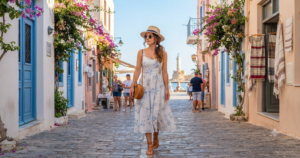
Athens in July and August is seriously hot — white Pentelic marble reflects heat, the city’s stone streets radiate it, and there’s often little shade between major sightseeing points. The Acropolis hill path is entirely exposed. Lightweight, breathable, loose-fitting clothing is essential; avoid dark colours that absorb heat and synthetic fabrics that don’t breathe.
- Lightweight linen or cotton sundresses — the single most comfortable and versatile Athens garment in summer
- Loose linen trousers or wide-leg cotton trousers for both sun protection and modesty requirements
- Breathable cotton t-shirts or linen blouses in light colours
- A lightweight linen kimono or cardigan (serves as a layer for air-conditioned restaurants and as a modesty cover for churches)
Acropolis & Church Dress Code
The Acropolis itself has no strict dress code — it’s an archaeological site rather than an active religious venue. However, the heat and sun exposure make long-sleeved coverage and sun protection practically necessary rather than culturally required. Athens’s active Orthodox churches — the Monastiraki area’s Kyria Pantanassa Byzantine church, the Cathedral of Athens (Metropolis), and Kapnikarea church — request covered shoulders and modest dress. A scarf in your bag handles this instantly for spontaneous church visits.
- A large scarf or pashmina for church shoulder coverage
- Knee-covering bottoms (trousers, midi skirt, or maxi dress) for church interiors
- Comfortable, supportive flat shoes for the Acropolis hill path (uneven marble and steep stone steps)
Athens Evening: Kolonaki & Psyrri Style
Athens has a genuinely sophisticated nightlife and dining culture, particularly in the Kolonaki neighbourhood (Athens’s most upscale district, below Lycabettus Hill) and the bohemian bar and restaurant scene of Psyrri and Monastiraki. Greeks dress with care and style for evenings out — a sundress and flat sandals work beautifully for casual Psyrri souvlaki; Kolonaki restaurants appreciate a more polished look.
- A dressier sundress or wrap dress for Kolonaki restaurant dining and rooftop bar evenings
- Smart casual trousers or a linen skirt with a quality blouse for upscale Athens dining
- Dressier flat sandals — heels are impractical on Athens’s uneven cobblestone neighbourhood streets
Shoes for Athens
Athens involves serious walking on ancient, uneven surfaces. The Acropolis approach is steep, polished marble — smooth-soled shoes are genuinely dangerous when wet. The Monastiraki bazaar area’s cobblestones are irregular. Flat, supportive, good-grip shoes are essential.
- Comfortable leather sandals with ankle support for daily Athens exploring
- Trainers or hiking sandals with grip for the Acropolis climb (avoid smooth-soled leather soles)
- Dressier flat sandals for evening dining
- No heels — cobblestones throughout the historic centre make heels painful and dangerous
Athens Packing Essentials
- SPF 50 sunscreen — the Acropolis in summer is fully exposed, and UV at Athens’s latitude is intense
- A wide-brim sun hat for the Acropolis, Panathenaic Stadium, and outdoor archaeological sites
- Reusable water bottle — free water fountains (cranes) are found throughout Athens; tap water in the city is safe to drink
- Comfortable day backpack for water, sunscreen, layers, and the camera
- Compact umbrella for winter and spring visits
What to Do in Athens: Top Experiences & What to Wear
The Acropolis & Parthenon
The Acropolis — the rocky citadel above Athens crowned by the Parthenon, the Erechtheion, the Temple of Athena Nike, and the Propylaia — is the defining achievement of ancient Greek civilization and one of humanity’s greatest architectural monuments. The Parthenon (447–438 BC) remains extraordinary even in its partially ruined state. Book timed entry tickets online in advance at hhticket.gr (peak season queues without pre-booking can be 2 hours). Wear comfortable flat shoes with good grip — the path involves polished marble steps that become genuinely slippery when wet. Go early (the site opens at 8am) or late afternoon (last entry 2 hours before closing) to avoid the worst midday heat. The Acropolis Museum at the base of the hill houses the original Parthenon sculptures and is superb.
Monastiraki Flea Market & Psyrri
Monastiraki is Athens’s most atmospheric neighbourhood — a dense, chaotic, vibrant quarter of antique dealers, souvlaki stands, street musicians, Byzantine churches, and the famous Monastiraki Flea Market (Sunday mornings are most atmospheric). The flea market spreads across Ifestou Street and Avissinias Square with genuine antiques, vintage clothing, records, and Athenian ephemera. Adjacent Psyrri is Athens’s creative neighbourhood — street art, independent restaurants, and some of the city’s best mezze bars (ouzeries). Comfortable walking shoes, a crossbody bag, and casual but stylish clothing fit this neighbourhood best.
Cape Sounion Day Trip
Cape Sounion — 70km south of Athens along the Attic coast — is home to the Temple of Poseidon, perched dramatically on a cliff above the Aegean. The sunset from the cape, with the temple silhouetted against the sky and Lord Byron’s name carved in the marble (still visible), is one of Greece’s iconic experiences. The site is fully exposed to coastal wind and sun; a light layer, sun hat, and flat shoes for the rocky approach are practical. Buses from the Athens Pedion tou Areos run several times daily; the journey takes about 90 minutes along the scenic Attic Riviera coast.
Kolonaki: Shopping & Upscale Athens
Kolonaki, the elegant neighbourhood on the lower slopes of Lycabettus Hill, is Athens’s most upscale shopping and dining district — home to Greek designer boutiques, international luxury brands, and Athenian café culture at its most refined. The Lycabettus Hill funicular (or a 20-minute walk up) offers the finest panoramic view over Athens and the Acropolis. Kolonaki’s restaurants and bars attract a smartly dressed Athenian crowd; smart casual dress is appropriate for evening dining here. The neighbourhood connects well with the National Gardens and the upmarket Syntagma area.
Athens Outfit Mistakes to Avoid
- Smooth-soled shoes on the Acropolis: The ancient marble path to the Parthenon has been polished by millions of feet over centuries and becomes dangerously slippery when wet. Rubber-soled shoes or hiking sandals with grip are essential; smooth leather soles cause serious slip risks.
- Visiting the Acropolis at midday in summer: The site is fully exposed and the heat reflection from white marble makes midday visits in July and August genuinely miserable. Early morning (8–10am) or late afternoon (4–6pm) visits offer manageable temperatures and better photography light.
- Not booking Acropolis tickets in advance: Peak season (June–September) queues for walk-up tickets regularly exceed 90 minutes. Book timed-entry tickets online at hhticket.gr — a combined ticket covers the Acropolis plus six other major sites including the Ancient Agora, Roman Agora, and Temple of Zeus.
- Forgetting a layer for evenings: Athens summer days are extreme, but evenings cool down pleasantly after sunset. A light cardigan or linen jacket for evening terrace dining prevents unexpected chill on rooftop bars, which can be breezy.
Athens FAQ
What is the best time to visit Athens?
April, May, September, and October are Athens’s finest months — warm and sunny (22–28°C) without the extreme heat and crowds of July and August. Spring brings wildflowers on the Acropolis slopes and perfect sightseeing conditions. October is particularly good value with summer prices still dropping and excellent weather. December through February is mild and rainy, but the Acropolis and museums are uncrowded and atmospheric.
How many days do I need in Athens?
Three days covers Athens’s major sites comfortably: Day 1 for the Acropolis, Acropolis Museum, and Monastiraki neighbourhood; Day 2 for the National Archaeological Museum (one of the world’s great archaeology collections), the Panathenaic Stadium, and Kolonaki; Day 3 for a day trip to Cape Sounion or to the island of Aegina (90 minutes by ferry from Piraeus). Athens is also an excellent base for longer Greek island ferry departures from Piraeus.
Is Athens safe for solo female travellers?
Athens is generally safe for solo female travellers. The main risks are typical of major tourist cities: pickpockets in crowded areas (Monastiraki market, the Acropolis approach, and metro stations), and occasional scams targeting tourists near major sites. Use a crossbody anti-theft bag in crowded markets, keep valuables secure on the metro, and be cautious of men who approach you near tourist sites with “special offers.” The central neighbourhoods of Plaka, Monastiraki, Syntagma, and Kolonaki are well-lit, well-policed, and comfortable to walk in the evening.
📌 Related: Moving from Athens to Paris? Our Paris outfit guide covers the transition from Mediterranean casual to Parisian chic.


Pingback: Athens Packing List: What to Pack for Greece (2025) - Vacation Style Guide