
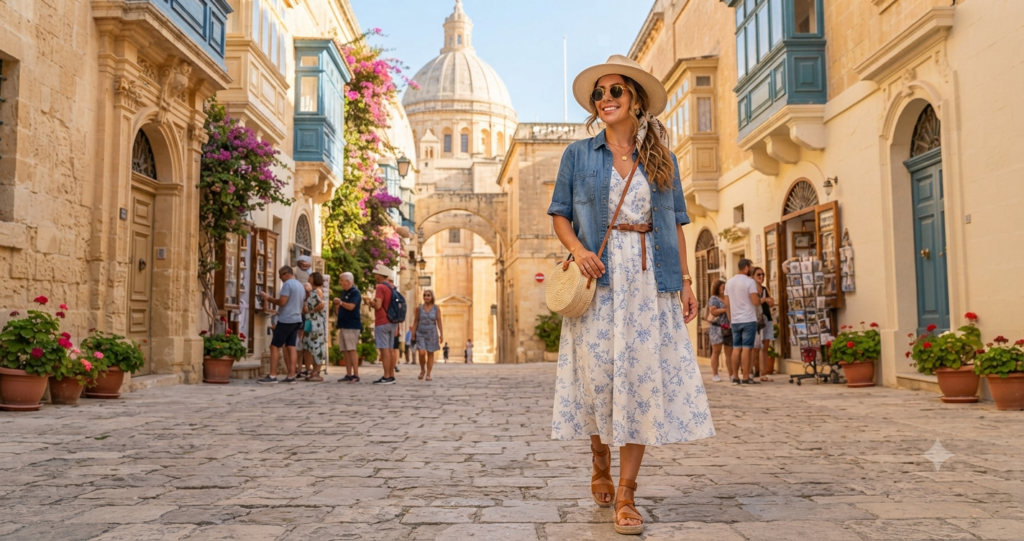
Malta is the Mediterranean’s most unexpected destination — a tiny archipelago of three inhabited islands south of Sicily that punches enormously above its weight in history, architecture, and natural beauty. The ancient capital Valletta (Europe’s smallest capital city and a UNESCO World Heritage site), the medieval walled city of Mdina, the azure window geology of Gozo, and some of the Mediterranean’s clearest swimming waters make Malta one of Europe’s most compelling destinations. Packing for Malta means dressing for warm Mediterranean weather, respectful church visits, and cliff-top exploration.
Malta Weather & When to Visit
Malta has one of Europe’s most reliably warm climates. Spring (March to May): mild temperatures (15–22°C), wildflowers in bloom, uncrowded, excellent for sightseeing — arguably the best time to visit. Summer (June to September): hot (28–35°C), dry, and intensely sunny. August is peak season with highest prices and most tourists; the heat can be demanding. Autumn (October to November): warm (18–25°C), beautiful light, quieter, and still excellent swimming weather in October. Winter (December to February): mild by Northern European standards (12–16°C) with occasional rain; Malta is a popular winter escape for those who find it cold at home. The sea remains swimmable (but cool) year-round — water temperature reaches 28°C in August and September.
What to Wear in Malta: Clothing
Spring & Autumn
- Light layers — mornings can be cool (15°C) while afternoons warm to 22–25°C; a cardigan or light jacket for morning and evening is useful
- Sundresses and linen trousers for afternoon sightseeing
- A light jacket or denim layer for cool evenings in Valletta’s outdoor restaurants
- Comfortable walking shoes — Valletta and Mdina’s streets are steep, stepped, and stone-paved
Summer
- Lightweight sundresses and linen sets — Malta’s summer is genuinely hot and humid; natural fabrics breathe much better than synthetics
- Swimsuit and beach cover-up (Malta’s Blue Lagoon and St. Peter’s Pool are extraordinary)
- A light scarf for church visits (required for covered shoulders inside churches)
- Flat sandals rather than trainers — summer heat makes closed-toe shoes uncomfortable for long walks
Winter
- Layering pieces — Malta winter is mild but not warm; a wool sweater and a rain-resistant jacket are practical
- Light trousers or jeans with layered tops
- Closed shoes — winter rain makes Malta’s stepped streets slippery
Church Dress Code (Important)
Malta is a deeply Catholic country with a high density of churches — St. John’s Co-Cathedral in Valletta (home to Caravaggio’s The Beheading of Saint John the Baptist) is one of the world’s most ornate interiors. Virtually all Maltese churches require covered shoulders and knees for entry. A lightweight scarf worn as a shoulder wrap and a midi or maxi dress covers both requirements elegantly. Shorts and sleeveless tops will be turned away at church entrances; carry a scarf in your bag as a versatile solution.
Shoes
- Comfortable flat walking shoes or trainers — Valletta’s streets are beautiful but steep and stepped; heels are genuinely impractical
- Water shoes or grip sandals for rocky swimming spots (St. Peter’s Pool and the Blue Lagoon have rocky entries)
- Flat sandals for beach days and casual exploring
- A pair of slightly nicer shoes for Valletta restaurant evenings (smart casual)
Essentials
- SPF 50 sunscreen — Malta’s summer sun is intense and the island’s limestone reflects additional UV light
- Sunglasses and wide-brim hat for summer sightseeing
- Reusable water bottle — stay hydrated in Malta’s heat; tap water is safe to drink
- Small lightweight daypack (day trips to Gozo and Comino require carrying essentials)
- Euros (Malta’s currency; card acceptance is high but useful to have cash for bus tickets, markets, and smaller cafés)
- Portable power bank
- Lightweight cardigan or layer for air-conditioned spaces and cooler evenings
What to Wear in Malta: By Destination
Valletta: Europe’s Smallest Capital
Valletta is one of the Mediterranean’s most rewarding capital cities — a dense grid of Baroque architecture, grand Hospitaller churches, cliff-top gardens overlooking the Grand Harbour, and a restaurant and café scene that punches well above the city’s tiny size. St. John’s Co-Cathedral, the Upper and Lower Barrakka Gardens, the National Museum of Fine Arts, and the Grand Harbour itself are the essential sights. Dress smart-casual for Valletta — it’s a capital city, and locals dress with a certain Mediterranean elegance for evenings out. The streets are steep; flat or low shoes are strongly recommended over heels.
Mdina: The Silent City
Mdina, Malta’s ancient fortified capital, is one of Europe’s most atmospheric walled cities — a tiny hilltop settlement where cars are prohibited (except for residents), the streets are almost impossibly narrow, and the silence at dawn or dusk is extraordinary. The views from the bastions across the Maltese countryside are spectacular. Mdina is best visited early morning before the tour groups arrive. Modest clothing for church visits and comfortable shoes for the uneven stone lanes are both important. The cathedral (Mdina Cathedral) is one of Malta’s finest and requires covered shoulders and knees.
Blue Lagoon, Comino
The Blue Lagoon on the island of Comino is one of the Mediterranean’s most photogenic swimming spots — shallow, extraordinarily clear turquoise water enclosed by white rock. It’s reached by ferry from Malta or Gozo (day trips available) and becomes very crowded in summer. The entry is entirely rocky — water shoes are essential for comfortable swimming access. Bring everything you need for the day (food, water, sun protection) as facilities on Comino are limited. The Blue Lagoon experience is best on shoulder-season weekdays when crowds are manageable.
Gozo: Temples, Cliffs & Countryside
Gozo, Malta’s sister island (a short ferry from Ċirkewwa), is quieter, greener, and more rural than Malta — ancient temples (Ggantija, among the world’s oldest freestanding structures), dramatic cliff formations at Ta’ Ċenċ and Dwejra, and some of the Mediterranean’s best diving (the former Azure Window site remains a world-class dive). Gozo is a slower, more authentic pace than Malta’s northern resort areas. Comfortable walking shoes and modest clothing for temple visits are both appropriate. Rent a car or hire a taxi on Gozo — the bus service is limited.
St. Julian’s & Sliema: Restaurants & Nightlife
St. Julian’s and Sliema form Malta’s most modern and cosmopolitan strip — upscale seafront restaurants, shopping, and the Paceville nightlife district. This is where Malta’s younger population and expat community congregates. The dress code here is smart casual for restaurants and more dressed-up for Paceville’s clubs and bars. A nice sundress or a more editorial outfit (wide-leg trousers, a statement top) suits the Sliema waterfront scene. The promenade between Sliema and St. Julian’s is an excellent evening walk along the seafront.
Common Packing Mistakes in Malta
- Not packing a church cover-up: Malta’s most important sights are its Baroque churches and cathedrals, and covered shoulders and knees are required at virtually all of them. Pack a lightweight scarf that can function as a shoulder wrap — without it, you’ll be turned away from St. John’s Co-Cathedral and Mdina Cathedral.
- Wearing heels in Valletta: Valletta’s streets are stepped and steeply graded; the beautiful 16th-century urban planning was not designed with stilettos in mind. Flat shoes or low wedges are appropriate and far more comfortable for a sightseeing day.
- Not bringing water shoes: Malta’s best swimming spots — St. Peter’s Pool, the Blue Lagoon, and many rocky coves — have no sandy beach entry. Water shoes with grip transform these swimming experiences from painful to effortless.
- Visiting the Blue Lagoon without provisions: Comino has minimal food and water infrastructure. Bring everything you need for a full day including adequate water, sunscreen, snacks, and a waterproof bag for your belongings.
- Packing too many clothes: Malta is compact (27km long) with an excellent bus network; laundry services are widely available, and shopping for lightweight Maltese lace items or quality basics is part of the Valletta experience.
Malta FAQ
What language is spoken in Malta?
Maltese (a unique Semitic language with heavy Arabic, Italian, and English influences) and English are both official languages. English is widely spoken across the island at virtually all tourist-facing businesses, making Malta one of the most accessible destinations in the Mediterranean for English-speaking visitors. Road signs, menus, and communications are routinely in both Maltese and English.
Is Malta good for a beach holiday?
Malta has excellent swimming and some beautiful spots, but it’s not a classic sandy beach destination — most of the island’s coastline is rocky limestone cliffs and coves. Sandy beaches exist (Golden Bay, Mellieħa Bay, and Ramla Bay on Gozo are the best) but are modest in size compared to, say, Greek or Spanish beaches. What Malta offers instead is extraordinary water clarity, the Blue Lagoon experience, and cliff swimming spots like St. Peter’s Pool that are uniquely dramatic. Combine beach time with history and you get the best of Malta.
Is Malta expensive?
Malta is moderately priced by Western European standards — significantly cheaper than France or Italy but more expensive than Eastern Europe. Restaurant meals range from €10–15 for a casual lunch to €30–60+ for a dinner at a better Valletta restaurant. Hotel prices range widely; staying in Valletta or Sliema is most convenient. The bus network is inexpensive and reliable for most tourist routes. Day trips to Gozo and Comino by ferry are affordable. Overall, Malta is excellent value for a Mediterranean destination with UNESCO World Heritage status.
How many days do you need in Malta?
Four to five days is the ideal Malta itinerary for first-timers — enough time for Valletta (one full day), a half-day in Mdina, a day trip to Gozo, a day at the Blue Lagoon and Comino, and an evening in St. Julian’s. Extending to seven days allows for more relaxed exploration, a second Gozo visit, and time at the southern cliff swimming spots. Malta rewards slow travel; it’s a place where the longer you stay, the more layers of history and culture you uncover.
For the complete style philosophy behind these looks, see our Mediterranean Fashion Style & Chic Dress Code Guide — covering fabrics, colors, outfit ideas for every setting, and how style varies across Greece, Italy, Spain, Croatia, and more.
Pingback: Malta Packing List: Everything You Need for the Mediterranean's Best-Kept Secret - Vacation Style Guide