Europe is one of the most stylistically diverse travel destinations in the world. What works in a Scandinavian capital differs significantly from what suits a Mediterranean beach town, and the fashion culture of Paris is distinct from that of Prague. This guide covers Europe vacation outfit ideas for every type of European destination, with practical packing strategies.
The European Outfit Philosophy
European style, broadly speaking, favours quality over quantity, understated over obvious, and considered over thrown-together. European cities are famously walkable — you will cover significant distances on foot — but this does not mean athletic wear is appropriate. The European approach to comfort is elegant rather than casual: leather loafers rather than trainers, linen trousers rather than joggers, a tailored blazer rather than a hoodie. Dressing slightly more formally than you might at home is a reliable approach across most European destinations.
Paris Outfit Ideas
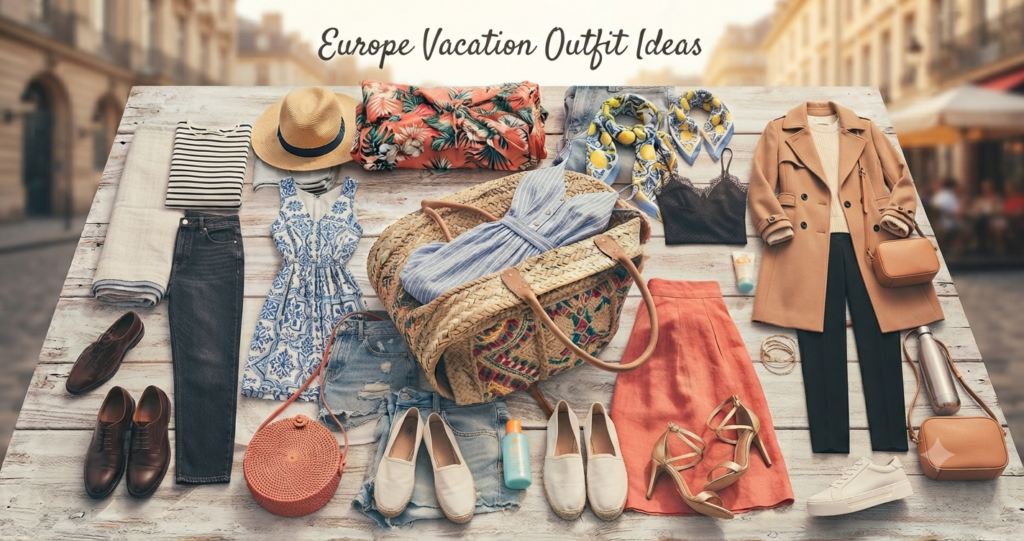
Paris rewards the Parisian wardrobe approach: fewer, better pieces. A classic Parisian vacation outfit: straight-leg or wide-leg tailored trousers + a simple striped or solid top + a blazer or trench coat + leather loafers or ankle boots. The French approach to colour is generally restrained — navy, white, black, beige, burgundy — with one interesting element (a scarf, a handbag, or an unusual accessory). Avoid heavily logo’d or obviously tourist-coded clothing.
For warmer Parisian summers: a midi dress in a subtle print with flat leather sandals and a straw bag; or wide-leg linen trousers with a fitted silk camisole and block-heeled mules. For evenings: a simple slip dress or tailored blazer over a dress. Paris’s restaurant culture skews smart casual to smart — for dinner reservations.
Italy Outfit Ideas
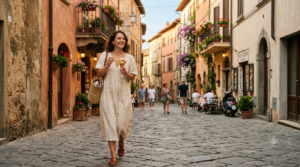
Italy’s fashion culture is expressive, polished, and varied by region. Northern Italian cities (Milan, Florence, Bologna) tend toward more formal, design-conscious dressing. Southern Italy and the coastal towns (Positano, Capri, Sicily) embrace a more relaxed but still elegant aesthetic. Rome sits somewhere between: cosmopolitan but accessible.
Key Italy outfit formulas: tailored linen trousers + silk blouse + block-heeled sandals for cities; a flowing sundress + flat leather sandals for coastal areas; well-fitted jeans + a quality blouse + leather accessories for everyday sightseeing. Important: many Italian churches require covered shoulders and knees — carry a scarf or light layer for entry.
Spain Outfit Ideas
Spain’s diverse geography means outfit needs vary significantly. Madrid and Barcelona are warm, cosmopolitan cities where smart casual to casual smart dressing is the norm. The Balearic Islands (Ibiza, Mallorca) have a distinct bohemian-luxury beach style. Andalusia (Seville, Granada) is characterized by bold colours and a slightly more traditional aesthetic.
For Barcelona: a simple dress or coordinated separates + leather sandals works well. For Ibiza: flowy, bohemian fabrics in bright or earth tones. For Madrid: slightly more formal than Barcelona — linen or cotton trousers + blouse combination, or a tailored dress for evening.
Greece Outfit Ideas
Greek island dressing is arguably the most photogenic on the planet — white against blue-domed churches and Aegean sea is an iconic combination that actually reflects local architecture and light. White linen, cotton sundresses, and simple sandals genuinely suit the Greek island environment. Santorini and Mykonos have a slightly more glamorous beach town aesthetic than smaller islands, where simple practical clothing is perfectly appropriate.
For Athens: the city is more formal than the islands — linen trousers or a midi skirt for sightseeing is appropriate. Comfortable walking shoes are essential as the Acropolis and surrounding areas involve significant walking over uneven terrain.
Scandinavia Outfit Ideas
Scandinavian countries have a style culture that prizes minimalism, quality, and function. The colour palette tends toward neutrals and muted tones. Copenhagen, Stockholm, and Oslo all have thriving design and fashion cultures — dressing with intentionality is appreciated. Practical considerations: Nordic weather is variable even in summer, so layering is essential. A quality waterproof jacket, a cashmere or merino layer, and versatile shoes that handle both city walking and potential rain are all important.
Eastern Europe Outfit Ideas
Eastern European cities — Prague, Budapest, Krakow, Tallinn, Warsaw — are increasingly cosmopolitan but generally have a more conservative aesthetic than Western European capitals. Smart casual dressing works well across this region. Cobblestones are a significant factor in many Eastern European old towns — comfortable, stable footwear is a practical necessity.
Universal Europe Packing List
For a two-week European trip, the following covers most combinations: two pairs of trousers (one casual, one slightly smarter); two to three dresses or skirts; four to five tops (including one dressy option); one blazer or structured cardigan; one lightweight waterproof layer; two pairs of shoes (comfortable walking option + one smarter evening option); and one versatile accessory set (scarf, simple jewellery).
Shoes for European Travel
Footwear is the most important practical decision for European travel. The most-walked cities in the world include several European capitals. Trainers or sneakers are now broadly accepted across Europe, but white trainers specifically have become something of a tourist-identifier. Leather loafers, clean leather sneakers, or supportive ankle boots read as more intentionally stylish while remaining comfortable for long walking days. Break in shoes thoroughly before travel — for new shoes on cobblestones is a recipe for blisters.
Germany and Central Europe Outfit Ideas
Germany and its Central European neighbors reward a slightly more practical, less overtly fashion-forward approach than Paris or Italy — quality basics, a good jacket, and comfortable walking shoes cover most cities from Berlin to Vienna to Prague. Beer halls, Christmas markets, and outdoor festivals all lean casual, while opera houses and upscale restaurants call for the same smart-casual step-up as the rest of Europe.
Weather shifts more dramatically here than in Southern Europe, so a packable layering system — base layer, sweater, weatherproof outer layer — matters more for a Central Europe trip than the lighter Mediterranean-focused wardrobe covered elsewhere in this guide.
Frequently Asked Questions
Is smart casual appropriate for European dinner reservations?
Smart casual is appropriate for most European restaurant reservations. Paris and Italian fine dining establishments may expect slightly more formal attire. Beach resort restaurants are generally more relaxed. As a guideline: avoid athletic wear, shorts, or flip-flops for any sit-down dinner reservation in a European city.
What should I pack for a European summer vacation?
Lightweight fabrics that breathe and dry quickly are essential for European summer heat. Linen, lightweight cotton, and bamboo blends all work well. Pack a light layer for air-conditioned museums and transportation, and a compact umbrella for afternoon thunderstorms in Southern Europe. Sun protection is important — both a hat and sunscreen, as European summer sun can be intense.
Can I wear the same outfit to multiple European countries?
Absolutely. A quality core wardrobe of neutral basics works across all European countries with minimal adjustment. The key is versatile pieces that can be combined differently each day. A French tuck here, a different accessory there, and swapping sandals for loafers creates enough visual variety to feel fresh without carrying a different outfit for every country.
Do I need different clothes for Germany than for Southern Europe?
The core wardrobe philosophy stays the same, but pack more layering pieces for Germany and Central Europe generally — weather shifts faster and temperatures run cooler than the Mediterranean destinations covered elsewhere in this guide, even in summer.
Is casual clothing acceptable at European opera houses and concert halls?
Generally not for evening performances — smart-casual to formal is expected at most opera houses and classical concert venues across Europe. Daytime tours of the same venues are far more relaxed about dress.