
63 — Number of national parks in the USA — the world’s greatest collection of protected landscapes
2,278mi — Historic Route 66 length from Chicago to Santa Monica, California
America’s Parks Pass — Annual pass covering entrance to all 2,000+ US federal recreation sites — best road trip value
$0.59 — Average cost per mile for petrol in road trip budget calculations for mid-size vehicles
Pacific Coast Highway — Most consistently voted America’s most scenic road trip route
The Road Trip: Travel at Its Most Free
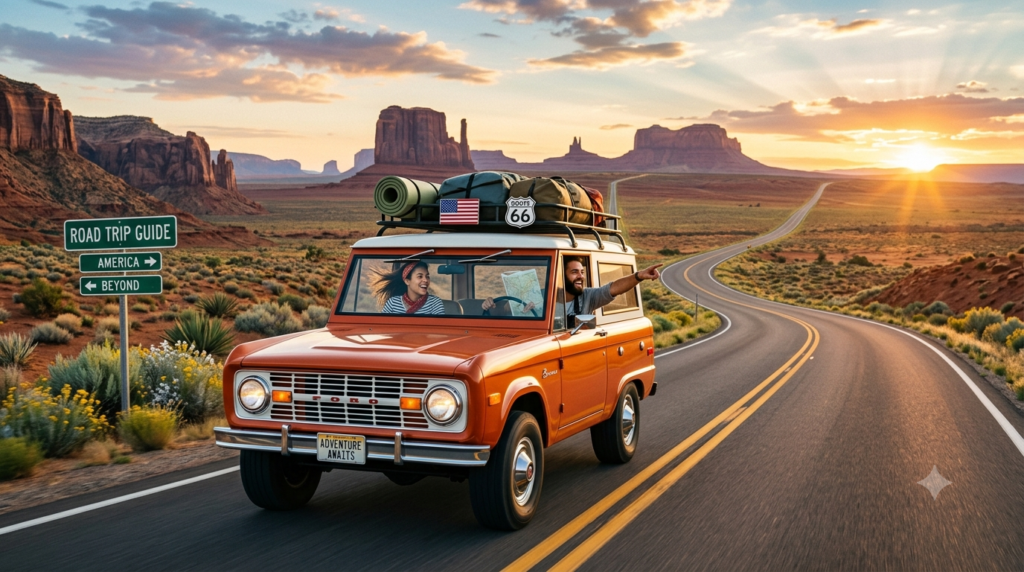
A road trip is the purest form of travel freedom — no schedule dictated by airline departure boards, no fixed itinerary, no prescribed pace. You move when you want, stop where you want, and stay as long as you want. The United States in particular offers road trip infrastructure and landscape variety unmatched anywhere in the world — from the Pacific Coast Highway’s dramatic ocean cliffs to the otherworldly desert landscapes of the Southwest, to the green mountain roads of New England and the live oak canopies of the Deep South. This guide covers how to plan, pack, and execute the perfect road trip.
America’s Best Road Trip Routes
Pacific Coast Highway (California): The most scenic drive in America and among the most dramatic in the world — 655 miles of California coastline from San Francisco to Los Angeles along cliffside Highway 1. Big Sur is the centrepiece: a 90-mile stretch of rugged coastline with no commercial development, just ocean, forest, and the extraordinary Bixby Bridge. Allow 5-7 days to drive it properly with stops.
Route 66: America’s most legendary highway runs 2,278 miles from Chicago to Santa Monica through the heartland of American road culture. The original Mother Road passes through eight states, connects small towns whose economies were transformed by and then abandoned with the interstate system, and delivers a genuinely moving experience of American history and landscape. Allow 2-3 weeks for a proper Route 66 road trip itinerary.
Southwest National Parks Loop: The most dramatic natural landscape road trip in America — linking Zion, Bryce Canyon, Capitol Reef, Canyonlands, Arches, and Grand Canyon in a 1,500-mile circuit through Utah and Arizona. The America the Beautiful Annual Pass ($80) covers entrance to all national parks and more than pays for itself on this single itinerary.
National Parks USA: How to Make the Most of Them
America’s 63 national parks are the country’s greatest natural treasure — from the geysers of Yellowstone to the rainforests of Olympic, the canyon lands of the Southwest to the glacier fields of Glacier National Park in Montana. The America the Beautiful Annual Pass ($80) covers entrance fees at every national park and over 2,000 federal recreation sites — it pays for itself after visiting just two or three parks and is the single best value purchase for any road trip through the American West.
Beating the crowds: Most national parks are most crowded in July and August. Entering any park before 7am avoids the majority of day visitors at popular trailheads. Shoulder season visits (May, June, September) combine good weather with significantly lower crowd levels. Reservations are now required at entry for some of the most popular parks (Arches, Rocky Mountain) — check the recreation.gov website before arrival.
RV Travel vs Car and Tent Camping
Renting an RV or campervan for a road trip solves the accommodation logistics entirely — you carry your home with you, campground fees are far lower than hotel costs, and you can stay in locations inaccessible to non-campers. The trade-off: fuel costs are significantly higher than a car, driving is more demanding, and some national park roads have vehicle length restrictions that preclude large RVs. Campervan rentals (Outdoorsy, Escape Campervans) offer more flexibility than full RVs at lower rental cost.
Road Trip Packing List
- Navigation: Downloaded offline Google Maps for every section of your route (cell coverage is unreliable in national parks and rural areas)
- Emergency kit: Jumper cables, tyre inflation kit, basic tools, first aid kit, and 2 litres of water per person minimum
- Camping essentials (if camping): Tent, sleeping bag rated to local nighttime temperatures, camp stove, headlamp
- Clothing layers: Desert roads can be 40C by day and 5C by night — layers essential for Southwest travel
- Entertainment: Podcasts, playlists, and audiobooks downloaded offline — streaming is unreliable on rural highways
- Cooler/icebox: Food savings on long road trips are significant with a well-stocked cooler
For budget planning, see our budget travel guide. For packing everything efficiently, see our travel packing list.
Frequently Asked Questions
What is the best road trip in the USA?
The Pacific Coast Highway is the most consistently cited for scenic beauty. The Southwest National Parks loop is the most dramatically landscape-varied. Route 66 is the most culturally significant. The choice depends on what you value — natural beauty, American history, or dramatic landscape variety.
How much does a road trip across America cost?
A 2-week cross-country road trip for two people budgets at roughly $3,000-$5,000 all-in — fuel ($600-900), accommodation ($700-1,200 split between camping and motels), food ($600-800), and national park fees ($80 annual pass + campground fees). Flying each way and renting a car for a regional road trip is often more economical than driving cross-country.
Do I need to book campgrounds in advance?
Yes — popular national park campgrounds (Yosemite Valley, Zion, Grand Canyon) fill months in advance and require booking through recreation.gov. Some campsites open for reservation exactly 6 months in advance to the day. Build your campground reservation schedule before your road trip departure, particularly for July and August travel.
Is it safe to camp alone in national parks?
National park campgrounds are among the safest camping environments available — staffed, well-lit, with ranger presence and clear emergency protocols. Solo camping in developed national park campgrounds is entirely safe for most travellers. Backcountry solo camping (wilderness camping away from developed areas) requires more experience, preparation, and bear safety awareness.
How do I plan a road trip itinerary?
Start with your start and end points and total days available. Calculate realistic daily driving distances (250-350 miles per day is comfortable for road tripping; more feels rushed). Identify your non-negotiable stops, then fill gaps with flexibility. Build in at least one unscheduled day per week — the best road trip moments are the unplanned ones.
The Open Road Is Waiting
A road trip is the closest thing modern travel offers to genuine freedom — the freedom to change your plan on a whim, to stay longer in the place that moved you, and to find the view around the next bend that nobody told you about. Load the car, download the maps, and find out what America — or wherever your road leads — looks like through a windshield at your own pace.
✈️ Trip Essentials
Affiliate links — we may earn a small commission at no extra cost to you.
Compare millions of hotels worldwide — boutique stays to luxury resorts. Best price guarantee.
Discover top-rated tours and experiences worldwide. Instant booking, free cancellation on most activities.