
Golden hour — The 30-minute window after sunrise and before sunset producing the best travel photography light
Rule of thirds — The single most effective composition technique for dramatically better travel photos
Smartphone — The camera most travel photographers actually use most — modern phone cameras are genuinely excellent
RAW format — Shooting in RAW vs JPEG preserves 3-5x more editing latitude for colour and exposure correction
Tripod — The single accessory that most improves travel photography quality for landscape and night shots
Travel Photography Is the Art of Seeing a Place Clearly
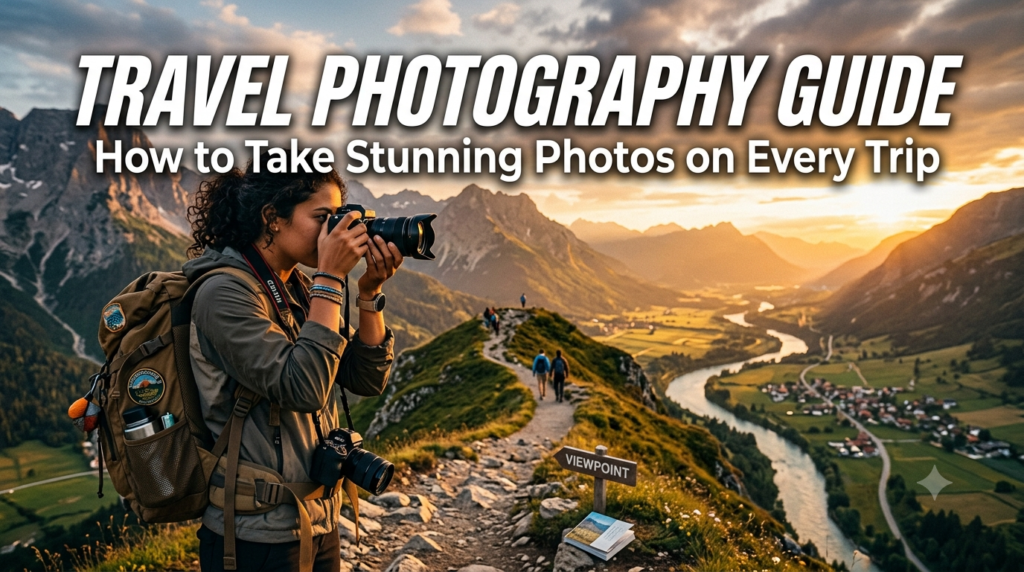
The difference between a travel photograph that captures something real about a place and a snapshot that documents your presence there isn’t the camera you used — it’s how you looked at what was in front of you. The best travel photographers consistently describe their practice as a discipline of attention: arriving early, waiting for light, noticing the human detail in a landscape, and being willing to return to the same location multiple times. This guide covers both the technical foundations and the creative practice of travel photography across every budget and skill level.
The Best Camera for Travel: Honest Recommendations
The camera you will carry consistently is worth more than the technically superior one you leave in your hotel room because it’s too heavy. This is the foundational principle of travel camera choice:
Light: The Single Most Important Element
Golden hour — the 30-60 minutes after sunrise and before sunset — produces the warm, directional, shadow-rich light that transforms ordinary travel scenes into extraordinary photographs. Blue hour — the 20 minutes before sunrise and after sunset — produces the cooler, more even, atmospheric light that excels for cityscapes and seascapes. Midday light is flat and harsh; it’s when most tourists are photographing actively, meaning most tourist travel photographs look the same. The discipline of arriving at a location at dawn rather than mid-morning produces results that justify every extra effort.
Composition: The Rules Worth Learning
Rule of thirds: Position your subject or horizon at one of the third-lines of the frame rather than dead centre — it creates visual tension and interest that centre composition rarely achieves. Enable the grid overlay in your camera or smartphone settings and practice this until it becomes instinctive. Leading lines: Roads, rivers, fences, and shorelines that run from foreground to background create depth that pulls viewers into the image. The most powerful landscape photographs almost always contain a leading line. Foreground interest: Including something compelling in the immediate foreground — flowers, rocks, patterns in sand — creates a three-dimensional quality in a two-dimensional image that separates technically strong landscape photography from snapshots.
Drone Photography for Travel
Consumer drone photography — primarily DJI Mini 4 Pro and DJI Air 3 — has opened aerial perspectives that were previously only available to professionals with helicopter access. The overhead shot of a beach, the bird’s-eye reveal of a temple complex, and the sweeping crater-rim panorama are all now accessible to any travel photographer willing to learn the basic drone operation skills. Important practical notes: many countries require drone registration, permits, or have restricted flight zones (especially near airports, national parks, and military areas). Research drone laws for every country you plan to fly before departure — violations carry significant fines.
Building a Travel Blog or Content Creator Career
Travel content creation has matured from a hobby into a legitimate career path, though the pathway is longer and more competitive than it appeared five years ago. The consistent advice from established travel bloggers and Instagram travel content creators is: choose a specific niche (budget travel in Southeast Asia, luxury European hotels, national park hiking photography) rather than generic travel content; be consistent in posting over 18-24 months before expecting meaningful audience growth; and build email list and multiple platform presence rather than relying solely on one algorithm-controlled platform.
For destination-specific photography inspiration, see our world’s best destinations guide and our destination travel articles throughout this site.
Frequently Asked Questions
What is the best camera for travel photography beginners?
Start with your smartphone — modern iPhone and flagship Android cameras produce genuinely excellent travel photography results when used with compositional intention and at the right time of day. If you want to progress to a dedicated camera, a Sony ZV-E10 or Fuji X-S10 offers the best balance of portability, image quality, and learning value for a first dedicated travel camera.
How do I avoid tourist photography cliches?
Arrive at famous sites at dawn rather than midday to eliminate crowds and get better light. Step back and include more context rather than just the subject. Look for details — the food on a market stall, the pattern on a tile floor, the interaction between locals rather than just the architecture. Your unique perspective on a famous place, rather than the standard composition, is what creates original travel photography.
How do I start a travel blog?
Choose a specific niche, buy a domain name, set up WordPress with a clean theme, and write 20-30 high-quality destination or topic articles before focusing on promotion. SEO (search engine optimisation) is the most sustainable long-term traffic source for travel blogs — writing articles targeting specific search queries rather than general inspiration content is the foundation of a traffic-generating travel blog.
Is drone photography worth it for travel?
For travel photographers who want aerial perspectives, yes — the DJI Mini 4 Pro produces professional-quality aerial footage at a weight and price point accessible to most serious hobbyists. The key limitations are regulatory (research drone laws for every destination) and practical (battery life requires careful management). If you’re committed to travel photography and video, a drone significantly expands your creative possibilities.
What editing software is best for travel photography?
Adobe Lightroom (mobile and desktop) is the industry standard for travel photography editing — non-destructive, powerful colour grading tools, and excellent preset system for creating consistent look across your body of work. Lightroom Mobile is free with limited features; the full Creative Cloud subscription adds more comprehensive tools. Snapseed is an excellent free mobile-only alternative for smartphone travel photographers.
See More, Photograph Better
The best travel photography advice is the simplest: look at what’s actually in front of you rather than at your phone screen, arrive early and stay late for the light, and prioritise one excellent photograph over fifty mediocre ones. The discipline of attention that great travel photography requires also happens to be the discipline that produces the richest travel experiences — it is, at heart, about seeing a place rather than simply being in it.
✈️ Trip Essentials
Affiliate links — we may earn a small commission at no extra cost to you.
Compare millions of hotels worldwide — boutique stays to luxury resorts. Best price guarantee.
Discover top-rated tours and experiences worldwide. Instant booking, free cancellation on most activities.