
3hrs/timezone — Approximate jet lag adjustment time — one day recovery per three time zones crossed
48hrs before — Optimal hydration head-start window for minimising jet lag on long-haul flights
10% rule — Sustainable travel guideline — offset at least 10% of trip carbon through verified schemes
Travel rewards — Strategic credit card use can fund 1-2 free flights per year for average travellers
6-8 weeks — Recommended advance booking for travel health clinic vaccination appointments
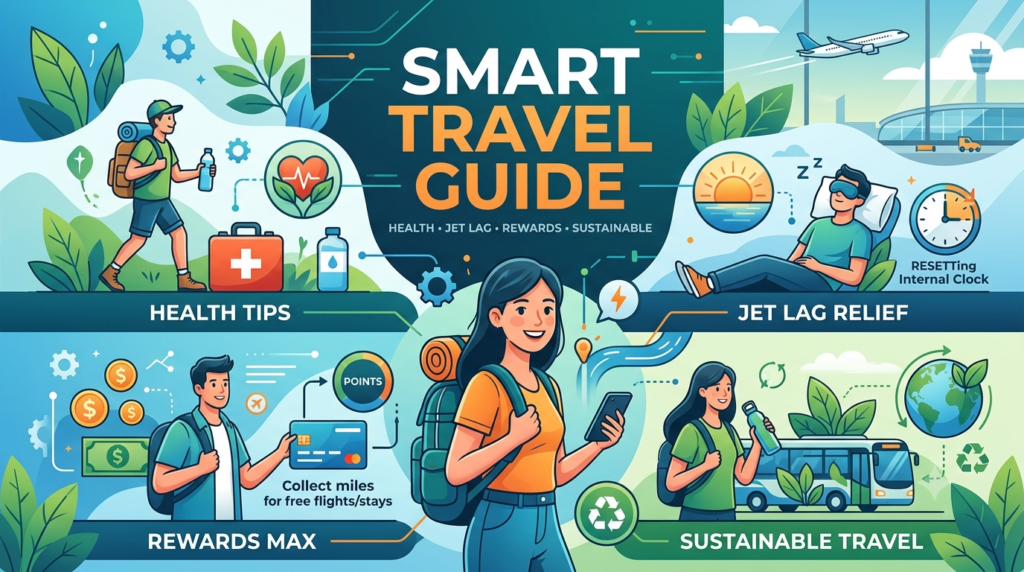
Smart Travel Goes Beyond Cheap Flights and Good Hotels
The most experienced travellers aren’t just good at finding deals and interesting destinations — they’re good at arriving healthy, managing the physical toll of long-distance movement, earning rewards that fund future travel, minimising their environmental impact, and navigating the specific challenges of family travel. This guide covers the practical dimensions of travel that most destination guides miss: health, rewards, sustainability, and the logistics of travelling with children.
Travel Health: What to Do Before You Leave
A travel health consultation with a specialised travel medicine clinic — booked 6-8 weeks before departure — is the most important pre-travel health action for any trip outside your home region. The clinic assesses your specific itinerary, reviews your existing vaccination record, and recommends destination-specific vaccinations and medications (malaria prophylaxis, altitude sickness medication, traveller’s diarrhoea treatment) that no general internet resource can provide with the same accuracy.
Core travel vaccinations: Most travellers need to ensure their routine vaccinations (MMR, tetanus, hepatitis B) are current. Destination-specific additions include: typhoid and hepatitis A for most developing world travel, yellow fever for sub-Saharan Africa and parts of South America (required entry vaccine for some countries), Japanese encephalitis for rural Asia, and rabies for travellers planning extended wildlife-heavy itineraries.
Pre-Travel Health Checklist
Jet Lag: The Science and the Solutions
Jet lag is a genuine physiological disruption — your circadian rhythm, body temperature regulation, and hormone cycles are all calibrated to your home time zone and require time to reset after crossing multiple time zones. The general adjustment rate is approximately one day per time zone crossed; a 10-hour time zone shift takes roughly 10 days to fully adjust to, though functional recovery is typically faster.
Evidence-based jet lag strategies: Begin shifting your sleep schedule 2-3 days before departure — earlier for westward travel, later for eastward. Stay hydrated before and during the flight (dehydration worsens jet lag significantly). Avoid alcohol on long-haul flights (it dehydrates and fragments sleep). On arrival, expose yourself to natural light aligned with your destination’s day-night cycle — morning light is particularly powerful at resetting the circadian clock. Melatonin (0.5-3mg) taken at destination bedtime for the first 2-3 nights provides genuine evidence-backed support for jet lag recovery.
Travel Sickness: Prevention and Management
Motion sickness affects roughly one third of travellers in some form — on ships, winding mountain roads, and certain aircraft turbulence patterns. Prevention is more effective than treatment once nausea begins. Evidence-based prevention: sit in the front of buses and over the wing in aircraft (most stable positions). Focus on a fixed point on the horizon when motion is significant. Ginger (natural antiemetic) taken before travel has genuine evidence for reducing motion sickness. Prescription antiemetic patches (scopolamine) are the most effective pharmaceutical option for known severe sufferers.
Travel Rewards Credit Cards: Making Travel Pay for Itself
Strategic use of travel rewards credit cards is the most consistently effective way to reduce the cost of future travel without changing your spending behaviour. The most valuable travel cards offer: sign-up bonuses equivalent to one or two domestic flights, points or miles on all spending (strongest in travel and dining categories), and airport lounge access that transforms layovers from miserable waiting to genuinely comfortable rest.
Important qualification: Travel rewards cards only deliver value when the balance is paid in full each month. The interest charges on a carried balance eliminate any rewards value quickly. Used as a disciplined spending tool (replace cash/debit for regular purchases, pay in full monthly), a single good travel rewards card can realistically fund one domestic or regional international flight per year for an average household’s spending.
Sustainable Travel: Making Your Travel Count
Tourism accounts for approximately 8% of global greenhouse gas emissions — a significant footprint that grows as travel becomes more accessible. The sustainable travel movement isn’t about stopping travel; it’s about making travel choices that minimise harm and maximise positive local impact:
- Fly less, stay longer: The most impactful single sustainable travel decision — the carbon cost of a flight is fixed; extending your stay at each destination reduces your per-trip average significantly
- Choose direct flights: Taking off and landing are the most carbon-intensive parts of air travel — one direct flight produces significantly less emissions than two flights with a connection
- Stay in locally-owned accommodation: Guest houses, boutique hotels, and local homestays keep more money in the destination economy than international hotel chains
- Eat local food: Local restaurants using local ingredients support local agriculture and reduce food transport emissions
- Carbon offset verified schemes: Gold Standard and Verified Carbon Standard projects offer credible offset options for unavoidable flight emissions
Travelling with Kids: Practical Tips
Family travel is simultaneously more complicated and more rewarding than solo or couple travel — the logistics are more demanding and the experiences are more memorable. The most consistent advice from experienced parent travellers: involve children in destination choice and planning from the age of 5-6 (investment in the process creates genuine engagement with the experience), plan one major activity per day and leave the rest flexible (over-scheduling exhausts children and parents alike), and prioritise accommodation with outdoor space or a pool (children need physical release after travel days).
For destination planning, see our best travel destinations guide. For budget planning and flight booking, see our complete budget travel guide.
Frequently Asked Questions
What is the best way to prevent jet lag?
The most evidence-supported jet lag strategies are: begin shifting your sleep schedule 2-3 days before departure, stay well-hydrated before and during the flight, avoid alcohol on the plane, expose yourself to natural light on arrival timed to your destination’s daylight hours, and take melatonin (0.5-3mg) at destination bedtime for the first few nights.
Is travel insurance really necessary?
Yes — unequivocally for any international travel. A single medical emergency abroad without insurance — particularly in countries without reciprocal health arrangements — can produce bills of $50,000 to $500,000. The annual cost of comprehensive travel insurance is a fraction of a single potential emergency cost. The question is not whether travel insurance is worth it; it’s which policy adequately covers your specific trip and activities.
What vaccinations do I need for travel?
It depends entirely on your destination and existing vaccination record. A travel health clinic (booked 6-8 weeks before departure) is the correct and only reliable source for personalised vaccination advice. General internet lists are not a substitute for a clinical assessment of your specific itinerary, medical history, and current outbreak data.
Which is the best travel rewards credit card?
The best card depends on your primary airline and whether you prefer airline miles or transferable points. In the US: Chase Sapphire Preferred and American Express Platinum consistently top travel rewards rankings. In the UK: American Express Preferred Rewards Gold is the most widely recommended entry-level travel rewards card. Compare sign-up bonuses, annual fees, and the value of your most-used spend categories before choosing.
How can I make my travel more sustainable?
The single highest-impact action is flying less and staying longer at each destination. Beyond that: choose direct flights over connections, stay in locally-owned accommodation, eat at local restaurants, use public transport where available, avoid single-use plastics, and offset unavoidable flight emissions through verified carbon schemes. Small collective changes across the millions of daily travel decisions made globally produce meaningful aggregate impact.
Travel Smarter, Not Just Further
The most satisfying travel is the kind that doesn’t leave you depleted, financially stressed, or guilty about your impact. Building the smart travel practices covered in this guide — health preparation, jet lag management, rewards strategy, sustainable choices, and family logistics — transforms travel from something that happens to you into something you do with genuine competence and joy.
✈️ Trip Essentials
Affiliate links — we may earn a small commission at no extra cost to you.
Compare millions of hotels worldwide — boutique stays to luxury resorts. Best price guarantee.
Discover top-rated tours and experiences worldwide. Instant booking, free cancellation on most activities.