
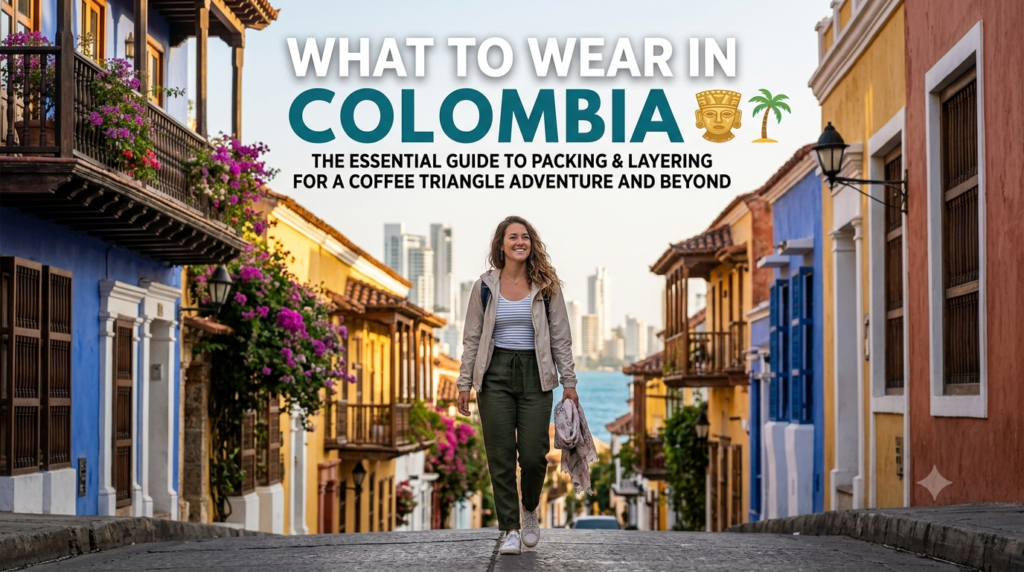
Colombia has become one of South America’s most exciting travel destinations — the colorful Caribbean walls of Cartagena, the coffee region of the Eje Cafetero, the electric nightlife of Medellín, and the colonial beauty of Bogotá. Dressing well here means navigating genuinely dramatic altitude differences alongside Colombia’s vibrant, expressive culture.
Colombia’s Climate: Altitude, Not Seasons
Colombia straddles the equator and has no traditional seasons — climate is determined almost entirely by altitude, a system locals call “pisos térmicos.” The Caribbean Coast (Cartagena, Santa Marta) is hot and humid year-round, 28-35°C / 82-95°F. Medellín, the “City of Eternal Spring,” stays pleasantly warm at 22-28°C / 72-82°F. Bogotá, at 2,600m / 8,500ft altitude, is cool and can be genuinely chilly, often 8-19°C / 46-66°F, especially after dark.
Colombia Packing List: The Essentials
- Breathable linen and cotton for the Caribbean coast’s heat and humidity
- A warm layer — fleece or a light wool sweater — for Bogotá’s altitude chill, any time of year
- A packable rain jacket, especially for Medellín and the coffee region, where showers are common
- Comfortable walking shoes for cobbled colonial streets in Cartagena and Bogotá’s La Candelaria
- A light scarf, useful as sun protection on the coast and warmth in Bogotá
- Modest, non-flashy daywear — Colombia’s cities have areas where standing out as an obvious tourist is worth avoiding
- One smart-casual outfit for Medellín’s nightlife or a nicer Bogotá dinner
What to Wear on the Caribbean Coast
Cartagena and Santa Marta call for classic warm-weather dressing: linen shirts, breathable dresses, and sandals. Cartagena’s walled Old Town has cobblestone streets, so a low block-heel or supportive sandal beats a flimsy flip-flop. Sun protection matters more here than almost anywhere else in Colombia — the Caribbean sun is intense and consistent.
What to Wear in Medellín
Medellín’s near-perfect year-round climate means light layering rather than heavy planning: breathable daywear for daytime, with a light jacket for cooler evenings and the city’s famous afternoon showers. Medellín’s nightlife scene, particularly in Poblado, leans stylish and put-together — worth packing at least one sharper outfit if evenings out are part of the plan.
What to Wear in Bogotá and the Highlands
This is where visitors most often underpack. Bogotá’s altitude keeps it cool year-round, and evenings can be genuinely cold — a proper jacket, layers, and closed shoes are essential, not optional. La Candelaria’s colonial streets are cobbled and hilly, so comfortable, supportive footwear matters as much here as in Cartagena.
Cultural and Safety Considerations
Flashy jewelry and obviously expensive gear can draw unwanted attention in Colombia’s larger cities, particularly Bogotá and Medellín — dressing a notch more low-key than resort-destination habits is a sensible default. A crossbody bag you can keep in front of you works better than an open shoulder bag in busy areas like markets and public transit.
Footwear for Colombia
Plan for at least two categories: sandals for the Caribbean coast, and closed, supportive walking shoes for Bogotá, Medellín, and any coffee-region hiking. Cobblestone streets show up in nearly every Colombian city worth visiting, so comfort and grip matter more than fashion-first footwear.
Related Guides
If Cartagena is your main stop, see our dedicated What to Wear in Cartagena guide. Exploring more of South America? Our what to wear in Rio de Janeiro guide covers a very different, beach-first Brazilian climate for comparison.
Colombia Packing List
Colombia has transformed dramatically as a travel destination — from a country travellers avoided to one of South America’s most exciting, with world-class coffee, extraordinary biodiversity, a vibrant nightlife scene in Medellín and Bogotá, colonial splendour in Cartagena, and one of the warmest, most hospitable cultures you’ll encounter anywhere. Colombia’s geography means packing for wildly different climates in the same trip — this Colombia packing list covers all of it.
Colombia Weather: It’s All About Altitude
Colombia doesn’t have traditional seasons — it has altitude zones. The country’s climate is determined by elevation, not time of year:
- Cartagena & Caribbean Coast: Hot and humid year-round (28–34°C). Pack light summer clothes.
- Medellín (City of Eternal Spring): 20–28°C year-round. Medellín sits at 1,495m — pleasantly warm days, cool evenings. Light layers.
- Bogotá: Cool and variable at 2,600m — 8–18°C. Can feel cold, especially at night and in the rain. A proper jacket is needed.
- Coffee Region (Eje Cafetero): 20–28°C. Lush, green, and occasionally rainy. Light layers and a rain jacket.
- Amazon region: Hot and humid (28–35°C) with frequent rain. Lightweight, insect-repellent-treated clothing.
Colombia Packing List for Women
Clothing — Pack for Multiple Climates
The biggest Colombia packing challenge is packing for 15°C Bogotá and 32°C Cartagena in the same trip. The solution: versatile layers and fabrics that work across multiple temperature ranges.
- 3–4 lightweight tops or blouses (work for Cartagena heat; layer up for Bogotá)
- 1–2 sundresses or casual dresses (Cartagena and the coffee region)
- 1–2 long-sleeved tops or light knits (Medellín evenings and Bogotá days)
- 1 medium-weight cardigan or sweatshirt (Bogotá evenings are genuinely cold)
- 1 lightweight waterproof jacket (rain can happen anywhere; essential in Bogotá and the coffee region)
- 1 pair of jeans or smart trousers
- 1 pair of comfortable walking trousers or chinos
- 1 swimsuit and cover-up (Cartagena’s beaches, hotel pools, and the isla Barú)
Shoes
- Comfortable walking trainers or sneakers: Essential everywhere. Colombia’s cities involve significant walking on often uneven streets.
- Flat sandals: For Cartagena’s beaches and casual sightseeing in warmer cities.
- Ankle boots or comfortable waterproof shoes: For Bogotá and the coffee region, where cobblestones and rain are both common.
Safety-Minded Packing
Colombia is significantly safer than it was 10–15 years ago, but smart precautions still apply:
- Use a crossbody bag with a zip in cities — Bogotá, Medellín, and Cartagena all have bag-snatching risks
- Leave expensive jewellery and watches at home or in the hotel safe
- Use your phone’s camera discretely in busy public areas rather than walking while looking at your screen
- Carry a secondary card and some cash separately from your main wallet
Accessories & Essentials
- Compact umbrella or light rain jacket (essential for Bogotá and the coffee region)
- SPF 50+ sunscreen (UV is intense at Colombia’s altitudes — even in Bogotá at 2,600m)
- Insect repellent with DEET (for Caribbean coast, Amazon, and rural areas; dengue and malaria risk in some regions)
- Reusable water bottle (Colombia’s coffee region has some of the world’s best water; Bogotá tap water is safe)
- Power adaptor: Colombia uses Type A/B plugs (same as the US)
What to Wear: Colombia City by City
Cartagena
Colombia’s most beautiful colonial city and its hottest. Light, breathable clothing — sundresses, linen tops, shorts, and swimwear for the beaches and island day trips. The walled city is atmospheric at sunset; a colourful sundress photographs beautifully against the colonial architecture. Evening restaurants and rooftop bars in Getsemaní appreciate slightly more polished casual dress.
Medellín
Colombia’s most stylishly dressed city. Medellín’s residents dress well — smart casual is the norm. Jeans, a good blouse, and ankle boots work for El Poblado’s restaurant and bar scene. The city’s famous street art in Laureles and the Botero Plaza are more casual sightseeing settings. Evenings can be cool — a light jacket or cardigan is always worthwhile.
Bogotá
Colombia’s capital is cosmopolitan and cool in every sense — temperature and style. At 2,600m, it’s genuinely cold at night and on rainy days. Layers are essential. The Zona Rosa and Usaquén neighbourhoods have excellent restaurants and boutiques that reward smart casual dress. La Candelaria (the historic centre) is more casual but worth visiting for the Gold Museum and colonial churches.
Coffee Region (Eje Cafetero)
Comfortable, practical, and layered. Coffee farm tours involve walking through verdant hillside plantations; good shoes and practical clothes matter. The region is lush and beautiful — light layers and a rain jacket for the frequent afternoon showers. The coffee towns (Salento, Filandia, Jardín) are relaxed and charming.
Common Colombia Packing Mistakes
- Not packing for Bogotá’s cold: The most common mistake — visitors pack for the beach (Cartagena) and freeze in Bogotá. Always include a proper jacket and at least one warm layer.
- Wearing conspicuous jewellery or expensive accessories in cities: Colombia’s major cities have theft risks and wearing visible valuable items increases that risk significantly. Travel jewellery rather than real pieces is strongly advised.
- Not bringing insect repellent: Dengue fever is present in Colombia’s lower-altitude regions. Quality DEET repellent is the most effective protection.
- Overpacking for a long country trip: Moving between Cartagena, Medellín, Bogotá, and the coffee region involves multiple flights and transfers. A medium-sized bag (under 20kg) makes the trip dramatically easier than a large suitcase.
Colombia Packing List FAQ
Is Colombia safe to visit?
Colombia is significantly safer than its international reputation, which lags behind reality by about 15 years. Cartagena, Medellín, and Bogotá’s main tourist neighbourhoods are comfortable and actively visited by millions of travellers annually. The standard urban safety precautions apply: don’t display valuables, use reputable transport, and avoid unfamiliar areas at night. Research your specific destinations; some regions still carry travel advisories.
What language is spoken in Colombia?
Spanish — and Colombian Spanish is considered some of the clearest and most accessible in Latin America, which makes it a good destination for Spanish learners. English is spoken in tourist-heavy areas of Cartagena and Medellín’s El Poblado, but much less elsewhere. A translation app and some basic Spanish go a long way.
What’s the best order to visit Colombian cities?
A classic Colombia itinerary: fly into Cartagena (2–3 days for acclimatisation and the coast), fly to Medellín (2–3 days), take a bus or fly to the Coffee Region (1–2 days), then fly to Bogotá for the last 2–3 days before flying home. This moves from warmest to coolest, giving your body time to adjust rather than arriving cold into Bogotá from home.
Pingback: Colombia Packing List for Women: What to Pack for Cartagena, Medellín & Bogotá - Vacation Style Guide