The Canary Islands â a Spanish archipelago located off the northwest coast of Africa â offer one of Europe’s most unusual travel experiences: a subtropical climate with year-round warmth (often called “the island of eternal spring”), extraordinary volcanic landscapes (Tenerife’s Teide is the highest point in Spain and third tallest volcanic island in the world), and a tourist infrastructure ranging from massive package-holiday resorts to the increasingly popular eco-tourism and cultural travel circuits. Packing for the Canary Islands requires understanding which island you are visiting and what activities you have planned â there is considerable variation between a week at a Tenerife resort and hiking Lanzarote’s volcanic Timanfaya landscapes. This Canary Islands packing list covers the essentials.
Canary Islands Climate: The Year-Round Advantage
The Canary Islands’ remarkable climate is their defining appeal for European tourists: temperatures range from 18â25°C in winter to 24â32°C in summer on most islands, with minimal rain on the south-facing resort coasts. This means a relatively consistent packing approach regardless of season, though evenings and higher altitude areas are noticeably cooler. The trade winds keep the islands from becoming oppressively hot in summer â the same winds that bring clouds and moisture to the north coasts while south coasts remain sunny.
Canary Islands Packing List: The Island Variation
Tenerife: The largest and most varied â from mega-resorts in the south (Playa de las Américas) to the charming colonial capital Santa Cruz, the Teide volcano national park (cold at altitude, regardless of south coast heat), and the lush Anaga mountains. Pack a warm layer for Teide, comfortable walking shoes for the diverse terrain, and standard beach resort clothing for the south.
Gran Canaria: A microclimatic wonderland â the south has desert-like dunes (Maspalomas), the north has green mountains, and Las Palmas is a genuinely interesting city. Beach resort packing for the south; slightly more practical clothing for exploring the interior.
Lanzarote: The most volcanic and dramatically lunar of the islands â black lava fields, Timanfaya National Park, and artist César Manrique’s remarkable architecture. Comfortable walking shoes and sun protection are essential for the volcanic landscape exploration.
Fuerteventura: The windiest island and the best for water sports â kitesurfing and windsurfing are world-class here. Pack active water sports clothing accordingly; add protective layers for the wind.
Canary Islands Packing List: Beach Resort Essentials
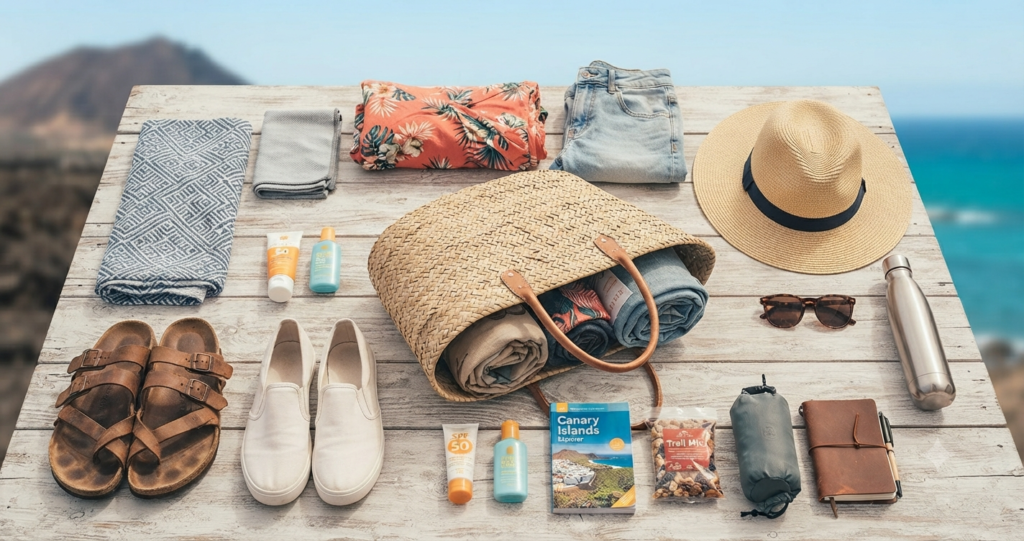
Standard beach resort packing applies to the resort areas: swimwear (two or three sets); beach cover-ups; sandals and flip-flops; sundresses and casual resort wear; and high-SPF sunscreen. The Canary Islands sun is stronger than mainland European destinations due to proximity to the equator and clear skies â sun protection is essential even in winter.
Canary Islands Packing List: Hiking and Outdoor Activities
For volcano hikes, Anaga mountains, or other outdoor activities: comfortable hiking shoes or trail runners; moisture-wicking active clothing; a warm layer for altitude (Teide summit is cold â often below 5°C even in summer â and requires a proper jacket); and a windproof layer for the trade wind exposure. Lanzarote’s volcanic walks are relatively flat but exposed and hot â sun protection and adequate water are critical.
Canary Islands Packing List: Evening Wear
The resort areas are casual â standard resort casual evening wear is appropriate. The capital cities (Las Palmas, Santa Cruz de Tenerife) have more sophisticated dining scenes that reward slightly smarter casual attire. A light evening layer (cardigan or wrap) is useful for evenings, which can be notably cooler than warm days, particularly in winter.
Canary Islands Packing List: Layering for Cooler Periods
Even in this “eternal spring” climate, winter evenings (DecemberâFebruary) can be surprisingly cool â 14â18°C in the evenings on many islands. A light jacket, a cardigan, and one pair of slightly warmer trousers or jeans are worth packing for winter visits, even if most days are warm enough for shorts.
Frequently Asked Questions
What is the best Canary Island to visit?
Each island has different appeal: Tenerife for variety and the dramatic Teide volcano; Lanzarote for unique volcanic landscapes and culture; Gran Canaria for diverse environments and Las Palmas city; Fuerteventura for beaches and water sports; La Palma and La Gomera for serious hiking and unspoiled nature. First-time visitors often choose Tenerife or Gran Canaria for their variety.
Do I need to dress modestly in the Canary Islands?
The Canary Islands are Spanish and secular â dress codes are minimal. Beach wear is appropriate at beaches and pool areas. For churches and cathedrals, covered shoulders and knees are standard Spanish courtesy. Resort casual applies to most other contexts.
Is it cold in the Canary Islands in winter?
Not by northern European standards â daytime temperatures are typically 18â22°C in January. However, evenings can be cool (14â17°C) and altitude areas (Teide, mountain interiors) can be genuinely cold. Pack light layers for evenings and a proper warm layer if you plan altitude activities.