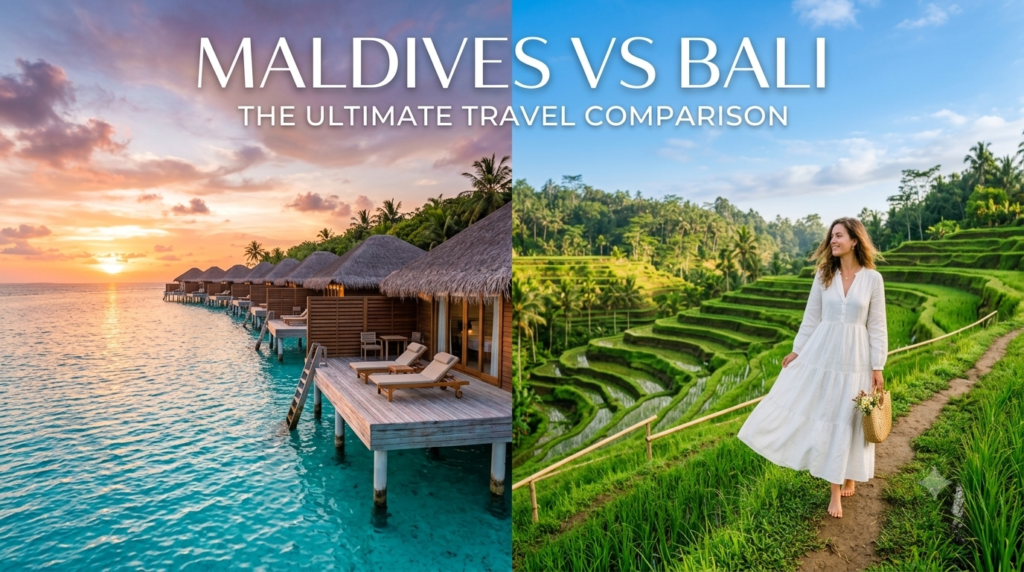
Two of the world’s most dreamed-about destinations. Both are paradise. Both have turquoise water, palm trees, and the kind of beauty that makes you question why you ever go anywhere else. But Maldives vs Bali are dramatically different experiences — different climates, different dress codes, different vibes, different price points, and very different wardrobes. This complete comparison guide covers everything you need to choose between them — and what to pack once you do.
The Essential Difference
In one sentence: the Maldives is pure escape; Bali is immersive adventure. The Maldives is overwater bungalows, coral reefs, and doing absolutely nothing beautifully. Bali is temples, rice terraces, spiritual encounters, world-class food, and never running out of things to explore. Both are extraordinary. Which is right for you depends entirely on what you’re seeking.
Maldives vs Bali: Climate & Best Time to Visit
Maldives
- Year-round tropical heat: 27–32°C (80–90°F)
- Best season: November–April (dry season, clear visibility for snorkelling and diving)
- Wet season: May–October (still beautiful but more rain and rougher seas)
- Water temperature: perfect year-round at 27–30°C
Bali
- Year-round tropical heat: 26–32°C (79–90°F)
- Best season: April–October (dry season, ideal for outdoor activities)
- Wet season: November–March (heavy afternoon rains, lush green scenery)
- Higher elevation areas (Ubud, Kintamani) are cooler: 20–26°C
Verdict: Their best seasons overlap in April only. For December–March travel, the Maldives is the clear winner. For May–October, Bali shines.
What to Wear in the Maldives vs Bali: Side by Side
Swimwear
Maldives: You’ll live in swimwear — on your resort island, everything from breakfast to sunset cocktails can happen in a beautiful bikini or swimsuit. Pack 3–4 high-quality pieces. The Maldives is where swimwear quality matters most: you’re in it from dawn to dusk.
Bali: Swimwear for the beaches (Seminyak, Kuta, Jimbaran, Nusa Dua) and hotel pools. However, because Bali involves so much time away from the beach — temples, markets, restaurants, rice terraces — swimwear is a smaller proportion of your Bali wardrobe than your Maldives wardrobe.
Temple & Cultural Dress
Maldives: If you stay on a resort island, there’s no temple dress code needed. If visiting local islands or Malé, cover shoulders and knees modestly (Islam is the state religion).
Bali: Temple visits are a central experience — and Bali has over 20,000 Hindu temples. A sarong and sash for temple visits is mandatory. You’ll use it constantly.
Winner for ease: Maldives (if staying on a private resort island). Winner for cultural depth: Bali.
Cover-Ups & Daywear
Maldives: Flowy kaftans, linen beach dresses, silk pareos — light, resort-elegant, and beach-adjacent. Everything revolves around the beach club aesthetic.
Bali: More diverse daywear needed — maxi dresses for temple visits, linen trousers for Ubud’s artistic cafés, boho dresses for shopping the markets, activewear for yoga and hiking. Bali demands a more versatile wardrobe.
Evening Wear
Maldives: Romantic and elegant — flowing maxi dresses for overwater dining, sandals, simple gold jewellery. The setting (stars reflecting on a lagoon, phosphorescent plankton glowing) does all the dramatic work.
Bali: More variety — from casual warungs to sleek rooftop bars in Seminyak. A dress and flat sandals covers most Bali evenings, with slightly dressier options for Potato Head Beach Club and similar upscale venues.
Footwear
Maldives: Flip flops and flat strappy sandals are all you need. The sandy pathways, wooden boardwalks, and resort grounds make heels unnecessary. Bring water shoes for reef walks.
Bali: Slightly more varied — comfortable walking sandals for temple steps and market exploring, flip flops for beaches, one pair of dressier sandals for evenings. Sturdy footwear for any volcano or waterfall hike.
Packing List Comparison
Maldives Packing List
- 3–4 swimsuits/bikinis (the foundation of your wardrobe)
- 3–4 resort cover-ups: kaftan, linen dress, silk pareo
- 2 elegant evening outfits
- Flat sandals + flip flops + water shoes
- Rash guard for snorkelling/diving
- 1 modest outfit for local island visits
- Wide-brim hat + SPF 50 reef-safe sunscreen
- Waterproof bag
Bali Packing List
- 2–3 swimsuits/bikinis
- 2–3 sarongs (temple wrap + beach towel + accessory)
- 3–4 maxi/midi dresses in natural fabrics
- 2–3 linen tops + trousers
- Lightweight evening outfit
- Comfortable walking sandals + beach flip flops
- Activewear if doing yoga or hiking
- Wide-brim hat + SPF 50 sunscreen
- Light rain poncho (wet season)
- Insect repellent
Style Aesthetic: Maldives vs Bali
Maldives Style
The Maldives wardrobe is luxury resort minimalism — a small number of beautiful, high-quality pieces. Think: a silk white kaftan, a stunning bikini, simple gold jewellery, a wide-brim hat. The setting is so extraordinary that understated elegance wins every time. Bold prints can work beautifully against turquoise water, but the Maldives rewards quality over quantity.
Bali Style
Bali has a much more eclectic fashion energy — bohemian, spiritual, tropical, and creative. Colourful batik prints, crochet tops, flowing maxi dresses, handmade jewellery, and artisan-crafted accessories from the Ubud market all feel right. Bali is also where you can buy extraordinary locally made clothing and accessories — budget for shopping.
Shopping: Where Is Better?
Bali wins decisively. Bali has world-class artisan markets, independent boutiques, and craft villages producing everything from hand-painted silk to handmade silver jewellery. The shopping in Ubud Market, Seminyak’s boutiques, and Kuta’s surf shops is extraordinary. Budget at least one shopping day and leave suitcase space.
The Maldives has very limited shopping — most resorts have a small boutique selling resort wear at high prices. Buy anything you need before arriving or in Male.
Price & Budget
This is perhaps the most significant practical difference:
- Maldives: One of the world’s most expensive destinations. Expect to pay €300–2,000+ per night for decent to luxury resort accommodation. Everything on the island is expensive (it’s all imported by boat or plane).
- Bali: Extraordinarily good value. You can stay in a beautiful private villa with a pool for €80–200/night, eat incredible food for €5–15 per meal, and have experiences (spa treatments, cooking classes, temple tours) that would cost ten times as much elsewhere.
Activities: What Will You Actually Do?
Maldives
- Snorkelling and diving in world-class coral reefs (manta rays, whale sharks, sea turtles)
- Overwater bungalow relaxation
- Sunset dolphin cruises
- Sandbank picnics
- Underwater dining experiences
- Water sports: kite surfing, paddleboarding, jet skiing
Bali
- Temple visits (Tanah Lot, Uluwatu, Besakih, Tirta Empul)
- Tegalalang Rice Terrace trekking
- Mount Batur volcano sunrise hike
- Traditional cooking classes
- Surfing (Kuta, Canggu, Uluwatu)
- World-class yoga and wellness retreats
- Waterfall hikes (Gitgit, Sekumpul)
- Seminyak beach clubs and nightlife
Book Maldives snorkelling, diving, and island experiences on GetYourGuide | Book Bali temples, treks, and cultural experiences on GetYourGuide
Which Is Better for Couples?
Maldives: The ultimate romantic escape. Overwater bungalows, private beaches, underwater restaurants, and complete seclusion make it one of the world’s top honeymoon destinations. If romance and privacy are the priority, the Maldives wins.
Bali: Also extremely romantic, but more active. Couples who enjoy exploring together — hiking, cultural experiences, cooking classes, discovering new restaurants — will love Bali. It’s also dramatically more affordable, meaning you can stay longer and do more.
Which Is Better for Solo Travellers?
Bali wins clearly for solo travel. The Maldives can feel isolating solo — you’re on a small island with mostly couples. Bali has an extraordinary solo travel community, excellent guesthouses, popular social hubs, and endless things to do independently. The warmth of Balinese culture makes solo travellers feel immediately welcome.
Verdict: Maldives or Bali?
Choose the Maldives if:
- You want a luxury honeymoon or romantic escape
- You can travel November–April
- Budget is not a constraint
- You want to completely switch off and relax
- World-class diving/snorkelling is a priority
Choose Bali if:
- You want cultural depth alongside natural beauty
- Budget matters (Bali is outstanding value)
- You’re travelling solo or with friends
- You want variety: beach + mountains + temples + food + nightlife
- Shopping and artisan experiences matter to you
- You want to travel for longer (your money goes much further)
The honest truth: If you can only go to one, and budget is a consideration — go to Bali first. You’ll have more diverse, memorable experiences per dollar than almost any destination on earth. Save the Maldives for a future special occasion when the simplicity and luxury of doing nothing, perfectly, is exactly what you need.
Book Your Trip
Whichever you choose, book accommodation early — both destinations’ best properties sell out months in advance.
✈️ Trip Essentials
Affiliate links — we may earn a small commission at no extra cost to you.
Compare overwater bungalows, beach villas and island resorts for the Maldives and Bali.
Discover top-rated tours and experiences worldwide. Instant booking, free cancellation on most activities.