
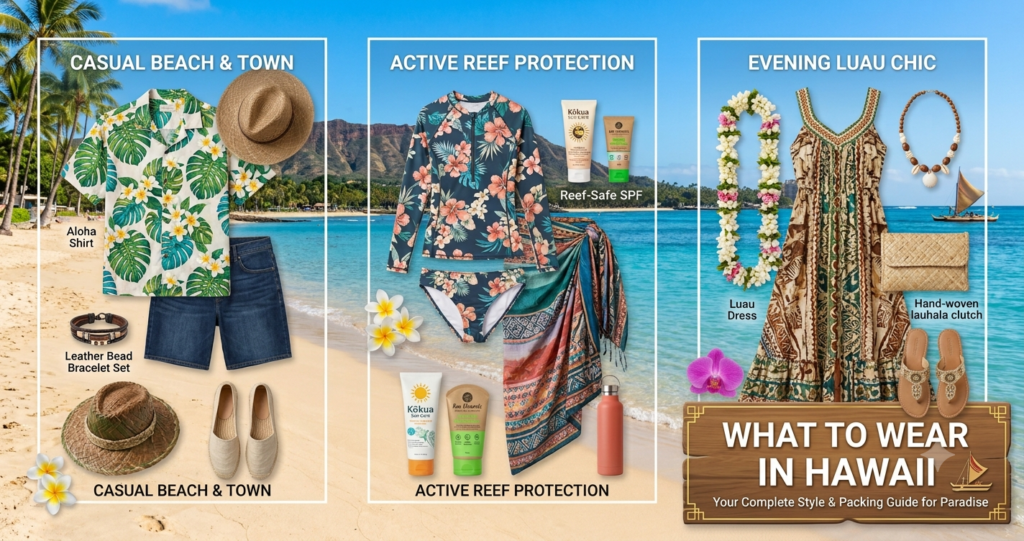
27°C — Average year-round Hawaii temperature at sea level — perfect for linen and cotton all day
Layers — Essential even in summer — trade winds, elevation changes, and AC all require a light layer
Trail shoes — The most underestimated item — Hawaii’s best experiences are hiking-based
Floral print — The culturally connected print choice — Aloha spirit is expressed through the island’s own textile tradition
Reef-safe — Sunscreen requirement for Hawaii’s protected marine environments — both legal and ethical
What to Wear in Hawaii Varies by Island and Activity
Hawaii is not one experience — it’s a collection of genuinely different island environments, each with distinct landscape, activities, and dress requirements. What works perfectly in Waikiki’s urban beach culture is insufficient for a Kauai Na Pali Coast hike. What’s appropriate for a Maui resort dinner is significantly more dressed-up than Big Island’s casual Kona restaurant culture. This guide gives you island-by-island and activity-by-activity specifics on what to wear in Hawaii.
Hawaii Climate by Island and Season
Hawaii has two seasons: summer (May–October), which is drier and warmer (26–32°C), and winter (November–April), which brings more rain, larger surf, and slightly cooler temperatures (22–27°C on most coasts). Each island has a wet side and a dry side — the windward (eastern) side receives significantly more rainfall than the leeward (western) side, which is where most resorts are located. High-altitude areas (Haleakalā on Maui, Mauna Kea on Big Island) are genuinely cold regardless of season.
Oahu: Urban Energy and Waikiki Beach Culture
Oahu is Hawaii’s most visited island — home to Waikiki beach, Pearl Harbor, Diamond Head, the North Shore surf culture, and Honolulu’s genuinely vibrant food and arts scene. Dressing on Oahu spans a wider range than any other Hawaiian island: beach casual for the Waikiki end of the spectrum, smart casual for Honolulu’s better restaurants, and practical outdoor wear for the Diamond Head crater hike and North Shore beach hopping.
Waikiki daytime: Swimsuit + printed cover-up or linen shirt, flat sandals, sun hat. Waikiki’s beach scene is fashion-conscious enough to reward quality swimwear over purely functional options.
Honolulu evening: Simple cotton or linen dress or a clean casual outfit for dinner in the Chinatown/Kakaako area, where the restaurant culture is genuinely good and slightly more considered than the Waikiki tourist strip.
Diamond Head hike: Moisture-wicking t-shirt, comfortable shorts, trainers with grip — the 1.6km trail is relatively short but steep in places, paved in parts, and best done in early morning before the heat peaks.
Hawaii Island Outfit Priorities
Maui: Luxury Resort Meets Dramatic Adventure
Maui combines some of Hawaii’s best luxury resort beach culture (Kaanapali, Wailea) with its most dramatic road trip (Road to Hana) and most extraordinary natural experience (Haleakalā sunrise). The wardrobe challenge is greater than any other island because the elevation and activity range requires genuinely different clothing categories within a single day.
Road to Hana: This is a full-day drive with stops at waterfalls, bamboo forests, and tide pools — wear shorts or linen trousers with a moisture-wicking top, a light waterproof jacket (the rainforest is genuinely wet), and closed-toe shoes for trail stops. You’ll be getting out of the car at numerous beautiful but sometimes muddy locations.
Haleakalā Summit: Pack a down jacket or warm fleece specifically for this. Summit temperatures at sunrise range from 0–13°C with wind chill. The experience is extraordinary — the volcanic crater landscape at dawn looks otherworldly — but only if you’re warm enough to enjoy it rather than shivering through it.
Kauai: The Hiking Island
Kauai is the most naturally spectacular of Hawaii’s main islands — the Na Pali Coast (accessible only by boat, helicopter, or the demanding Kalalau Trail), Waimea Canyon (the “Grand Canyon of the Pacific”), and the Napali wetlands are its signature experiences, all requiring genuinely practical outdoor clothing.
For Kauai hiking: moisture-wicking tops, quick-dry shorts or lightweight hiking trousers, traction trail shoes (not sandals — the Kalalau Trail particularly involves very challenging terrain), and a packable waterproof jacket. Kauai is the wettest of Hawaii’s main islands — rain showers arrive fast and are the norm rather than the exception in the island’s lush interior valleys.
Big Island: Five Climate Zones in One Island
The Big Island is uniquely Hawaii’s most climatically diverse — active lava flows on one side, snow on Mauna Kea on another, tropical rainforest, and desert coast. Visiting Hawaiʻi Volcanoes National Park requires layers (summit areas are genuinely cold), while the Kona coast is classic beach Hawaii. Pack for the full range if your Big Island itinerary covers multiple areas.
Universal Hawaii Packing Guide
| Item | Islands It Covers | Function |
|---|---|---|
| Floral linen dress (2) | All | Beach days and evening dining |
| Swimsuits (2–3) | All | Beach and pool every day |
| Trail shoes | All (essential Kauai / Big Island) | Any trail, volcanic park, mountain |
| Light waterproof jacket | Kauai / Maui Hana | Rainforest and waterfall stops |
| Warm layers | Maui (Haleakalā) / Big Island (Mauna Kea) | Summit visits (0–13°C) |
| UPF rash guard | All | Snorkelling and extended water time |
For full styling details, see our Hawaii outfits guide, our Maui outfits guide, and our Hawaii packing list.
Detailed Hawaii Packing List
Swimwear and Beach Essentials
Two or three swimsuit sets — you will swim almost every day. Mix of one-pieces and bikinis depending on your preference and planned activities (snorkelling and surfing are easier in one-pieces or rash guards). Two or three beach cover-ups or light sarongs. A rash guard for snorkelling and surfing — Hawaii’s coral reefs mean sun protection matters and a rash guard eliminates the sunscreen-and-coral problem. Water shoes for lava rock beaches where coral and sharp rock make bare feet impractical.
Daytime Clothing
Lightweight sundresses and maxi dresses that transition from beach to town without requiring a full outfit change. Casual shorts and tops for hiking and exploration. One pair of active leggings or quick-dry hiking shorts for more serious trails. A lightweight, packable rain jacket — even on dry islands, brief tropical showers are common and high-altitude hikes (Haleakalā crater, Kīlauea volcano) require rain protection regardless of lowland weather.
Evening Attire
Hawaii’s resort dining culture is relaxed — resort casual is the standard. A slightly dressier sundress or a simple wrap dress is appropriate for most dinner contexts, including upscale resort restaurants. Heeled sandals work for beach town dining. Very few Hawaii restaurants require anything beyond smart casual. The exception is a special occasion dinner — one slightly elevated dress is worth packing if you plan a special evening out.
Adventure and Hiking Gear
If your Hawaii itinerary includes hiking, volcanic park visits, or active water sports, add: comfortable hiking shoes or trail runners (not flip-flops — Hawaii’s trails can be muddy, steep, and rough); moisture-wicking active clothing; a lightweight fleece or warm layer for high-altitude sites (Haleakalā summit at sunrise is cold — often below 10°C); a dry bag for boat trips and water activities; and insect repellent for jungle trails.
Footwear
Flip-flops or sandals for beach and pool. Water shoes for rocky beaches. Comfortable walking sandals for town exploration. Hiking shoes or trail runners if your itinerary includes trails. One pair of slightly elevated sandals for dinner. You do not need formal footwear for Hawaii unless attending a specific event.
Sun Protection
High-SPF, reef-safe sunscreen — Hawaii has regulations requiring reef-safe formulas (no oxybenzone or octinoxate) to protect coral reef ecosystems. A UV-protective rash guard or long-sleeved swimsuit top eliminates sunscreen concerns in the water. A wide-brimmed sun hat for beach days. UV-protective sunglasses. Hawaii’s sun is intense year-round — sun protection is a genuine health need, not just a comfort preference.
Hawaii-Specific Extras Worth Packing
Insect repellent earns its space too — mosquitoes show up in rainforest and waterfall areas, especially on Kauai’s trails and Road to Hana stops on Maui. A reusable water bottle is worth bringing since Hawaii’s tap water is excellent and refill stations are common at parks and trailheads, and a dry bag protects your phone and valuables on any boat or snorkeling excursion.
What NOT to Pack for Hawaii
Formal attire — Hawaii’s dress culture is genuinely relaxed and you will not need it. Jeans (heavy, hot, and slow to dry — lightweight alternatives are more practical). Excessive clothing — Hawaii’s warm climate means you will wear lighter, simpler pieces repeatedly. Heavy hiking boots unless you specifically plan technical mountain hikes — trail runners handle most Hawaii trails adequately.
Frequently Asked Questions
What is the Hawaii dress code for restaurants?
Most Hawaiian restaurants operate on casual or smart casual — the Aloha State’s culture is genuinely relaxed about dining dress. High-end restaurants in Wailea (Maui) and Waikiki may request smart casual. Some very upscale resort restaurants ask for collared shirts for men. Flip flops are generally acceptable everywhere in Hawaii.
Do I need to remove shoes at any places in Hawaii?
In traditional Hawaiian culture, removing shoes before entering a home is customary and appreciated. Some cultural sites and heiau (temples) may request removing footwear. Most tourist venues don’t require it, but following the lead of locals at any private or cultural setting is the respectful approach.
What should I wear to Hawaiʻi Volcanoes National Park?
Layers are essential — the Kilauea summit area sits at 1,200 metres elevation where temperatures are significantly cooler than the coast. Long trousers, closed shoes (hot volcanic surfaces and rough lava rock terrain), a light windproof jacket, and sun protection for the open crater views. Avoid synthetic fabrics near active lava areas.
Can I wear a muumuu or traditional Hawaiian dress in Hawaii?
Absolutely — the muumuu is a genuinely Hawaiian garment with deep cultural roots on the islands, not a tourist novelty. Wearing a traditional Hawaiian floral muumuu or aloha dress in Hawaii is a respectful engagement with island culture and entirely appropriate for most social and restaurant settings.
Is Hawaii appropriate for wearing a bikini outside of the beach?
Unlike some Asian destinations, Hawaii has no public dress code requirements. That said, local culture treats bikini wearing similarly to most Western beach towns — appropriate at the beach and pool, with a cover-up expected for restaurants, shops, and public areas away from the water. The practical approach is the same as any beach holiday in the US or Europe.
What should I wear in Hawaii?
Lightweight, breathable clothing — sundresses, shorts, casual tops, and swimwear cover virtually all Hawaii daytime contexts. Evenings rarely require more than a slightly nicer sundress or wrap dress. Comfort and sun protection are the primary considerations.
Do I need to dress modestly in Hawaii?
Hawaii has no specific religious or cultural modesty requirements for visitors. Normal resort casual dress standards apply — swimwear is appropriate at beaches and pools, covered clothing for shops and restaurants. Hawaii’s overall vibe is extremely relaxed about dress.
What is the best island for first-time visitors?
Maui is often recommended for first-time visitors — it combines beautiful beaches, the dramatic Hana Highway, Haleakalā volcano, whale watching (in winter), and excellent resort infrastructure. Oahu offers more urban amenities and historical sites like Pearl Harbor. Each island has a distinct character.
Pack for the Island, Not Just the Weather
Hawaii’s extraordinary diversity — from the world’s most active volcanoes to its most beautiful beaches — is what makes it one of the world’s greatest travel destinations. A wardrobe that addresses both the tropical beach reality and the genuine outdoor adventure opportunities across each island makes the full range of Hawaii’s experiences available to you, rather than limiting your trip to the activities your clothes happen to be right for.
✈️ Trip Essentials
Affiliate links — we may earn a small commission at no extra cost to you.
Beachfront hotels and resorts across Maui, Oahu, Kauai and the Big Island.
Skip the tourist traps — book top-rated tours, day trips and experiences in Hawaii with instant confirmation.