
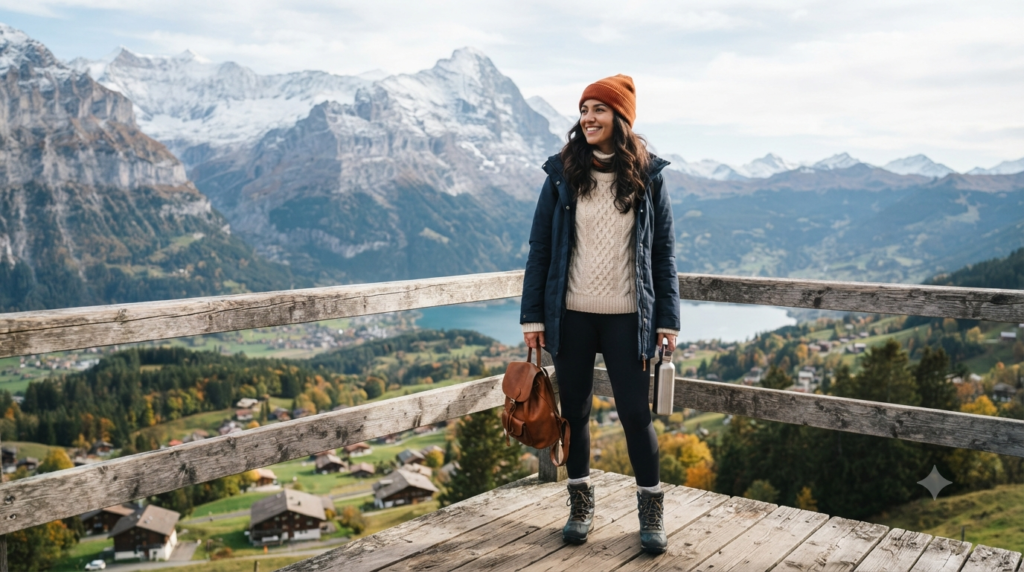
Switzerland is a year-round destination of extraordinary beauty — the snow-capped Alps in winter, wildflower meadows in summer, pristine lake towns like Lucerne and Interlaken, and cosmopolitan cities like Zurich and Geneva. Knowing what to wear in Switzerland ensures you’re prepared for dramatic altitude changes, variable mountain weather, and one of Europe’s most stylish urban cultures.
Switzerland’s Climate: What to Expect
Switzerland’s climate varies dramatically with altitude. Lowland cities like Zurich and Geneva have mild summers of 25–30°C (77–86°F) and cool, sometimes snowy winters of 0–5°C (32–41°F). Alpine regions like Zermatt, Verbier, and Grindelwald can see temperatures drop to -15°C (5°F) in winter, with year-round snow above 3,000 metres. Spring and autumn are transitional — beautiful but variable. Mountain weather changes rapidly; conditions at altitude can deteriorate significantly within hours regardless of lowland forecasts.
What to Wear in Switzerland: The Core Wardrobe
Quality Layering System
Switzerland’s altitude variations make layering absolutely essential. You might start the day in a warm Zurich café and end it at a cold, wind-swept mountain viewpoint. A three-layer system — moisture-wicking base, insulating mid-layer, and waterproof outer shell — handles all scenarios. Pack pieces that work together so you can add or remove layers efficiently throughout the day.
Waterproof Jacket
A quality waterproof and windproof jacket is essential year-round for Switzerland. In summer, a lighter hardshell works for mountain excursions. In winter or for skiing, a fully insulated, waterproof ski jacket is required. Even in city settings, a stylish waterproof trench or anorak handles Switzerland’s frequent alpine showers.
Smart Casual for Swiss Cities
Switzerland has one of the most well-dressed urban cultures in Europe. Zurich and Geneva residents dress smartly — quality clothing, excellent footwear, and understated elegance are the norm. Casual wear is acceptable at most tourist attractions, but scruffy or overly informal outfits can feel out of place in upscale restaurants, lakeside hotels, and city centres. Smart casual — clean jeans, blazers, quality knitwear, and leather footwear — works excellently.
Hiking and Outdoor Technical Gear
Switzerland has over 65,000 km of marked hiking trails. For any alpine hiking — Jungfraujoch, Matterhorn base trails, or the Via Alpina — technical gear is required. Waterproof hiking boots with ankle support, technical hiking trousers, moisture-wicking base layers, and a waterproof jacket are the minimum. Never attempt alpine trails in fashion trainers or sandals.
Ski and Snow Gear (Winter)
Switzerland’s ski resorts — Zermatt, St. Moritz, Verbier, Davos — are world-class and attract a well-dressed international crowd. Proper ski gear includes waterproof ski trousers, an insulated ski jacket, thermal base layers, ski socks, gloves, helmet, and goggles. Après-ski in Swiss resorts has its own fashion culture: fitted ski trousers, cosy knitwear, and good après-ski boots transition smoothly from slopes to mountain restaurants.
Comfortable Footwear
Swiss terrain demands excellent footwear. Waterproof hiking boots for mountain activities, clean leather or suede ankle boots for cities, and quality trainers for general sightseeing cover most needs. Swiss cities are walkable but hilly — comfort and grip matter. Avoid impractical fashion footwear for any outdoor activity.
What to Wear in Switzerland by Season
Spring (March–May)
Spring in Switzerland is beautiful but variable. Alpine snow lingers well into May while lowland valleys bloom with flowers. Pack layers: long-sleeve tops, a fleece or light down jacket, and a waterproof outer layer. Waterproof boots handle both city puddles and muddy mountain trails. Temperatures range from 8–18°C (46–64°F) at lower altitudes, with much colder conditions on mountains.
Summer (June–August)
Switzerland’s most popular hiking season. Lowland temperatures reach 25–32°C (77–90°F), while mountain passes and high-altitude viewpoints remain significantly cooler. Pack T-shirts and light layers for the valleys, but always bring a fleece and waterproof jacket for mountain excursions — temperatures drop approximately 6.5°C for every 1,000 metres of altitude gain. Sunscreen and sunglasses are essential at altitude where UV intensity increases.
Autumn (September–November)
Crisp, golden, and stunning for photography. Temperatures of 8–18°C (46–64°F) in September transition to near-freezing by November in many regions. Layer thoughtfully: thermal base layers, a chunky knit sweater, and a waterproof outer layer. First snows arrive in the Alps from October. Hiking in September and early October is exceptional.
Winter (December–February)
Switzerland’s ski season peaks December through March. Alpine resorts see heavy snow and temperatures of -5 to -15°C (23 to 5°F). Cities are cold (0–5°C / 32–41°F) with frequent snow. Pack thermal base layers, insulated ski jacket and trousers (for ski trips), a heavy overcoat (for city stays), warm boots, hat, scarf, and gloves. Après-ski outfits blend practicality with Swiss resort style elegantly.
What to Wear for Key Switzerland Activities
Jungfraujoch — Top of Europe
The Jungfraujoch at 3,454 metres is cold year-round — temperatures average -2°C (28°F) in summer and -25°C (-13°F) in winter. Even in July, pack a down jacket, warm hat, gloves, and sunscreen. The altitude intensifies UV exposure significantly. Snow boots or hiking boots with good grip handle the icy outdoor terraces safely.
Lake Lucerne and City Sightseeing
Lucerne’s Old Town, covered bridges, and lakefront are best explored in smart casual comfort. Quality jeans or chinos, a clean knitwear layer, and leather ankle boots work beautifully for city days. A packable jacket handles the lake breezes. For evening dining in Lucerne’s excellent restaurants, slightly smarter attire is appreciated.
Skiing in Zermatt or Verbier
Swiss ski resorts have a distinctive style culture. On the slopes: technical ski gear, quality helmet and goggles, waterproof gloves, and thermal layers. Après-ski in Zermatt: fitted ski pants can remain, adding a cosy oversized knitwear layer and furlined après-ski boots. For resort restaurants and evening dining, smart-casual with a stylish winter coat works well.
Geneva and Zurich City Stays
Geneva hosts international organisations and luxury watchmakers; Zurich is one of Europe’s most prosperous cities. Both reward dressing well. Quality basics — tailored jeans, well-cut blazers, leather shoes, and minimal jewellery — suit both cities. Evening dining in Geneva’s lakefront restaurants or Zurich’s sophisticated Langstrasse neighbourhood merits dressing up slightly.
What NOT to Wear in Switzerland
Never attempt alpine trails or mountain excursions without proper footwear — this is genuinely dangerous on Switzerland’s steep, often wet terrain. Avoid wearing fashion trainers or flat shoes in the mountains. Don’t underpack layers — altitude changes rapidly and dramatically in Switzerland. Avoid overly casual or scruffy attire in upscale city restaurants and hotels. Skip heavy, formal clothing for outdoor mountain adventures.
Switzerland Packing List
- Waterproof hardshell or insulated jacket
- Merino wool or thermal base layers
- Fleece or light down mid-layer
- Quality knitwear for cities
- Waterproof hiking boots with ankle support
- Clean leather or suede ankle boots (cities)
- Warm socks (wool recommended)
- Hat, scarf, and gloves (year-round for mountains; essential in winter)
- Waterproof trousers or hiking trousers
- Smart casual outfits for city evenings
- Sunscreen (high SPF for altitude)
- UV-protective sunglasses
- Ski jacket, trousers, and thermal layers (winter/ski trips)
Final Style Notes for Switzerland
Switzerland sits at the intersection of outdoor adventure and refined European elegance. Dressing for Switzerland means honouring both — technical performance gear for the mountains, thoughtful smart-casual for the cities. The Swiss have high aesthetic standards and genuine expertise in outdoor clothing; the country that invented Gore-Tex partnerships and hosts global watch brands understands the marriage of function and style. Pack quality over quantity, layer intelligently, and let Switzerland’s extraordinary Alpine grandeur set the backdrop for your most carefully considered wardrobe yet.
Planning a multi-city European trip? Don’t miss our complete guide on what to wear in Vienna — a perfect pairing with this destination for a classic Central European city break.
The Essential Switzerland Packing List
Outerwear — The Layering Foundation
- Waterproof hardshell jacket — A quality waterproof and windproof outer layer is essential year-round in Switzerland. Look for taped seams, underarm venting, and a helmet-compatible hood for mountain use. Brands: Arc’teryx, Mammut, Patagonia.
- Insulated ski jacket (winter/ski trips) — Waterproof, insulated, and resort-ready for Zermatt, Verbier, or St. Moritz. Look for 20,000mm waterproof rating and 600+ fill down insulation.
- Down or synthetic puffer jacket — Packable insulating mid-layer that adds warmth without bulk. Essential for mountain visits year-round.
- Fleece mid-layer — 200-weight for summer mountain use; 300-weight for autumn and winter. The core warmth layer in the Swiss layering system.
- Stylish wool coat or trench (optional) — For Zurich and Geneva city days when a hiking jacket feels out of place.
Base Layers
- Merino wool long-sleeve base layers (x3) — Temperature regulating, odour-resistant, and comfortable enough to wear multiple days. Swiss mountain conditions demand merino over cotton.
- Thermal base layer set (winter) — Heavyweight merino or synthetic thermal top and bottoms for ski days and cold mountain visits.
- Moisture-wicking athletic base layers — For summer hiking where breathability is the priority over warmth.
Tops
- T-shirts (x3–4) — For summer city days and indoor layering year-round.
- Quality knitwear / sweater (x1–2) — Smart casual for Zurich and Geneva evenings. A fine wool or cashmere sweater suits Swiss city aesthetics well.
- Smart blouse or shirt (x1) — For upscale restaurant evenings in Lucerne, Zurich, or lakeside resort dining.
Bottoms
- Technical hiking trousers (x2) — Quick-dry, stretch fabric with water-resistant finish. Essential for all Swiss mountain trails. Never cotton for hiking in Switzerland.
- Waterproof over-trousers — Packable and critical for heavy rain days on mountain trails. Also used for skiing.
- Ski trousers (winter) — Waterproof, insulated, and fit for resort use. Many people hire these locally if space is limited.
- Smart dark jeans or chinos (x1–2) — For city stays and restaurant evenings. Swiss cities have a smart-casual standard.
- Thermal leggings — Excellent base layer under hiking trousers in cold conditions.
Footwear
- Waterproof mid-height hiking boots — GORE-TEX lined with Vibram sole. Non-negotiable for any Swiss alpine hiking including Jungfraujoch surroundings, Matterhorn base trails, and Via Ferrata routes. Break in thoroughly before travel.
- Ski boots (hire locally) — For ski trips, hire quality boots at your resort’s rental shop. Carrying your own boots is an option if you have high-performance preferences.
- Smart leather or suede ankle boots — For Zurich, Geneva, and Lucerne city days. Quality matters in Switzerland’s well-dressed urban culture.
- Light clean trainers — For casual city days and transit.
- Après-ski boots (winter) — Warm, waterproof, and stylish for resort village walks between slopes and restaurants.
Socks
- Merino wool hiking socks (x4–5 pairs) — Cushioned, blister-resistant, and warm even when damp. The most important sock investment for Switzerland.
- Ski socks (winter) (x3 pairs) — Knee-high, padded ski socks specifically designed for ski boots.
- Regular socks (x3–4 pairs) — For city days and light activities.
Accessories
- Warm wool or fleece hat — Year-round for mountain excursions; essential from October through April. Many Swiss summits require a hat even in July.
- Neck gaiter or balaclava — For mountain ridge exposure, skiing, and winter city days.
- Lightweight hiking gloves — For summer mountain trips where temperatures at altitude can drop unexpectedly.
- Insulated waterproof gloves (winter) — For skiing and Northern winter walks.
- Trekking poles — Collapsible poles are enormously helpful on Switzerland’s steep descents (Trolltunga-style steep trails but with more rock).
- UV-protective sunglasses — UV intensity at altitude is significantly higher than at sea level. Polarised glacier glasses for high-altitude snow environments.
- Sunscreen SPF 50+ — For mountain and glacier visits where UV is intense regardless of temperature.
Bags and Carry
- Main luggage — Rolling case is fine for city-focused trips. A 60–70L rucksack is better for mixed hiking/city itineraries using trains and cable cars.
- Day hiking backpack (25–35L) — With rain cover. Must carry your full layering kit, water, snacks, and emergency supplies for mountain hikes.
- Dry bag — Waterproof bag for phone, camera, and electronics on rainy or snowy mountain days.
- Hydration bladder or insulated bottle — Swiss mountain springs and streams offer some of the world’s purest drinking water. A filter bottle or hydration bladder is environmentally responsible and saves plastic.
Documents and Money
- Passport or EU ID card
- Schengen visa (if required) — Switzerland is Schengen area. Most Western visitors do not need a visa; check your country’s requirements.
- Swiss Franc (CHF) cash — Switzerland is expensive. Cards are accepted widely, but some mountain huts, cable cars, and smaller restaurants prefer cash. Withdraw CHF on arrival; airport rates are poor.
- Credit cards — Visa and Mastercard are the most widely accepted. Some places don’t accept Amex.
- Travel insurance with mountain rescue coverage — Swiss mountain rescue (Rega) is excellent but very expensive without insurance. Ensure your policy includes helicopter rescue.
- Swiss Half Fare Card or Travel Pass — Consider purchasing if doing extensive train, bus, and cable car travel. Available at Swiss stations on arrival.
Electronics
- Travel adapter — Switzerland uses Type J plugs (three-pronged Swiss standard). A universal adapter works but dedicated Type J adapters are better.
- Portable power bank — Cold temperatures reduce phone battery life at altitude.
- Camera with weather sealing — Switzerland’s scenery justifies bringing your best camera. Weather-sealed bodies handle mountain mist and rain.
- Offline Switzerland maps downloaded — Swisstopo app for hiking maps (the gold standard for Swiss trail navigation).
Safety and Mountain Essentials
- Emergency whistle
- Headtorch with fresh batteries — For pre-dawn hike starts and cable car waiting times in tunnels.
- First aid kit — Blister treatment, pain relief, antiseptic, personal medications.
- Mountain weather app installed — MeteoSwiss app is the official Swiss meteorological service and the most accurate for mountain weather forecasting.
Switzerland Packing List by Season
Summer (June–August) — Hiking Season
Merino base layers, T-shirts, hiking trousers, fleece, waterproof jacket, hiking boots, wool socks, sun hat, sunscreen, sunglasses, and trekking poles. Smart casual for city evenings. Light layers for altitude changes.
Autumn (September–November)
Add thermal base layers, heavier fleece or down jacket, neck gaiter, and insulated gloves to the summer kit. First snows arrive from October at higher altitudes. Waterproof over-trousers become important.
Winter (December–March) — Ski Season
Full ski kit (jacket, trousers, thermals, gloves, goggles, helmet), après-ski boots, insulated walking jacket for resort villages, wool knitwear for evenings. Smart casual for Zurich and Geneva city stays.
What to Leave at Home
Never hike Swiss alpine trails in fashion trainers, sandals, or smooth-soled shoes. Don’t bring cotton base layers for hiking — hypothermia risk in wet conditions. Skip overly casual clothing for Zurich and Geneva restaurant evenings (smart casual is the Swiss standard). Don’t underestimate how cold mountain summits are in summer — the Jungfraujoch is cold year-round.