
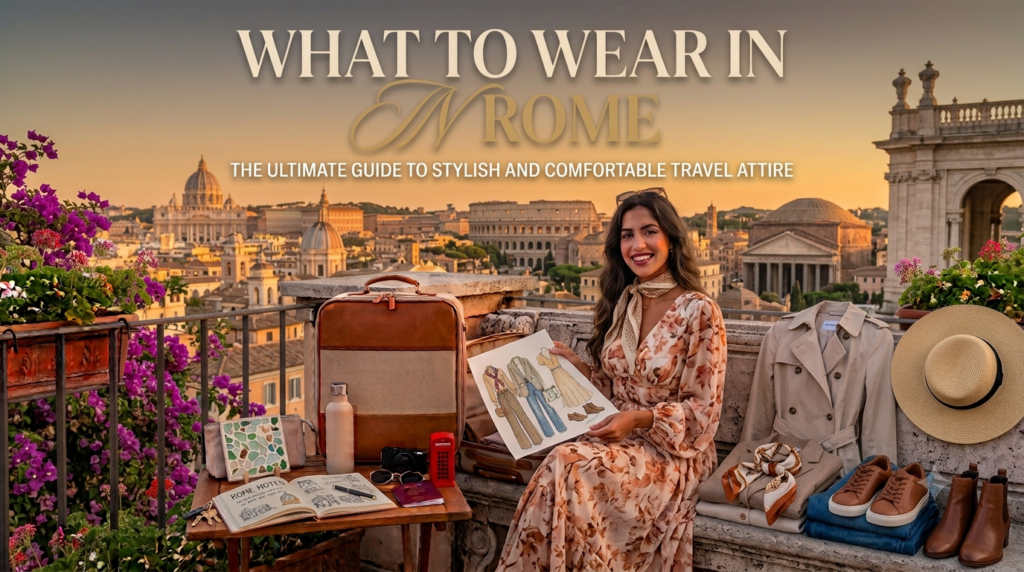
Planning a trip to Rome and wondering what to wear in Rome? The Eternal City demands a careful balance between style and practicality — elegant enough for its world-class restaurants, comfortable enough for hours of cobblestone walking, and modest enough for its sacred churches and the Vatican.
Rome is a fashion-conscious city, so looking put-together matters. The good news? Roman style is effortlessly chic — think flowy sundresses, linen trousers, and quality leather sandals rather than athletic wear or beachwear.
Rome Dress Code Essentials: What You Must Know
Before packing for Rome, there are two critical dress code rules every traveler must know:
- Vatican & Churches: Shoulders and knees must be covered. Sleeveless tops and shorts or short skirts are not allowed inside the Vatican, Pantheon (after it became a church), and most other Roman churches. Carry a scarf to drape over your shoulders.
- Fountains & Monuments: Rome has strict rules against sitting or swimming in fountains like the Trevi. Stay dressed and camera-ready.
What to Wear Sightseeing in Rome
Rome’s cobblestone streets are beautiful but tough on feet. Your sightseeing outfit should combine style with walkability:
Summer (June–August): A flowy midi dress or wide-leg linen trousers with a tucked-in blouse. Choose breathable fabrics like linen and cotton. Pair with leather sandals (not flip-flops — Romans consider them too casual for city streets). Always carry a lightweight cardigan or large scarf for church visits.
Spring & Fall (March–May, September–November): Layering is key. A midi skirt with a fitted top and a light jacket works perfectly. Or try tailored ankle trousers with a blouse and a denim jacket. Ankle boots or comfortable sneakers (white leather sneakers are very Roman) are ideal.
Winter (December–February): Rome winters are mild but damp. A wool coat over a sweater and tailored trousers is the Roman standard. Add a scarf and boots — you’ll be well-dressed for both the Colosseum and a cozy trattoria.
What to Wear to the Vatican
The Vatican has the strictest dress code of any Rome attraction. Guards will turn you away if you’re not appropriately covered — and there are no exceptions, even in summer heat.
- Shoulders must be covered (bring a scarf or cardigan)
- Knees must be covered (midi skirts, trousers, or capri length minimum)
- No sleeveless tops, shorts, or mini-skirts
- Hats should be removed inside the churches
Best Vatican outfit: A knee-length wrap dress with a light cardigan, or wide-leg linen trousers with a short-sleeve blouse. Pack a light scarf in your bag — it doubles as a church cover-up and a stylish accessory for the rest of the day.
What to Wear for Dinner in Rome
Romans take dinner seriously. While there’s no strict dress code at most restaurants, looking polished is expected — especially in the Trastevere or Prati neighborhoods.
Smart casual to elegant: A floral midi dress with block heels, or tailored trousers with a silk blouse. Men: a collared shirt with chinos. Avoid sportswear, athletic shoes, or overly casual beach looks for evening dining.
Rome Outfit Ideas by Season
Summer Rome Outfits (June–August)
- Flowy linen midi dress + leather sandals + wide-brim hat + crossbody bag
- Linen wide-leg trousers + tucked-in white blouse + espadrilles
- Cotton wrap skirt + lightweight blouse + block-heeled sandals
Spring/Fall Rome Outfits
- Midi skirt + fitted turtleneck + ankle boots + tailored blazer
- Dark jeans + silk blouse + white leather sneakers + trench coat
- Wrap dress + denim jacket + low block-heel ankle boots
Winter Rome Outfits
- Tailored wool trousers + cashmere sweater + long wool coat + ankle boots
- Knit midi dress + opaque tights + leather boots + structured coat
- Dark-wash jeans + fitted turtleneck + leather jacket + scarf
What to Pack for Rome: Essentials
- Comfortable walking shoes — cobblestones are brutal; choose leather sandals or cushioned sneakers
- Lightweight scarf — for church visits and cooling breeze on summer evenings
- Crossbody bag — secure and stylish for navigating crowded areas
- Sunglasses — Rome gets intensely sunny in summer
- Packable rain jacket — for unpredictable spring and fall showers
Book Your Rome Experience
Rome rewards those who go beyond the surface. Book a skip-the-line Vatican tour or a guided Colosseum experience so you spend less time waiting and more time exploring (and outfit photo ops).
👉 Browse top-rated Rome tours on GetYourGuide — from Vatican access to twilight Colosseum visits.
👉 Explore Rome experiences on Viator — food tours, hidden gems, and private guides.
Frequently Asked Questions
What should tourists NOT wear in Rome?
Avoid athletic wear, flip-flops, and anything that looks like beachwear in the city. At churches and the Vatican, avoid sleeveless tops, shorts, and mini-skirts — you’ll be denied entry.
Can I wear shorts in Rome?
Yes, for general sightseeing in summer. However, shorts are not permitted inside the Vatican or churches. Carry a light wrap or long skirt to change into when visiting religious sites.
Is Rome dressy or casual?
Rome leans smart-casual. Italians are famously stylish and tend to be more polished than tourists. You won’t need formal attire, but avoid pure casual (gym clothes, plastic flip-flops) especially in the evenings and upscale neighborhoods.
What shoes are best for walking in Rome?
Leather sandals with ankle straps, cushioned walking sneakers (white leather is very Italian), or block-heeled mules. Avoid stilettos (dangerous on cobblestones) and pure flip-flops (too casual and impractical).
📌 Related: Many travellers combine Rome with Paris on European trips. Our Paris outfit guide will help you nail Parisian chic before you cross the border.
Planning a multi-city European trip? Don’t miss our complete guide on what to wear in Vienna — a perfect pairing with this destination for a classic Central European city break.
Rome Packing List
Rome is the Eternal City — a living, breathing 3,000-year-old metropolis where you stumble across the Pantheon while looking for a café, where ancient Roman columns are built into Renaissance church walls, and where some of the world’s most important art hangs in the Vatican Museums. Packing for Rome requires negotiating the heat (Rome summers are genuinely intense), the relentless cobblestones of the historic centre, strict church and Vatican dress codes, and a sophisticated Italian style culture that rewards looking put-together without being overdressed. Here’s your complete Rome packing list for women.
Rome Weather: What to Pack by Season
Rome has a Mediterranean climate with hot, dry summers and mild, wetter winters. Summer (June–August) is very hot — regularly 32–38°C in July and August, with intense sun and minimal shade in outdoor sightseeing areas like the Colosseum and Forum Romanum. August sees many Romans leave the city; some local restaurants close but tourist sites remain open. Spring (March–May) is Rome at its most comfortable — 16–24°C, the city’s gardens blooming, and fewer crowds than summer. Autumn (September–October) is also excellent — the summer heat subsides, golden light, and harvest season food and wine. Winter (November–February) is mild by northern European standards (7–14°C) but can be rainy; a waterproof jacket and light wool layers are sufficient. Snow in Rome is extremely rare — it has happened but is not a planning consideration.
Rome Packing List: Clothing
Vatican & Church Dress Code Essentials
The Vatican — St Peter’s Basilica, St Peter’s Square, and the Vatican Museums including the Sistine Chapel — enforces a strict dress code: covered shoulders (not just straps, but fully covered) and knees covered (shorts and miniskirts are not permitted). This is checked by guards at the entrance to St Peter’s Basilica and the Vatican Museums; those who don’t meet the code are denied entry. Rome’s other major basilicas — Santa Maria Maggiore, San Giovanni in Laterano, San Paolo Fuori le Mura — similarly require modesty. Given that Rome’s most important sights are almost all churches, dressing for church coverage from the morning is the practical approach.
- Lightweight linen or cotton trousers covering the knees — the most comfortable church-appropriate bottom in Rome’s heat
- A lightweight cardigan, long-sleeved linen shirt, or kimono for covering shoulders
- A large scarf or pashmina (can wrap around shorts to create a skirt when needed, cover shoulders at churches, and double as a sun shade)
- Midi dresses and skirts that fall below the knee — the most elegant and church-appropriate option
Italian Casual & City Wear
Rome’s dress culture is Italian — which means looking polished rather than tourist-casual. Romans dress with care; shorts and a logo t-shirt identify you as a tourist faster than anything else. Elevated casual — a good linen dress, tailored shorts with a silk blouse, or quality jeans with a smart top — fits Rome’s culture perfectly and simultaneously meets most church requirements.
- 3–4 versatile linen or cotton tops in neutral colours
- 1–2 pairs of well-fitted jeans or tailored trousers
- 2–3 lightweight midi dresses (ideal for Rome — comfortable in the heat, church-appropriate, elegant for evening)
- A linen blazer or structured jacket for evenings (Rome cools pleasantly after 8pm and the blazer elevates any outfit for dinner)
Evening Wear
- 1–2 dressier outfits for Rome’s excellent restaurants (smart casual is appropriate; a silk dress or tailored trousers with a quality top works beautifully)
- Dressier flat sandals for Trastevere evening aperitivo and dinner
Shoes
Rome’s ancient streets — Sampietrini basalt cobblestones throughout the historic centre — are beautiful and punishing for any footwear with a heel. The Colosseum and Roman Forum involve significant walking on rough ancient stone. The Vatican involves extensive indoor marble floors after the outdoor approach. Flat, comfortable, well-made shoes are genuinely non-negotiable.
- Comfortable leather sandals or quality flat sandals — the essential Rome shoe; Italian leather sandals are worth buying here if your current pair isn’t up to the task
- Supportive walking trainers or leather sneakers for the Colosseum, Forum, and Palatine Hill
- Dressier flat sandals or ballet flats for evenings in Trastevere and Campo de’ Fiori
- Avoid heels entirely — Sampietrini cobblestones eat heels and cause ankle injuries; even experienced Italian heel-wearers avoid Rome’s ancient streets
Rome Packing List: Essentials
Heat & Sun Protection
- SPF 50 sunscreen (the Colosseum, Roman Forum, Palatine Hill, and the Vatican approach are all in full sun; summer visitors without sunscreen suffer badly)
- A wide-brim sun hat for outdoor archaeological sites
- Reusable water bottle (Rome has over 2,500 nasoni — the iconic small cast-iron drinking fountains that provide cold, free, delicious municipal water throughout the city; never buy plastic water bottles in Rome)
- Sunglasses with UV protection
Museum & Sightseeing Essentials
- Pre-booked Vatican Museums and Sistine Chapel tickets (peak season queues for walk-up tickets are 3–5 hours; skip-the-line tickets are essential and sell out days in advance during July and August)
- Pre-booked Colosseum + Roman Forum + Palatine Hill combined ticket (also sells out in peak season)
- A light day backpack for water, sunscreen, layers, and the inevitable guidebook
- Portable phone charger for long days of navigating, photographing, and audio guide use
Documents & Money
- Passport or EU national ID card (Italy is in the Schengen Area)
- Euro cash (Rome is more cash-oriented than northern Italy; smaller trattorias, pizza al taglio shops, and gelaterie sometimes prefer or require cash; €5–20 notes are far more useful than €50 notes)
- EHIC/GHIC card for EU/UK citizens
- Travel insurance with theft and medical coverage (tourist area pickpocketing is a genuine issue in Rome)
What to Pack for Rome’s Top Experiences
The Vatican: St Peter’s & Sistine Chapel
The Vatican is the single most-visited site in Rome — the world’s smallest sovereign state containing the largest church ever built (St Peter’s Basilica), the most important collection of Renaissance art in existence (the Vatican Museums), and Michelangelo’s Sistine Chapel ceiling (1508–1512), a work of such beauty and scale that it reduces first-time visitors to silence. The logistics: book Vatican Museums timed entry online at museivaticani.va weeks in advance; the walk to the Sistine Chapel from the entrance covers nearly a mile of galleries. Comfortable shoes are critical. Photography without flash is permitted in the Sistine Chapel — tripods are not. Dress code is enforced; shoulders and knees covered. The climb to the top of St Peter’s dome (551 steps to the top lantern, or take the lift to the drum and walk the rest) offers the finest view over Rome.
The Colosseum & Roman Forum
The Colosseum — the Flavian Amphitheatre, completed in 80 AD, with a capacity of 50,000–80,000 spectators — is Rome’s most iconic monument and the world’s most visited ancient structure. The combined Colosseum + Roman Forum + Palatine Hill ticket must be pre-booked online; same-day tickets are often unavailable in peak season. The Forum and Palatine Hill involve extensive walking on ancient stone and rubble — supportive shoes are essential. Visit early morning (the complex opens at 9am) or in the late afternoon (4–6pm) to avoid the worst midday heat and crowds. The area is entirely exposed to sun; hat, sunscreen, and water are non-negotiable in summer.
Trastevere: Aperitivo & Evening Rome
Trastevere — the neighbourhood of medieval alleyways, ivy-covered walls, and vibrant piazzas on the west bank of the Tiber — is Rome’s most atmospheric evening destination. The golden-mosaiced Basilica di Santa Maria in Trastevere is among Rome’s most beautiful churches (no queue, no ticket, and full of local Trastevere residents). The neighbourhood’s bars and trattorias fill from 7pm for aperitivo (Campari Spritz, Aperol, Negroni) and dinner. Cobblestones throughout — flat sandals are the right call. Smart casual dressing fits perfectly with Trastevere’s mix of sophisticated locals and younger international visitors.
Borghese Gallery
The Borghese Gallery, set in a park on the Pincian Hill above the Piazza del Popolo, houses one of Rome’s most concentrated collections of Baroque masterpieces — Bernini’s Apollo and Daphne, Caravaggio’s entire Roman period output, Raphael, Titian, and Canova. Critically: the gallery admits only 360 visitors per 2-hour session, and all tickets must be pre-booked at borghesegallery.it — typically selling out 2–4 weeks in advance in peak season. The Borghese gardens surrounding the gallery are a beautiful free outdoor space for a post-gallery walk.
Pingback: Rome Packing List for Women: What to Pack for Italy's Eternal City - Vacation Style Guide
Pingback: What to Wear in Sicily: Italian Island Style Guide for Every Occasion