
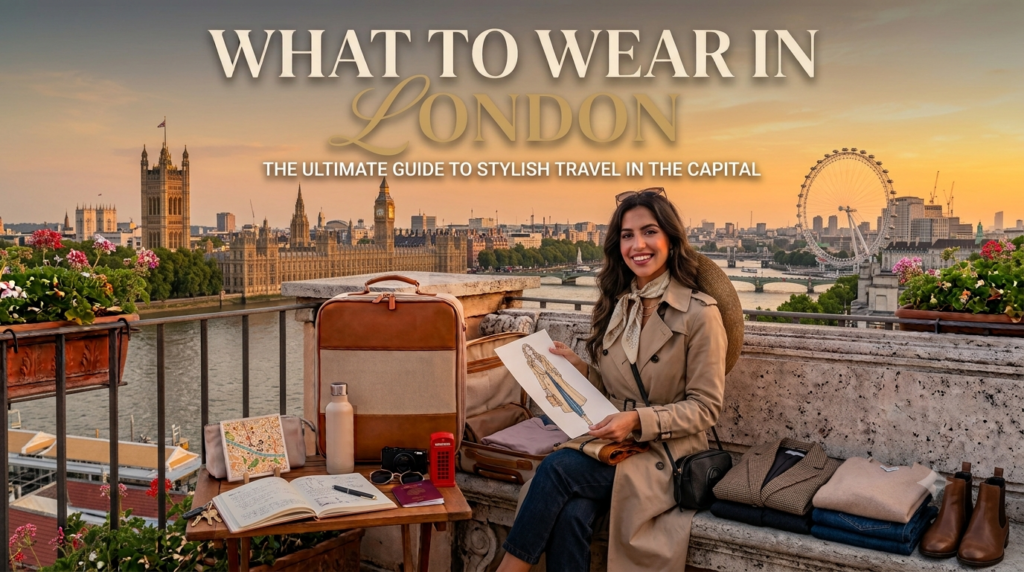
Planning a trip to London and wondering what to wear? The British capital has its own distinct style — layered, eclectic, and always prepared for unpredictable weather. Unlike Paris’s polished minimalism or Rome’s sun-soaked elegance, London style is more individualistic, mixing high street with vintage, and formal with casual effortlessly.
Here’s everything you need to know about dressing for London — from Notting Hill cafés to West End theatre nights, from Buckingham Palace to Borough Market.
London Weather: The Real Story
London’s weather is famously unpredictable — which is why locals always carry a compact umbrella. Here’s what to actually expect:
- Spring (March–May): 10–17°C (50–63°F). Mix of sunshine and showers. Layers essential. Light jacket or trench coat is perfect.
- Summer (June–August): 18–25°C (64–77°F). Warm but rarely hot. Can drop to 15°C in evenings. Sundresses with a cardigan work well.
- Autumn (September–November): 10–17°C. Cooler, rainier, beautiful leaf colours. Coats and boots season begins.
- Winter (December–February): 3–10°C (37–50°F). Cold and grey. Wool coats, scarves, and waterproof boots are essentials.
London Style: What Locals Actually Wear
London has no single dress code — it’s one of the world’s most diverse fashion cities. But there are some consistent threads in how locals dress:
- Layering is key — a base, a mid-layer, and a coat is the default approach for most seasons
- Trench coats are practically the city’s unofficial uniform in spring and autumn
- Quality over quantity — Londoners often invest in fewer, better pieces
- Mix high-low — pairing designer bags with high-street clothes, or vintage pieces with smart blazers
- Trainers (sneakers) are acceptable almost everywhere — London is a walking city
What to Wear in London by Season
Spring London Outfits
- Midi dress + trench coat + ankle boots + tote bag
- Straight-leg jeans + striped Breton top + tailored blazer + white sneakers
- Floral midi skirt + fitted knit sweater + loafers
Summer London Outfits
- Linen sundress + light cardigan for evenings + sandals
- Wide-leg linen trousers + fitted tee + trainers + compact crossbody
- Flowy midi dress + white leather sneakers + light denim jacket
Autumn London Outfits
- Tailored trousers + chunky knit sweater + wool coat + ankle boots
- Dark jeans + oversized blazer + turtleneck + Chelsea boots
- Midi skirt + thin turtleneck + structured coat + knee-high boots
Winter London Outfits
- Knit midi dress + opaque tights + knee-high boots + long wool coat
- Dark jeans + thick cable-knit sweater + parka coat + scarf + boots
- Tailored wool trousers + cashmere roll-neck + structured wool coat
What to Wear for London Activities
Museums & Galleries (V&A, British Museum, Tate)
Smart casual is perfectly appropriate. Comfortable shoes are essential — you’ll walk miles. Jeans, nice trainers, and a clean jacket is the standard.
West End Theatre
Smart casual to dressy. A midi dress or tailored trousers with a blouse is ideal. No need for black tie — but avoid gym wear or very casual clothing. Evening venues can feel slightly formal.
Borough Market & Street Food
Casual and comfortable. Jeans, trainers, and a relaxed jacket. Wear something you don’t mind getting splashed (the market can be wonderfully chaotic).
Notting Hill & Portobello Road
This is where London’s most stylish residents live. People-watch and be inspired — floral dresses, vintage finds, and creative layering are the local aesthetic.
Afternoon Tea
Smart casual is the minimum — most classic venues (Claridge’s, The Ritz) request no trainers or sportswear. A dress, skirt, or smart trousers with a blouse is ideal.
London Packing Essentials
- Compact umbrella — the single most important London accessory
- Trench coat or waterproof jacket — year-round essential
- Comfortable walking shoes — London is a walking city; your feet will thank you
- Layers — a cardigan, scarf, and light jacket cover most weather scenarios
- Crossbody bag — practical for the Tube and crowded markets
Book Your London Experience
👉 Browse London tours on GetYourGuide — from Tower of London access to Harry Potter studio tours.
👉 Explore London experiences on Viator — Jack the Ripper tours, afternoon tea, and Thames river cruises.
Frequently Asked Questions
Is London dressy or casual?
London is eclectic — it depends entirely on the neighbourhood and occasion. The City (financial district) is formal, East London is creative and casual, West End evenings are smart, and everyday tourist spots are relaxed. Pack versatile pieces that can be dressed up or down.
Can I wear jeans in London?
Absolutely — jeans are standard everyday wear in London. Pair with a nice blouse and jacket for evenings, or keep casual with a clean tee for daytime sightseeing.
What shoes are best for London?
Comfortable walking shoes are non-negotiable. White leather trainers, ankle boots, and loafers are all popular with locals. Avoid stilettos for daytime sightseeing — London’s pavements are busy and you’ll cover serious distances.
Do I need a coat for London in summer?
Yes — always bring a light jacket or cardigan even in summer. London evenings can drop significantly, and many restaurants and venues are air-conditioned. A trench coat or denim jacket is the perfect summer layer.
London Packing List
London is one of the world’s most visited cities — and one of the most weather-demanding to pack for. A single day in London can move from a cold, grey morning drizzle to a bright warm afternoon and back to a chilly evening requiring a proper coat. Add London’s extraordinary social range — from muddy Glastonbury festival fields to Michelin-starred Mayfair restaurants, from the National Gallery to a Premier League match at Stamford Bridge — and packing thoughtfully becomes essential. Here’s your complete London packing list for women.
London Weather: What to Expect by Season
London’s climate is famously unpredictable but rarely extreme. Spring (March–May) brings mild temperatures (8–16°C), longer daylight hours, and a mix of sunshine and showers — layers are essential. Summer (June–August) is London’s peak tourist season — warm and mostly pleasant (18–26°C), with occasional heatwaves pushing above 30°C, but also persistent overcast stretches. A light jacket is still useful even in July. Autumn (September–November) brings cooling temperatures, golden parks, and increasing rain — a proper waterproof jacket becomes necessary. Winter (December–February) is cold (2–8°C), grey, and damp, but rarely freezing; layers and a substantial coat are the priority. Rain is possible any month — London receives approximately 600mm annually spread fairly evenly through the year. The key is layers and a genuinely waterproof jacket rather than attempting to guess the forecast.
London Packing List: Clothing
The Core London Wardrobe
London dressing is fundamentally about layering. The classic London look — a good trench coat over a light knit, jeans or tailored trousers, ankle boots — works for 10 months of the year. London is a genuinely stylish city; locals dress with intention. You won’t be overdressed in smart casual at virtually any point during the day.
- A quality trench coat or structured coat (the single most useful item for London — works across all casual-to-smart dress codes and provides rain protection)
- 2–3 versatile tops in neutral colours that work across multiple outfits
- 1–2 light knitwear layers (a fine-knit jumper or cashmere-blend cardigan adds warmth without bulk)
- 2 pairs of trousers or jeans — one smart, one casual
- 1–2 dresses or skirts with tights (for warmer months or evening out)
- A smart blazer (London’s café and restaurant culture rewards slightly elevated casual)
Evening & Going Out
- 1 dressier outfit for a London theatre, Michelin-starred restaurant, or rooftop bar (London’s evening scene ranges from ultra-casual to dress code-required)
- A small clutch or crossbody bag for evenings out
- Dressier flat sandals or low heels for summer evenings
Shoes
London involves significant walking — the Tube stations alone involve long corridors and escalators, and the city’s best neighbourhoods are best explored on foot. Comfortable shoes are non-negotiable.
- Comfortable ankle boots with a low heel or flat — the single most versatile shoe for London, working from day sightseeing to evening dinner
- Waterproof walking shoes or trainers for rainy days and long sightseeing circuits
- A pair of ballet flats or loafers for drier days and lighter walking
- For summer: sandals, but always pack a backup closed-toe option — London can cool quickly
London Packing List: Essentials
Rain Gear
- A compact, packable umbrella — essential year-round (London’s showers arrive without warning)
- A genuinely waterproof jacket or mac (a water-resistant trench coat covers most needs; for autumn/winter, a proper waterproof outer layer is important)
- Waterproof shoes or ankle boots (wet leather shoes make for a miserable day; a waterproof membrane makes the difference)
Bags & Day Kit
- A spacious tote bag or backpack for daily museum visits, market shopping, and carrying layers you’ve shed as the day warmed up
- A crossbody bag or anti-theft bag for crowded Tube travel and tourist areas (Oxford Street, Camden, Borough Market see heavy pickpocket activity)
- Reusable shopping bag (London’s supermarkets and markets charge for bags)
Transport & Tech
- Contactless bank card or Apple/Google Pay — the single most important transport item in London (TfL Tube, buses, and Elizabeth line all accept contactless payment; an Oyster card is no longer necessary for most visitors)
- Universal UK plug adapter (Type G, three-pin rectangular) if travelling from outside the UK
- Portable charger for long sightseeing days away from power points
- Offline London map downloaded (Google Maps works excellently offline for London’s complex street layout)
Documents & Money
- Passport or travel document (UK is outside the EU; non-UK nationals need a passport)
- UK ETA (Electronic Travel Authorisation) — required from 2025 for non-visa-required nationalities visiting the UK; apply online before travel
- British pounds (GBP) — contactless card payment is accepted almost universally in London, but small cash amounts are useful for markets and some smaller cafés
- Travel insurance with theft coverage (tourist area pickpocketing is a genuine risk)
What to Pack for London’s Top Experiences
London Museums & Galleries
London’s world-class museums — the British Museum, Natural History Museum, Victoria & Albert Museum, National Gallery, Tate Modern — are all free to enter, making them the city’s greatest bargain. Museum visiting involves significant walking on hard floors — comfortable, supportive shoes are essential. Most museums have coat checks for heavy bags. The V&A in particular has a dress code sensibility among its visitors; smart casual is appropriate and the café is worth visiting in its own right. Tate Modern on the South Bank pairs well with a walk across Millennium Bridge to St Paul’s Cathedral.
London Markets: Portobello, Borough & Columbia Road
London’s markets are among the city’s most distinctive experiences. Borough Market (Thursdays–Saturdays) is the finest food market in the UK — bring cash and an appetite. Portobello Road Market in Notting Hill (Saturdays) covers antiques, vintage fashion, and street food across half a mile of stalls. Columbia Road Flower Market (Sunday mornings) is a narrow East London street transformed into a fragrant corridor of plants and flowers. All markets require comfortable shoes and a large bag for purchases. Arrive early at Borough Market (before 11am) to beat the worst crowds.
West End Theatre
London’s West End is the world’s greatest theatre district — over 40 theatres within walking distance of each other in the Covent Garden and Soho area. There’s no strict dress code at most West End theatres, but smart casual is appropriate and locals tend to dress up slightly for evening shows. Afternoon performances (matinees) are more casual. Book tickets in advance online through official theatre websites or TodayTix for discounts; day seats (queue at the theatre from early morning) offer significant savings at most productions.
Royal Parks & Outdoor London
London’s Royal Parks — Hyde Park, Regent’s Park, Richmond Park, Greenwich Park — are extraordinary urban green spaces and ideal for a sunny London afternoon. Richmond Park has free-roaming deer; Greenwich Park offers one of the finest views over London and access to the Royal Observatory. Pack a light picnic from a nearby Waitrose or M&S Simply Food, a blanket (or rent deckchairs in Hyde Park), and sunscreen for summer days. Parks also get muddy after rain — flat shoes with some grip are advisable after wet weather.