
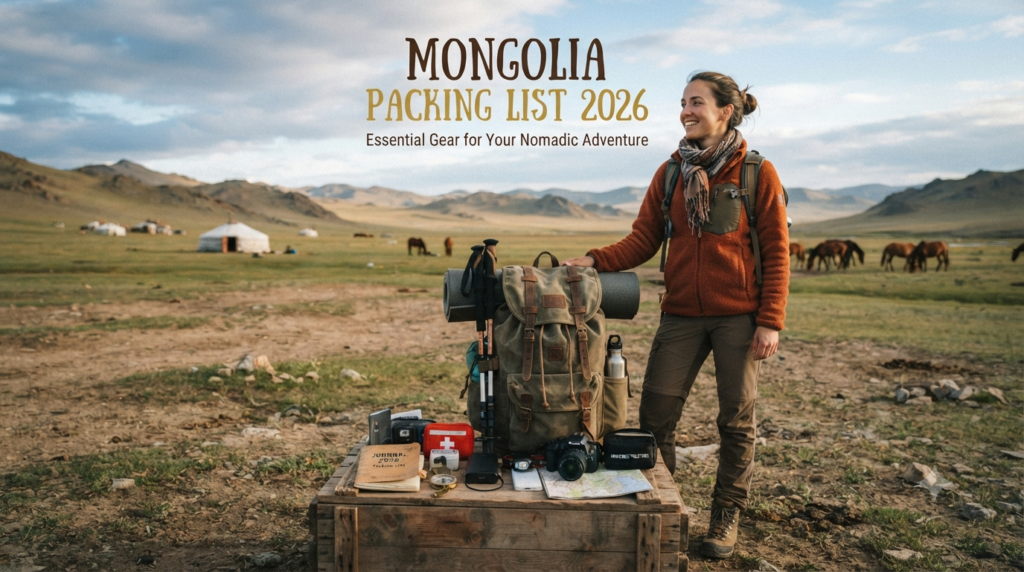
Mongolia is one of the most remarkable travel destinations on earth — a country where 40% of the population still lives a nomadic lifestyle, where ger (yurt) camps dot vast open steppe under skies with almost no light pollution, and where you can ride horses across grasslands that stretch to every horizon. It’s a destination that rewards those willing to pack thoughtfully for genuinely varied and sometimes extreme conditions.
This Mongolia packing list covers everything from Ulaanbaatar city days to Gobi Desert nights, Naadam festival dressing, and multi-day horse trekking in the Khövsgöl lake region.
Understanding Mongolia’s Climate
Mongolia has one of the world’s most extreme continental climates — hot dry summers and intensely cold winters, with almost no moderate seasons in between:
- Ulaanbaatar (1,350m elevation): One of the world’s coldest capital cities. July averages 16–22°C (surprisingly warm and pleasant). January averages -25°C. Travel season is May–September.
- Gobi Desert: Dramatic temperature swings — July days can reach 35–40°C, but nights even in summer drop to 5–10°C. Spring and autumn bring sandstorms. Winter is brutally cold.
- Mongolian steppe (central grasslands): Similar to Ulaanbaatar — warm dry summers, cold nights at altitude. The majority of Mongolia’s summer tourism takes place here.
- Khövsgöl Lake (1,646m, Taiga region): Cooler and wetter than the steppe. July temperatures 10–20°C by day; nights cool (5–10°C). The lake region has a short but intense summer season.
- Best travel season: June–August for Naadam festival (July 11–13), ger camp tourism, and trekking. May and September offer fewer crowds and dramatic golden light. Winter travel is possible but extreme.
Mongolia Layering System: Day vs. Night
The single most important principle for packing Mongolia is the temperature swing between day and night. Even in peak summer (July), ger camp nights on the steppe drop to 5–10°C. The Gobi can be 38°C by day and 8°C after sunset. Pack for both extremes:
- Day layers: Lightweight and breathable for warm summer temperatures. The Mongolian sun is intense at altitude — sun protection is critical.
- Night layers: Warm mid-layers and down insulation for cold ger camp evenings. A -5°C sleeping bag is worthwhile even in summer if your ger camp doesn’t have heating.
Mongolia Packing List: Clothing
Base Layers
- 2–3 merino wool or synthetic moisture-wicking long-sleeve tops
- 2 lightweight merino wool t-shirts
- 2 thermal leggings for cold ger camp nights
- 3–4 pairs of merino wool socks (essential for horse riding comfort)
- Moisture-wicking underwear (merino wool preferred for multi-day horse trekking)
Mid Layers
- 1 heavyweight fleece jacket — evenings on the steppe get genuinely cold
- 1 packable down jacket — for Gobi Desert nights and cold ger camps
- 1–2 long-sleeve shirts for daywear and cultural site visits
Outer Layers
- 1 waterproof, windproof shell jacket — for unexpected rain on the steppe and windy conditions
Bottoms
- 2 pairs of quick-dry trekking trousers (denim is too heavy and slow-drying)
- 1–2 pairs of lightweight shorts (for warm Ulaanbaatar city days and base camp)
- 1 pair of casual trousers or lightweight jeans for Ulaanbaatar
Naadam Festival Clothing (If Attending in July)
The Naadam Festival (July 11–13) is Mongolia’s greatest national celebration — a festival of the “Three Manly Games” (horse racing, archery, and wrestling). Hundreds of thousands of Mongolians attend in their finest deel (traditional robe). For visiting foreigners:
- Smart-casual clothing is completely appropriate. There is no dress code for tourists.
- If you want to honour the occasion and the culture, wearing a deel purchased in Ulaanbaatar is welcomed and appreciated by Mongolians — not considered cultural appropriation.
- Bright colours are traditional at Naadam — deep blues, oranges, and reds in the Mongolian palette are festive choices.
- Comfortable walking shoes — you’ll stand and walk for hours at the stadium and outdoor events.
What to Wear for Horse Trekking
Horse trekking — from day rides in Terelj National Park to multi-day expeditions in the Khövsgöl or Orkhon Valley regions — is one of Mongolia’s greatest experiences. Correct riding clothing significantly improves both comfort and safety:
- Full-length trousers — Never ride in shorts. The friction between the saddle (Mongolian saddles are often hard wooden frames with leather covering) and bare legs causes painful chafing within minutes. Wear long trekking trousers.
- Padded cycling shorts underneath — For multi-day or all-day riding, padded cycling shorts worn under your trekking trousers dramatically reduce saddle soreness.
- Long-sleeve top — Even in summer, arms are exposed to sun and wind on horseback for hours. A lightweight long-sleeve merino or UV-protection top is the right choice.
- Boots with a heel — A small heel (2–3cm) prevents the foot from sliding through the stirrup — a genuine safety concern. Hiking boots, ankle boots, or riding boots are the right choice. Do not ride in trainers or flat-soled shoes.
- Wind layer — At a canter across open steppe, you feel the wind even on a warm day. A packable windbreaker in your daypack is practical.
Gobi Desert Specific Packing
The Gobi Desert is dramatically different from Mongolia’s grassland regions — hot, arid, and subject to sudden sandstorms. The dunes of Khongoryn Els and the flaming cliffs of Bayanzag are the Gobi’s iconic highlights. Gobi-specific additions:
- Buff or neck gaiter — For sand and dust protection during sandstorms and sandy drives in open jeeps
- Sunscreen SPF 50+ applied generously — Desert UV exposure at high altitude is intense
- Lightweight long-sleeve sun-protective top — More practical than sunscreen for full-day Gobi exposure
- Camel riding trousers — The same principle as horse riding: full-length trousers for camel riding at Khongoryn Els dunes
- Warm sleeping layer — Gobi ger camp nights require serious warmth even in July
Ulaanbaatar City Packing
Ulaanbaatar (“UB”) is a larger, more modern city than many visitors expect — with good restaurants, cashmere shopping, museums, and a thriving café culture. City dressing:
- Smart-casual clothing works well. Jeans, casual trousers, and casual dresses are normal.
- One slightly smarter outfit for nicer restaurants (particularly if staying at one of the central hotels)
- Comfortable walking shoes — UB’s central area is walkable but the sidewalks can be uneven
Mongolia Cashmere Shopping
Mongolia produces some of the world’s finest cashmere, and shopping at UB’s cashmere stores (Gobi Cashmere, Mary & Martha Mongolia) is one of the city’s highlights. If you’re planning to buy cashmere clothing — jumpers, cardigans, scarves, socks — budget for the weight in your luggage before you arrive. Mongolian cashmere is genuinely excellent quality at lower prices than you’ll find in Europe, and makes a practical purchase that you can wear on your remaining trip.
Complete Accessories List
- Wide-brim sun hat — Essential for Gobi Desert and open steppe days with no shade
- Polarised sunglasses — High-altitude UV is intense; good sunglasses are a health priority
- Warm beanie — For ger camp evenings and any cold night conditions
- Neck gaiter/Buff — For Gobi sandstorms and cold steppe wind
- Waterproof gloves — For autumn travel, high passes, and unexpectedly cold ger nights
Mongolia Practical Essentials
- Cash (Mongolian Tögrög / MNT) — Mongolia is predominantly cash-based outside Ulaanbaatar. ATMs are available in UB (USD exchange is easy here) but non-existent in rural areas and ger camps. Carry sufficient MNT cash for your full rural itinerary.
- Visa-free for many nationalities — Mongolia offers visa-free entry for many passport holders including US (90 days), most EU countries, and others. Confirm at the Mongolian Embassy or lonelyplanet.com for your specific passport.
- Travel insurance with emergency medical evacuation — Medical facilities outside Ulaanbaatar are very limited. Helicopter evacuation from rural areas is extremely expensive. This insurance is essential for adventure travel in Mongolia.
- Offline maps (Maps.me) — Download Mongolia before travel. Mobile data is available in Ulaanbaatar but unreliable to non-existent in most rural areas.
- Power bank — Many ger camps have solar or generator power for basic lighting but charge devices unreliably. A high-capacity power bank is essential.
- Water purification — Carry a Sawyer Squeeze filter or SteriPen purifier for rural Mongolia. Spring water from streams can be used but purification is advisable.
- Wet wipes and dry shampoo — Water is limited in ger camps; ger camp showers (where available) are cold or inconsistent. Wet wipes are practical hygiene essentials for multi-day steppe itineraries.
Ger Camp Etiquette: What to Know Before You Arrive
Staying in a nomadic family ger is one of Mongolia’s most special experiences — but there are customs to observe:
- Always enter a ger walking clockwise (right side first when entering)
- Never step on the threshold of a ger doorway
- Remove your hat upon entering a ger as a guest
- Accept offerings of fermented mare’s milk (airag) or vodka graciously — take with your right hand or both hands, even if you just sip and set it down
- Sleep clothes — Bring comfortable warm clothing for sleeping; ger camp temperatures at night require layers
What NOT to Pack for Mongolia
- Only summer clothing — Ger camp nights and the Gobi require warm layers even in July. A light jacket is the bare minimum; a down puffer is strongly recommended.
- Hard-shell suitcases — Rural Mongolia involves 4WD Russian jeeps (often Soviet-era UAZ vans), horse panniers, and ger camp transfers. A 50–65L duffel bag or travel backpack is the correct format for any itinerary beyond Ulaanbaatar.
- Flip-flops as your primary footwear — Terrain is varied; ger camp ground is often uneven, and horse riding requires heel support. Sandals are fine for camp evenings only.
- Cotton clothing as base layers — Cotton dries slowly and provides no insulation when damp. Merino wool and synthetic fabrics only for base and mid-layers.
Mongolia Packing by Month
May–June: Shoulder season with blooming steppe. Excellent for fewer crowds. Pack full layering including down jacket — nights can be cold and spring weather is variable. Some ger camps open as early as May.
July: Peak season and Naadam Festival (July 11–13). Warm, sunny days; accommodation in high demand around festival time. Pack for both summer warmth and cool ger camp evenings. Book tours and Ulaanbaatar accommodation well in advance.
August: Excellent travel month — warm, most ger camps fully operating, and good pre-autumn light. Pack as for July.
September: Golden autumn light and turning steppe colours. Temperatures begin to drop. Pack an extra warm layer. Some more remote camps begin closing.
Frequently Asked Questions: Mongolia Packing List
What should women pack for Mongolia?
A practical mix of outdoor technical clothing and modest cultural clothing. In Ulaanbaatar, casual Western dress is normal. In nomadic communities and rural areas, modestly covered clothing (longer trousers, covered shoulders) is respectful and appreciated. For horse trekking and outdoor adventures, the priority is functional layering — merino wool base layers, a down jacket for cold nights, windproof outer layers, and solid boots with heel support for riding.
Is it cold in Mongolia in summer?
The days are warm — July temperatures in Ulaanbaatar and the steppe average 18–25°C, and the Gobi Desert can reach 35–40°C. But evenings and nights on the steppe and in the Gobi drop significantly, sometimes to 5–10°C even in July. Ger camps can be cold before the stove is lit in the morning. A down jacket and thermal layers are essential even for midsummer travel.
What do I wear at a Naadam festival?
There’s no dress code for foreign visitors — smart casual is perfectly appropriate. Comfortable walking shoes and layers (it can be warm in the stands during the day, then cool in the evening) are practical. Many foreigners choose to buy a deel (Mongolian traditional robe) in Ulaanbaatar before the festival — this is welcomed and considered respectful by Mongolians, who are proud of their traditional dress. Department stores and the State Department Store in UB sell deels at reasonable prices.
Heading to Kyrgyzstan for more Central Asian adventure? See our Kyrgyzstan packing list — the country offers similar nomadic culture and mountain trekking, and many travellers combine the two on a wider Central Asia circuit.
💡 Book Naadam Festival tours, Gobi Desert ger camp packages, and Khövsgöl Lake horse trekking through Viator Mongolia, and find hotels in Ulaanbaatar on Booking.com.