
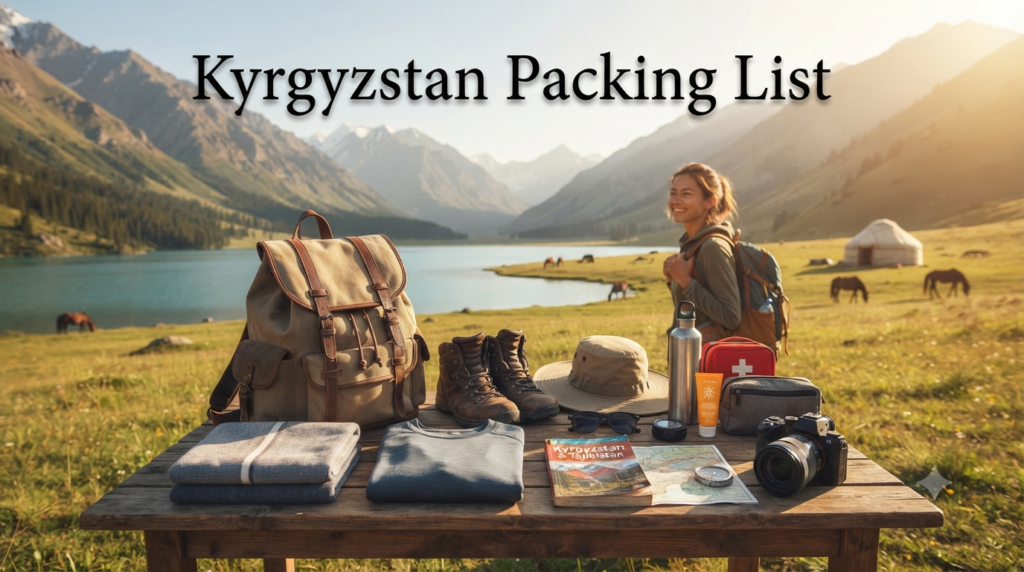
Kyrgyzstan is the nomadic heart of Central Asia — a country of snow-capped Tian Shan peaks, high-altitude alpine lakes, and a living nomadic culture of felt yurts and eagle hunters. It’s one of the most rewarding adventure travel destinations in Asia, still genuinely off the main tourist trail despite growing in popularity among trekkers and overlanders.
Packing for Kyrgyzstan is different from anywhere else: you might spend a morning in Bishkek’s modern café culture, an afternoon bouncing across mountain passes in a Soviet-era 4WD, and an evening sleeping in a yurt at 3,000 metres. This packing list covers it all.
Understanding Kyrgyzstan’s Climate
- Bishkek (760m elevation): Continental climate with hot summers (July averages 30°C) and cold winters (-10°C in January). Spring and autumn are mild and pleasant.
- Issyk-Kul Lake (1,600m): The world’s second-largest alpine lake stays ice-free year-round due to its salt content. Summer temperatures of 25–30°C make it Kyrgyzstan’s beach destination. Evenings are noticeably cooler at altitude.
- Ala Archa National Park / Tian Shan: Alpine conditions year-round. Even summer days at 3,000m+ can be cold, with glacial winds and afternoon thunderstorms. Pack full mountain gear.
- Song Kol Lake (3,016m): The iconic high-altitude lake where nomads bring their herds in summer. July–August temperatures are 10–20°C by day and can drop below 0°C at night. Wind is significant and constant.
- Best season: June–September for trekking and yurt stays. May and October shoulder seasons are possible at lower elevations. The high mountain passes and Song Kol are only accessible June–September.
Kyrgyzstan Clothing Packing List
Base Layers (Critical for Mountains and Yurt Stays)
- 2–3 merino wool or synthetic moisture-wicking thermal tops (long sleeve)
- 2 thermal leggings for cold mountain nights
- Moisture-wicking underwear — merino wool is best for multi-day trekking
- 3–4 pairs of merino wool trekking socks
Mid Layers
- 1 heavyweight fleece jacket — essential for Song Kol evenings and high passes
- 1 packable down jacket — for sleeping at altitude in yurt camps (nights can be near-freezing even in July)
- 2–3 long-sleeve shirts for daywear in the mountains and city
Outer Layers
- 1 fully waterproof, windproof shell jacket — afternoon thunderstorms in the mountains are common in summer
- 1 pair of waterproof over-trousers — for passes and rainy trekking days
Bottoms
- 2–3 pairs of quick-dry trekking trousers — versatile for hiking and village visits
- 1–2 pairs of lightweight shorts — for Bishkek city and Issyk-Kul beach days
- 1 pair of lightweight casual trousers — for Bishkek evenings and mosque visits
Yurt Camp Comfort Items
Yurt stays at Song Kol, Kochkor, and other nomadic camps are one of Kyrgyzstan’s greatest experiences — but yurts are basic and can be cold at night. Specific comfort additions:
- Lightweight sleeping bag liner (even if the yurt provides blankets, a liner adds significant warmth)
- Warm sleeping socks
- A comfortable pair of sandals or slip-on shoes for inside the yurt (Kyrgyz culture involves removing outdoor boots at the entrance)
Dress Culture in Kyrgyzstan
Kyrgyzstan is a Muslim-majority country but historically more influenced by Soviet secularism and nomadic Tengrist traditions than strict Islamic practice. The dress culture is moderate compared to other Central Asian countries:
- Bishkek city: Relaxed and modern — jeans, t-shirts, and casual Western clothing are universal. Younger Bishkek residents dress similarly to European city-dwellers.
- Rural areas and villages: Dress more conservatively. Longer trousers (not shorts), covered shoulders, and modest tops are appreciated by locals and make interactions more comfortable.
- Mosques: Women need a scarf for head covering and modest clothing covering shoulders and knees.
- Yurt camps: Practical outdoor clothing is perfectly appropriate. Your nomadic hosts are used to receiving trekkers and outdoor travellers.
Footwear for Kyrgyzstan
- Waterproof hiking boots (mid-to-high ankle) — Essential for any trekking. Kyrgyzstan’s mountain trails involve river crossings, scree slopes, muddy passes, and glacial terrain. Solid waterproof boots with aggressive soles are the single most important footwear item.
- Trail running shoes or lightweight hiking shoes — For Bishkek city days and easier day walks. Can double as evening camp shoes.
- Sandals or flip-flops — For Issyk-Kul beach days and yurt camp evenings (remove boots at the yurt entrance).
- Gaiters — For high-altitude passes with snow or scree, particularly on Ala Kul Lake trek and other classic routes.
Kyrgyzstan’s Best Treks: What to Wear
Ala Archa National Park (Day Hikes from Bishkek)
Just 40km from Bishkek’s city centre, Ala Archa offers serious alpine hiking including the popular Ak-Sai Glacier trail (up to 4,200m). Weather changes quickly — morning sun can become afternoon thunder. Wear your full layering system with waterproofs, and solid hiking boots. The trail involves boulder hopping and glacial approaches at the upper reaches.
Ala Kul Lake Trek (3–5 days, near Karakol)
One of Kyrgyzstan’s most spectacular multi-day treks, crossing the Ala Kul Pass (3,860m) between two valleys. The Ala Kul Pass frequently has snow even in August. Pack:
- Full mountain layering system including down jacket
- Waterproof shell and over-trousers
- Gaiters for the pass
- Trekking poles (steep descent on the far side)
- Warm sleeping bag (rated -5°C minimum for the trek huts)
Song Kol Lake (2–5 days horseback or 4WD)
The high-altitude Song Kol plateau (3,016m) is Kyrgyzstan’s most iconic landscape — an endless green plateau ringed by mountains, dotted with nomadic yurts and horse herds. The wind at Song Kol can be constant and biting. Pack:
- Down jacket — essential for evenings and mornings
- Wind-resistant outer layer
- Thermal base layers for sleeping
- Warm hat, neck gaiter, waterproof gloves
- Waterproof boots (the plateau can be boggy after rain)
Issyk-Kul Lake: Beach Packing
At 1,600m elevation and 182km long, Issyk-Kul is Central Asia’s largest lake and Kyrgyzstan’s beach destination. The northern shore (Cholpon-Ata) has resorts, the southern shore is quieter and more scenic. Summer beach packing:
- Swimwear — the lake is swimmable July–August (water temperature 20–24°C in peak summer)
- Light cover-up or sarong
- Sunscreen — the high altitude means intensified UV radiation even on seemingly mild days
- Light jacket for evenings (cooler than you’d expect at this altitude even in summer)
Kyrgyzstan Practical Essentials
- Cash (Kyrgyz Som) — ATMs are available in Bishkek and Karakol. Outside these cities, cash is essential. USD can be exchanged but Som is needed for most transactions. The Song Kol and high mountain areas are entirely cashless economy.
- Visa-free for many nationalities — Kyrgyzstan has one of the most open visa policies in Central Asia. Check your nationality at mfa.gov.kg before travel.
- Travel insurance with mountain rescue coverage — Essential for trekking. Mountain Search and Rescue (MSAR) exists but response in remote areas can be slow.
- Altitude sickness awareness — Song Kol (3,016m), Ala Kul Pass (3,860m), and other high-altitude destinations carry altitude sickness risk. Ascend gradually and recognise symptoms early.
- Offline maps (Maps.me) — Download Kyrgyzstan before travel. Mobile data is unreliable outside Bishkek and Karakol.
- Power bank — Yurt camps do not have electricity. Many guesthouses in smaller towns have intermittent power.
- Water purification — Mountain streams in Kyrgyzstan are generally clean, but treat water from lower-altitude or inhabited areas. A Sawyer Squeeze filter or purification tablets are reliable.
What NOT to Pack for Kyrgyzstan
- Only lightweight warm-weather clothing — Even in July, high-altitude destinations require serious layering. A down jacket is not optional for Song Kol or any serious trekking.
- Hard-shell suitcases — 4WD vehicles, horse transport, and yurt camps are not compatible with rigid luggage. A 50–65L travel backpack or duffel is the right format.
- Expensive or irreplaceable items — The outdoor adventure nature of most Kyrgyzstan itineraries means things get dirty, wet, and occasionally lost. Leave irreplaceable items at home.
- Heavy cotton base layers — Cotton in wet mountain conditions is a risk. Merino wool and synthetic fabrics only for base and mid-layers.
Frequently Asked Questions: Kyrgyzstan Packing List
What should women pack for Kyrgyzstan?
A combination of technical mountain clothing and modest city/village clothing. In Bishkek, casual Western clothing is completely normal. In rural areas and villages, longer trousers and covered shoulders are respectful and more comfortable socially. For trekking and yurt stays, the priority is functional outdoor clothing: merino wool base layers, a down jacket for cold nights, waterproof shell, and solid hiking boots.
Is Kyrgyzstan safe for solo female travellers?
Yes — Kyrgyzstan is generally considered safe for solo female travellers and has an established network of community-based tourism (CBT) guesthouses and yurt camps run by local families. As in any destination, basic precautions apply: dress modestly in rural areas, use established CBT networks, share itineraries with people you trust, and be aware of your surroundings in Bishkek after dark.
What sleeping bag do I need for Kyrgyzstan?
For Song Kol yurt camps and multi-day trekking: a sleeping bag rated to -5°C minimum, or a 3-season bag. Most yurts provide heavy felt blankets that provide good insulation, but in early June or late September the nights can be genuinely cold (near or below 0°C at Song Kol). A -10°C bag is comfortable for all conditions.
Can I do the Ala Kul Trek without a guide?
Experienced trekkers with navigation skills and appropriate gear can do it independently. The trail is reasonably well-marked in the lower sections but the Ala Kul Pass can be tricky in poor visibility or with snow. First-time visitors to Kyrgyzstan or those without alpine experience should hire a guide through the Community Based Tourism (CBT) office in Karakol, which provides affordable local guide services.
Also travelling to Tajikistan or Uzbekistan? See our Tajikistan packing list and Uzbekistan packing list — the three countries combine perfectly on a Central Asia circuit.
💡 Book Kyrgyzstan trekking tours, Song Kol yurt camp experiences, and eagle hunting shows through Viator, and find guesthouses in Bishkek and Karakol on Booking.com.
Pingback: Mongolia Packing List: What to Pack for the Gobi & Steppes