
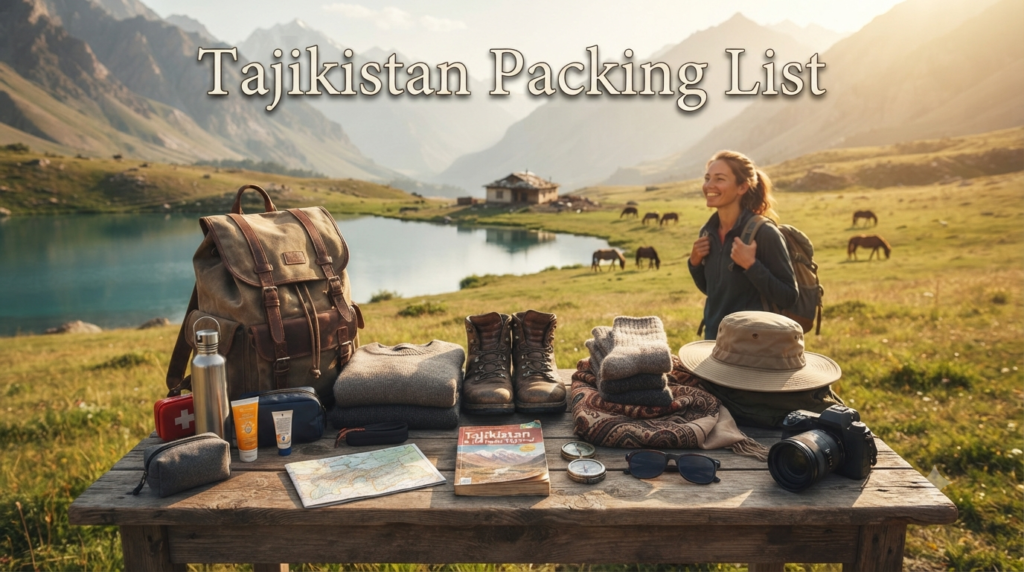
Tajikistan is Central Asia’s most dramatic and least-visited destination — a country where the Pamir Mountains meet the Hindu Kush, where the Wakhan Valley borders Afghanistan, and where ancient Silk Road towns sit beneath 7,000-metre peaks. It’s one of the world’s last great adventure travel destinations, and packing for it requires serious thought.
Whether you’re driving the legendary Pamir Highway (one of the world’s highest roads), trekking the Fann Mountains, or exploring the capital Dushanbe, this Tajikistan packing list covers everything you need for a safe and comfortable trip.
Understanding Tajikistan’s Climate
Tajikistan spans from lowland desert to alpine terrain above 7,000 metres, creating wildly different climate zones:
- Dushanbe (capital, 800m elevation): Hot summers (July averages 34°C), cold winters. Spring and autumn are mild and pleasant.
- Pamir Highway / Murghab plateau (3,000–4,655m): Cold year-round. Even in July, nights can drop to 0°C or below at Murghab (3,612m). Days can be warm (20–25°C) but temperature swings are extreme.
- Fann Mountains (2,000–4,000m): Cool summer trekking weather, cold nights year-round.
- Wakhan Corridor: Arid and cold. Summer days are warm; nights are cold at altitude.
- Best travel season: June–September for Pamir Highway and trekking. May and October are shoulder seasons with cooler temperatures and fewer tourists. Winter travel to the high Pamirs is extremely challenging.
Tajikistan Clothing Packing List
Base Layers (Essential for Pamir & Mountains)
- 2–3 merino wool or synthetic thermal long-sleeve tops
- 2 thermal leggings / base layer bottoms
- Moisture-wicking underwear (merino wool preferred)
- 3–4 pairs of merino wool socks
Mid Layers
- 1 heavyweight fleece jacket (the Pamirs get genuinely cold at night)
- 1 packable down jacket (essential for high-altitude nights on the Pamir Highway)
- 1–2 long-sleeve shirts for daywear
Outer Layers
- 1 waterproof, windproof shell jacket (GORE-TEX or equivalent) — essential
- 1 pair of waterproof over-trousers — for mountain trekking and wet weather
Bottoms
- 2 pairs of quick-dry trekking trousers (not jeans — too heavy and slow to dry)
- 1–2 pairs of lightweight shorts (for Dushanbe and low-elevation days)
- 1 pair of linen or lightweight trousers for Dushanbe city and mosque visits
Modesty Clothing (Important in Tajikistan)
Tajikistan is a Muslim-majority country, and while the culture is moderate compared to some regional neighbours, dressing respectfully matters — especially in mosques, rural villages, and the more conservative Gorno-Badakhshan region (GBAO) along the Pamir Highway.
- For women: At least one modest outfit covering shoulders and knees for mosque and village visits. A lightweight scarf for head covering when entering mosques.
- Longer trousers (rather than shorts) are appreciated when interacting with rural communities.
- A loose long-sleeve top or linen shirt for lower-elevation village visits.
Footwear for Tajikistan
- Waterproof mid-to-high hiking boots — Non-negotiable for any Fann Mountains trekking or serious Pamir walking. Ankle support and reliable waterproofing are essential.
- Comfortable camp shoes or sandals — For guesthouses and homestays after hiking days. A pair of lightweight trail runners can double here.
- Gaiters — For any passes with snow crossings (common in the Fann Mountains even in July–August).
Accessories
- Warm hat (beanie) — For Pamir nights; absolutely essential
- Lightweight balaclava — For driving in open jeeps at altitude on the Pamir Highway
- Waterproof gloves — For mountain days and cold Pamir nights
- Sunglasses with UV protection — High altitude means more intense UV radiation; quality sunglasses are a health necessity
- Lightweight scarf — Multi-use: mosque head covering, sun protection, extra warmth layer
- Headlamp with spare batteries — Power outages are common in rural Tajikistan
Pamir Highway Specific Packing
The Pamir Highway (M41) — one of the highest roads in the world — runs from Dushanbe to Osh in Kyrgyzstan via Murghab, at elevations reaching 4,655 metres. This iconic journey takes 4–7 days by shared 4WD or jeep. Specific additions for the Pamir trip:
- Altitude sickness medication (acetazolamide / Diamox) — Consult a doctor before travel. The rapid elevation gain on the Pamir Highway can cause acute mountain sickness. This is the most important health preparation for this journey.
- Sleeping bag (rated to -10°C) — Murghab guesthouses and homestays can be very cold at night even in summer. A quality sleeping bag is essential insurance.
- Water purification (filter or tablets) — Clean drinking water is scarce on the Pamir Highway. Carry a Sawyer Squeeze or SteriPen filter.
- High-calorie snacks — Food options are extremely limited along the highway, particularly between Khorog and Murghab. Carry nuts, dried fruit, energy bars for the journey.
- GBAO permit — Required to travel in Gorno-Badakhshan Autonomous Oblast (the Pamir region). Obtain in Dushanbe or arrange through your tour operator before travel.
Fann Mountains Trekking Packing
The Fann Mountains (near Penjikent, accessible from Samarkand in Uzbekistan) offer some of Central Asia’s most beautiful trekking — turquoise glacial lakes, alpine meadows, and challenging passes. Multi-day trekking additions:
- Trekking poles — highly useful on the steep, loose-scree passes
- 30–40L daypack with a rain cover
- Lightweight sleeping bag (most treks use yurt camps with blankets, but a liner adds comfort)
- Sandfly repellent — particularly relevant in valley camps in June
Tajikistan Practical Essentials
- Cash (US dollars or Tajik Somoni) — ATMs are unreliable outside Dushanbe. Carry sufficient USD cash for your entire trip; exchange at banks or exchange offices in the capital. Many rural homestays accept only local currency.
- E-visa — Most nationalities can obtain a Tajikistan e-visa online at evisa.tj. Additionally, a separate GBAO permit is required for the Pamir region.
- Travel insurance with high-altitude medical evacuation coverage — Helicopter evacuation from the Pamirs is extremely expensive and essential insurance for this region.
- Offline maps — Maps.me covers Tajikistan well and works without mobile data. Download before travel.
- Portable solar charger or power bank — Electricity is intermittent throughout the country. A solar panel charger is extremely useful on the Pamir Highway.
What NOT to Pack for Tajikistan
- Only warm-weather clothing — Even summer visitors need serious cold-weather gear for high altitude nights on the Pamir Highway and mountain trekking.
- Heavy or bulky luggage — Shared jeeps on the Pamir Highway have very limited space. A 50–65L backpack or duffel is the right format; hard-shell suitcases are impractical.
- Revealing clothing — Tajikistan’s rural communities are conservative. Modest coverage (covered shoulders, knees, and longer trousers) is the respectful and practical norm throughout the country.
Frequently Asked Questions: Tajikistan Packing List
What should women pack for Tajikistan?
A mix of technical outdoor clothing (essential for mountain and Pamir travel) and modest cultural clothing. In Dushanbe and urban settings, women can dress similarly to any Central Asian city — casual but covered. For mosques and rural communities, covered shoulders, knees, and a headscarf are important. For mountain trekking and the Pamir Highway, prioritise technical layering, waterproof gear, and warm insulation for cold nights at altitude.
Do you need a special permit for the Pamir Highway?
Yes. Travel in Gorno-Badakhshan Autonomous Oblast (GBAO), which includes the Pamir Highway, Murghab, and Khorog, requires a special GBAO permit in addition to your standard Tajikistan visa. This can be obtained at the Ministry of Foreign Affairs in Dushanbe (allow 1–2 working days) or arranged through most tour operators as part of your trip planning. Do not attempt to travel to GBAO without this permit.
What is altitude sickness risk on the Pamir Highway?
Significant. The Pamir Highway reaches 4,655 metres at the Ak-Baital Pass, and travellers often ascend rapidly from Dushanbe (800m). Altitude sickness (acute mountain sickness) is a real risk. Consult a doctor about preventative medication (acetazolamide/Diamox) before your trip. Acclimatise gradually where possible; do not push through severe symptoms.
Also planning Uzbekistan? See our Uzbekistan packing list — the two countries pair perfectly on a Silk Road itinerary.
💡 Book Dushanbe city tours and Pamir Highway guided expeditions through Viator, and find guesthouses in Dushanbe on Booking.com.
Pingback: Kyrgyzstan Packing List 2026: Trekking, Yurt Stays & Bishkek Essentials - Vacation Style Guide