
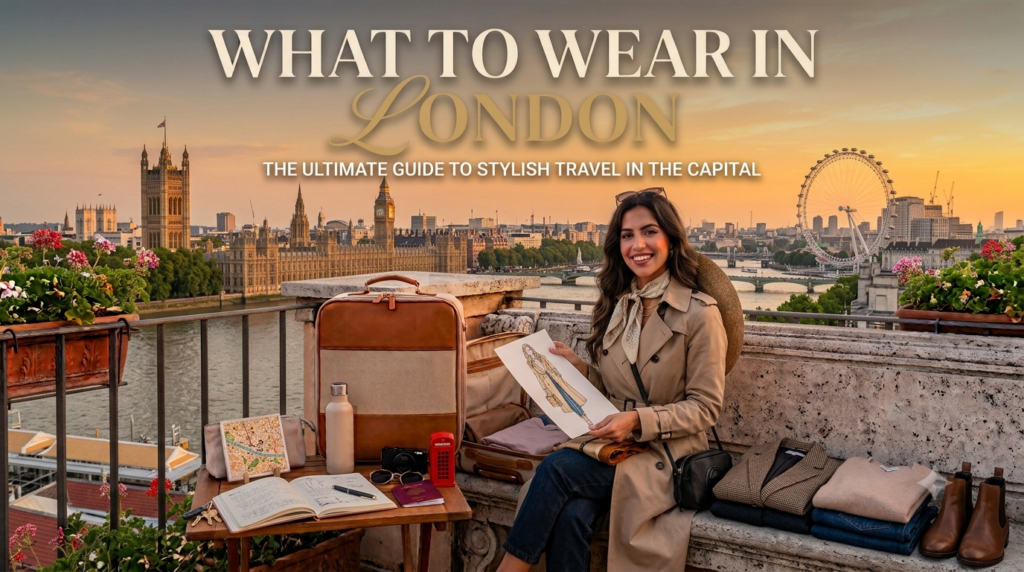
Planning a trip to London and wondering what to wear? The British capital has its own distinct style — layered, eclectic, and always prepared for unpredictable weather. Unlike Paris’s polished minimalism or Rome’s sun-soaked elegance, London style is more individualistic, mixing high street with vintage, and formal with casual effortlessly.
Here’s everything you need to know about dressing for London — from Notting Hill cafés to West End theatre nights, from Buckingham Palace to Borough Market.
London Weather: The Real Story
London’s weather is famously unpredictable — which is why locals always carry a compact umbrella. Here’s what to actually expect:
- Spring (March–May): 10–17°C (50–63°F). Mix of sunshine and showers. Layers essential. Light jacket or trench coat is perfect.
- Summer (June–August): 18–25°C (64–77°F). Warm but rarely hot. Can drop to 15°C in evenings. Sundresses with a cardigan work well.
- Autumn (September–November): 10–17°C. Cooler, rainier, beautiful leaf colours. Coats and boots season begins.
- Winter (December–February): 3–10°C (37–50°F). Cold and grey. Wool coats, scarves, and waterproof boots are essentials.
London Weather Season by Season
London’s climate is famously unpredictable but rarely extreme. Spring (March–May) brings mild temperatures (8–16°C), longer daylight hours, and a mix of sunshine and showers — layers are essential. Summer (June–August) is London’s peak tourist season — warm and mostly pleasant (18–26°C), with occasional heatwaves pushing above 30°C, but also persistent overcast stretches. A light jacket is still useful even in July. Autumn (September–November) brings cooling temperatures, golden parks, and increasing rain — a proper waterproof jacket becomes necessary. Winter (December–February) is cold (2–8°C), grey, and damp, but rarely freezing; layers and a substantial coat are the priority. Rain is possible any month — London receives approximately 600mm annually spread fairly evenly through the year. The key is layers and a genuinely waterproof jacket rather than attempting to guess the forecast.
London Style: What Locals Actually Wear
London has no single dress code — it’s one of the world’s most diverse fashion cities. But there are some consistent threads in how locals dress:
- Layering is key — a base, a mid-layer, and a coat is the default approach for most seasons
- Trench coats are practically the city’s unofficial uniform in spring and autumn
- Quality over quantity — Londoners often invest in fewer, better pieces
- Mix high-low — pairing designer bags with high-street clothes, or vintage pieces with smart blazers
- Trainers (sneakers) are acceptable almost everywhere — London is a walking city
What to Wear in London by Season
Spring London Outfits
- Midi dress + trench coat + ankle boots + tote bag
- Straight-leg jeans + striped Breton top + tailored blazer + white sneakers
- Floral midi skirt + fitted knit sweater + loafers
Summer London Outfits
- Linen sundress + light cardigan for evenings + sandals
- Wide-leg linen trousers + fitted tee + trainers + compact crossbody
- Flowy midi dress + white leather sneakers + light denim jacket
Autumn London Outfits
- Tailored trousers + chunky knit sweater + wool coat + ankle boots
- Dark jeans + oversized blazer + turtleneck + Chelsea boots
- Midi skirt + thin turtleneck + structured coat + knee-high boots
Winter London Outfits
- Knit midi dress + opaque tights + knee-high boots + long wool coat
- Dark jeans + thick cable-knit sweater + parka coat + scarf + boots
- Tailored wool trousers + cashmere roll-neck + structured wool coat
What to Wear for London Activities
Museums & Galleries (V&A, British Museum, Tate)
Smart casual is perfectly appropriate. Comfortable shoes are essential — you’ll walk miles. Jeans, nice trainers, and a clean jacket is the standard.
West End Theatre
Smart casual to dressy. A midi dress or tailored trousers with a blouse is ideal. No need for black tie — but avoid gym wear or very casual clothing. Evening venues can feel slightly formal.
Borough Market & Street Food
Casual and comfortable. Jeans, trainers, and a relaxed jacket. Wear something you don’t mind getting splashed (the market can be wonderfully chaotic).
Notting Hill & Portobello Road
This is where London’s most stylish residents live. People-watch and be inspired — floral dresses, vintage finds, and creative layering are the local aesthetic.
Afternoon Tea
Smart casual is the minimum — most classic venues (Claridge’s, The Ritz) request no trainers or sportswear. A dress, skirt, or smart trousers with a blouse is ideal.
London Markets: Portobello, Borough & Columbia Road
London’s markets are among the city’s most distinctive experiences. Borough Market (Thursdays–Saturdays) is the finest food market in the UK — bring cash and an appetite. Portobello Road Market in Notting Hill (Saturdays) covers antiques, vintage fashion, and street food across half a mile of stalls. Columbia Road Flower Market (Sunday mornings) is a narrow East London street transformed into a fragrant corridor of plants and flowers. All markets require comfortable shoes and a large bag for purchases. Arrive early at Borough Market (before 11am) to beat the worst crowds.
Royal Parks & Outdoor London
London’s Royal Parks — Hyde Park, Regent’s Park, Richmond Park, Greenwich Park — are extraordinary urban green spaces and ideal for a sunny London afternoon. Richmond Park has free-roaming deer; Greenwich Park offers one of the finest views over London and access to the Royal Observatory. Pack a light picnic from a nearby Waitrose or M&S Simply Food, a blanket (or rent deckchairs in Hyde Park), and sunscreen for summer days. Parks also get muddy after rain — flat shoes with some grip are advisable after wet weather.