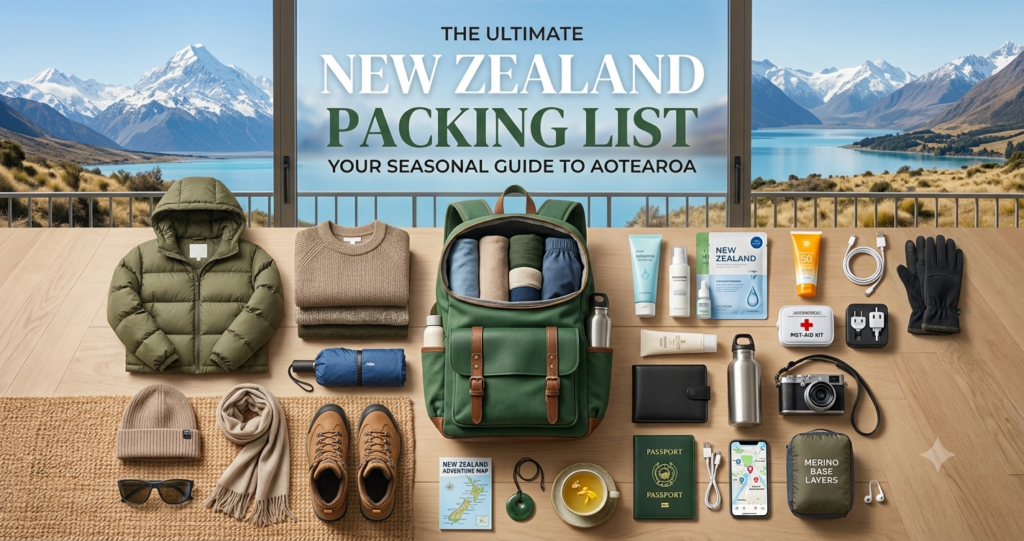
New Zealand is one of the world’s most dramatically diverse destinations — a country roughly the size of the UK that manages to contain active volcanoes, fjords rivalling Norway’s, the geothermal surrealism of Rotorua, one of the world’s most spectacular alpine road trips (the Milford Sound journey), Māori cultural depth, and a wine region that produces some of the finest Sauvignon Blanc and Pinot Noir on earth. Packing for New Zealand requires preparation for genuinely unpredictable weather — New Zealand’s famous saying “four seasons in one day” is not a joke — alongside hiking, geothermal activity, wine touring, city life in Auckland and Wellington, and the country’s strong outdoor adventure culture. Here’s your complete guide to what to wear in New Zealand.
New Zealand Weather: What to Expect
New Zealand’s weather is famously variable due to its position in the roaring forties wind belt and its mountainous terrain that creates dramatic microclimates within short distances. The North Island (Auckland, Rotorua, Wellington, Bay of Islands) is warmer and more subtropical in the north, with Wellington known for its wind. The South Island (Queenstown, Fiordland, Christchurch, Marlborough) has sharper seasonal contrasts — cold, snowy winters in the Southern Alps and Queenstown, Mediterranean-style summers in Marlborough and Nelson. Summer (December–February) brings warm temperatures (20–28°C in the North Island, 18–25°C in the South) but changeable weather. Winter (June–August) means snow sports in Queenstown and Wanaka, cool conditions in the North Island, and the possibility of hypothermia-risk conditions in Fiordland regardless of season. The key rule: pack layers and a waterproof jacket regardless of the season or destination within New Zealand.
What to Wear in New Zealand: Clothing Guide
The Essential New Zealand Layering System
New Zealand’s outdoor culture and changeable weather make layering essential year-round. The standard approach — a moisture-wicking base layer, a mid-layer (fleece or merino wool), and a waterproof outer shell — covers the full range of New Zealand conditions from Fiordland rain to Queenstown sunshine. Merino wool is particularly excellent for New Zealand travel: it’s lightweight, odour-resistant, temperature-regulating, and — appropriately — New Zealand is one of the world’s leading merino producers. Icebreaker (New Zealand’s own merino brand) makes outstanding base and mid-layers perfect for NZ travel.
- Merino wool base layers — lightweight merino t-shirts and long-sleeved tops regulate temperature beautifully across NZ’s conditions
- A fleece or merino mid-layer for warmth (essential year-round in the South Island and highlands)
- A waterproof, breathable outer jacket (Gore-Tex or equivalent) — the most important single item for New Zealand travel
- 2–3 casual everyday outfits for city exploring in Auckland, Wellington, and Queenstown
- Comfortable jeans or hiking trousers that work from trail to café
Hiking & Outdoor Adventure
New Zealand has nine Great Walks — the world’s finest collection of multi-day hiking routes, including the Milford Track, Routeburn Track, Tongariro Alpine Crossing, and Abel Tasman Coastal Track. Even single-day hikes on the Tongariro Alpine Crossing or the Fiordland tracks require proper hiking gear; New Zealand’s DOC (Department of Conservation) actively turns away ill-equipped hikers on alpine routes.
- Waterproof hiking trousers or convertible zip-off trousers
- Moisture-wicking hiking tops in multiple layers
- A sun hat for high-altitude UV exposure (NZ has one of the world’s highest UV indexes due to the ozone layer thinning over the Southern Ocean)
- Lightweight gaiters for muddy trails (New Zealand’s trails can be exceptionally muddy, particularly in Fiordland)
City Style: Auckland & Wellington
Auckland is New Zealand’s largest city and Pacific commercial hub — urban, multicultural, and relaxed in dress culture. The Viaduct Harbour dining precinct and Ponsonby Road’s independent restaurant scene are smart casual. Wellington — New Zealand’s compact, walkable capital — has a particularly strong café and restaurant culture (regularly cited as having more cafés per capita than New York) and a creative, arts-focused atmosphere. Wellington dresses slightly more intentionally than Auckland; a good jacket, quality jeans, and nice boots work perfectly for Wellington’s Cuba Street and Courtenay Place scene.
- Quality jeans or smart casual trousers for city exploring
- A smart blazer or structured jacket for Wellington and Auckland restaurant evenings
- Nice ankle boots or leather sneakers — the standard New Zealand city shoe
- Comfortable everyday tops that work for both daytime café culture and evening dining
Queenstown: Adventure & Après-Ski
Queenstown is New Zealand’s adrenaline capital — bungee jumping, skydiving, jet boating, and in winter, excellent skiing and snowboarding on the Remarkables and Coronet Peak ski fields. Queenstown also has a sophisticated après-ski and dining scene that rewards warmer, smarter evening wear after a day on the slopes or the lake. In summer, Queenstown’s lakeside setting and surrounding Otago wine country makes it one of New Zealand’s most beautiful bases.
- Winter: ski jacket and technical base layers for skiing; warm après-ski jacket, knitwear, and boots for Queenstown’s vibrant evening restaurant and bar scene
- Summer: layers for Milford Sound day trips (the fjord creates its own microclimate and is cold and wet regardless of Queenstown sunshine) plus casual warm-weather city wear
Shoes for New Zealand
- Waterproof hiking boots with ankle support — essential for the Great Walks and most South Island trails
- Waterproof trail runners — lighter alternative for day hikes and Abel Tasman Coastal Track (which is well-maintained)
- Quality leather ankle boots or Chelsea boots for city use
- Sandals or comfortable casual shoes for summer city days in Auckland and Nelson
New Zealand Packing Essentials
- SPF 50+ sunscreen and UV-protection sunglasses (New Zealand has some of the world’s highest UV radiation levels; sunscreen is non-negotiable even on overcast days)
- Insect repellent (New Zealand’s sandflies — particularly in Fiordland and the West Coast — are legendarily aggressive and relentless; DEET-based repellent is necessary in these areas)
- A reusable water bottle (New Zealand’s tap water is among the world’s cleanest and safest; refill at any tap)
- An e-SIM or local SIM card (New Zealand’s remote areas have limited coverage; download offline maps before heading into Fiordland, the West Coast, or the Mackenzie Basin)
- A compact day backpack for hikes, wine tours, and inter-city exploring
What to Wear for New Zealand’s Top Experiences
Tongariro Alpine Crossing
The Tongariro Alpine Crossing in the central North Island is consistently rated one of the world’s great one-day hikes — a 19.4km route across an active volcanic landscape of emerald crater lakes, steaming vents, and lava flows. The crossing traverses the South Crater and Red Crater at altitudes up to 1,886m, where conditions can change rapidly from sunshine to cloud, wind, and even snow regardless of season. Proper hiking boots (not trail runners — the volcanic rock is sharp), waterproof jacket, warm layers, sun protection, and at least 2 litres of water are essential. DOC rangers turn away hikers in jeans and sneakers; take the warning seriously. Shuttles run from Whakapapa and National Park villages.
Milford Sound
Milford Sound — the most famous of Fiordland’s fjords, with Mitre Peak rising 1,692m directly from the water — receives over 7 metres of rainfall per year, making it one of the wettest places on earth. Waterfalls cascade from every cliff face after rain. A cruise on the fjord (1–2 hours, operated daily) is the essential Milford experience. The sound creates its own climate; even on a warm Queenstown day, Milford can be cold, wet, and overcast. Bring a waterproof jacket, warm layers, and waterproof footwear regardless of the season or the Queenstown weather forecast. The drive to Milford through the Homer Tunnel is spectacular.
Rotorua: Geothermal & Māori Culture
Rotorua sits atop one of the world’s most active geothermal fields — boiling mud pools, erupting geysers, and sulphurous steam vents throughout the town create an otherworldly landscape. Wai-O-Tapu Thermal Wonderland and Te Puia are the best geothermal sites. Rotorua is also the most accessible centre for Māori cultural experiences — the Te Ara Aho pathway, Tamaki Māori Village, and whānau-run cultural experiences offer genuine engagement with New Zealand’s indigenous culture. Casual comfortable clothing suits Rotorua’s geothermal site walking; the sites involve uneven wooden boardwalk paths and occasional steam. The smell of sulphur does not come out of synthetic fabrics easily — wear older clothes or easy-wash cotton near the mud pools.
New Zealand Outfit Mistakes to Avoid
- Attempting the Tongariro Alpine Crossing in jeans and trainers: This is New Zealand’s most dangerous tourist mistake. DOC rangers turn away ill-equipped hikers, and conditions on the crossing can be life-threatening for those without waterproof clothing and proper footwear. Hire equipment in Whakapapa village if necessary, but do not attempt the crossing without proper gear.
- Underestimating Fiordland’s sandflies: The sandflies of Milford Sound, Doubtful Sound, and the West Coast are extraordinary in their persistence. DEET-based insect repellent (minimum 30%) is non-negotiable in these areas. Applying it to all exposed skin before getting off the bus at Milford is the first thing experienced visitors do.
- Leaving sunscreen in the bag on overcast days: New Zealand’s UV index is extreme even through cloud — the Southern Hemisphere’s ozone thinning allows higher UV penetration than equivalent latitudes in the Northern Hemisphere. Apply SPF 50 daily regardless of cloud cover.
- Packing only for warm weather: Many visitors book New Zealand in their home-country summer (January, Northern Hemisphere) and pack for tropical conditions. New Zealand’s South Island in January can be 22°C in the valleys and 5°C with wind and rain in the alpine areas — sometimes within the same day. Layers and a waterproof jacket are non-negotiable.
New Zealand FAQ
Do I need a visa for New Zealand?
New Zealand requires an NZeTA (New Zealand Electronic Travel Authority) for visa-waiver nationalities — this includes UK, EU, US, Canadian, and many other Western passport holders. The NZeTA is applied for online via the New Zealand Immigration website or app before travel, takes 24–72 hours to process, and costs NZ$23 (app) or NZ$17 (online). You must also pay an International Visitor Conservation and Tourism Levy (IVL) of NZ$100 at the same time. Australian citizens travel freely. Ensure your passport has at least 3 months validity beyond your planned departure date.
How long should I spend in New Zealand?
New Zealand rewards time. Two weeks is the minimum to see both islands without rushing — a week on the North Island (Auckland, Bay of Islands or Coromandel, Rotorua, Tongariro, Wellington) and a week on the South Island (Queenstown, Milford Sound, the West Coast Glacier region, and either the Marlborough wine country or Abel Tasman). Three weeks allows a more relaxed pace and the possibility of one of the Great Walks. A month lets you drive the entire length of both islands at a genuinely comfortable pace.
Is New Zealand safe for solo female travellers?
New Zealand is consistently ranked among the world’s safest countries for solo female travellers. Violent crime rates are low, towns and cities are well-lit and walkable, and New Zealand has a culture of genuine hospitality and looking after travellers. The primary safety considerations are outdoor rather than social: weather conditions in alpine areas change rapidly and can be life-threatening for unprepared hikers; always check DOC weather forecasts before any alpine or remote hike, and let someone know your plans. Hitchhiking, while practised by some travellers in New Zealand, is done at individual risk assessment.