Bali’s temples are among the most beautiful sacred spaces in the world — but they’re also the most common source of tourist confusion on the island. Every year, visitors are turned away at the gates of Uluwatu, Tanah Lot, and Tirta Empul simply because they didn’t know what to wear.
Unlike fashion guidelines that are ‘suggested,’ Bali’s temple dress code is enforced. Guards at the entrance will check, and if you don’t comply, you will not be allowed in — or you’ll be asked to cover up with a rented sarong at the gate. Knowing the rules in advance means you can dress deliberately, respectfully, and comfortably for your visit.
This guide covers exactly what to wear (and what not to wear) for Bali temple visits — including specific rules for the most popular temples, where to buy sarongs, and outfit ideas that look great while meeting the dress code.
Why Bali Has Temple Dress Codes
Balinese Hinduism is a living, daily practice — not a tourist attraction. Temples are active places of worship visited regularly by local Balinese for prayer, ceremony, and offerings. The dress code is a mark of respect for the sacredness of the space and the people who worship there.
In Balinese Hindu tradition, the lower body is considered spiritually significant. Covering from the waist down — specifically with a sarong — is a way of showing reverence. Shoulders are also expected to be covered at most temples as a general sign of modesty.
The Core Temple Dress Code Rules
These rules apply across virtually all Balinese Hindu temples:
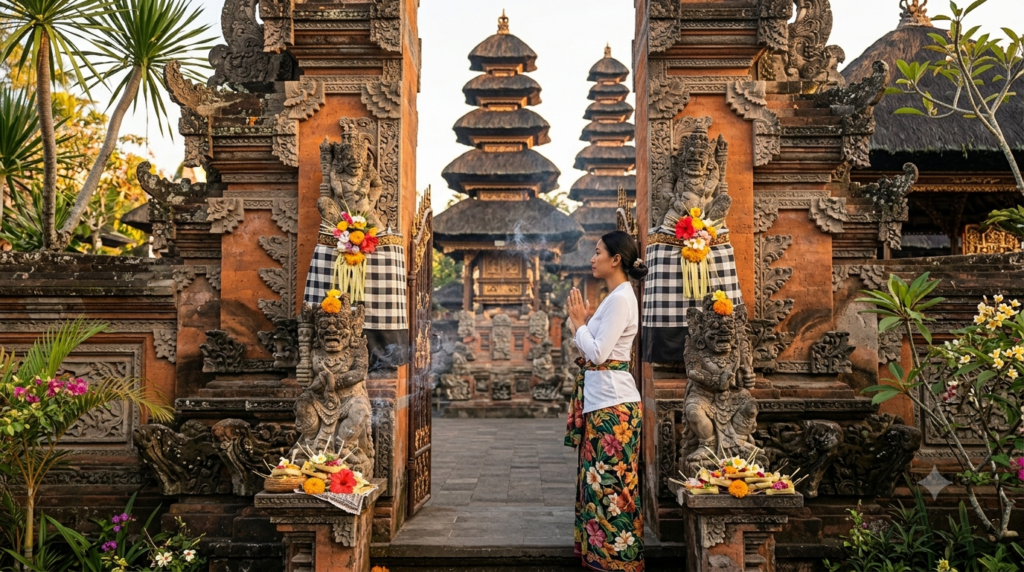
- Sarong required: A sarong must be tied around your waist, covering from waist to below the knees. This applies to all genders.
- Shoulders covered: A blouse, t-shirt, or sash covering the shoulders is required. Sleeveless tops and spaghetti straps alone are not acceptable.
- No shorts: Shorts alone (without a sarong over them) are not permitted inside temple grounds.
- No beachwear: Bikini tops, swimwear, and beach cover-ups are not appropriate temple attire.
- Menstruating women: Traditional Balinese belief holds that women who are menstruating should not enter the innermost areas of temples. Signage at major temples will note this.
What to Wear: Women’s Complete Guide
The Sarong — Your Most Important Item
A sarong is a rectangular piece of fabric — typically 1.5 to 2 metres long — that wraps around your waist and is tied or tucked at the side. For temples, it must cover from the waist to below the knee.
How to tie a sarong: Hold the sarong horizontally in front of you. Wrap it around your waist, pulling one end in front of the other. Tuck or knot securely at one side. The fabric should sit just at or above the waist and fall to mid-calf or below.
Outfit Idea 1: The Easiest Temple Look
White or light-coloured linen or cotton blouse (loose, covers shoulders) + lightweight trousers or a midi skirt + sarong tied over the top. This is comfortable, cool, and completely effortless. The sarong doesn’t need to cover trousers if they’re full-length, but most temples will ask you to wear it regardless.
Best for: Tirta Empul, Besakih, Pura Taman Ayun
Outfit Idea 2: The Beach-to-Temple Transition
Sundress or midi dress with sleeves, or a lightweight blouse over a strappy dress + sarong. If your dress already covers your shoulders and falls to the knee, you may only need to add a sarong at the waist. A lightweight linen button-up shirt thrown over a sleeveless dress covers the shoulder requirement.
Best for: Tanah Lot, Uluwatu, Gunung Kawi
Outfit Idea 3: The Traditional Balinese-Inspired Look
Kebaya top (traditional Balinese lace blouse) + batik sarong tied at the waist + a sash (selendang). This is the most respectful and authentic way to dress for a temple visit. Many local dress hire shops near major temples offer kebaya sets for rent. It’s a beautiful way to engage with Balinese culture.
Best for: Any temple, particularly during ceremonies
What to Wear: Men’s Guide
- Shirt with sleeves: A t-shirt is acceptable. A linen or cotton short-sleeve shirt is ideal.
- Sarong or long trousers: A sarong tied at the waist over shorts, or long linen trousers alone, meets the requirement.
- Sandals: Appropriate footwear — no bare feet on paths to the temple, though you may need to remove shoes before entering inner sanctuaries.
Dress Code by Temple: What You Actually Need
Tanah Lot
Bali’s most photographed temple sits on a sea rock accessible only at low tide. The dress code here is strictly enforced. Sarong and sash are mandatory — both are available to rent at the entrance for a small fee. The rocky terrain means comfortable, secure footwear is important.
Dress requirement: Sarong (provided free or rented at gate), covered shoulders, no beachwear.
Uluwatu Temple
Perched dramatically on a clifftop at Bali’s southern tip, Uluwatu is famous for its Kecak fire dance performances at sunset. Sarongs and sashes are provided at the gate and must be worn. The temple is also home to cheeky monkeys — keep jewellery and sunglasses secured.
Dress requirement: Sarong and sash provided at entrance, covered shoulders mandatory.
Tirta Empul (Holy Springs Temple)
Tirta Empul is a water purification temple where visitors can participate in a ritual bathing ceremony (melukat) in the sacred spring pools. If you plan to bathe, you’ll need to wear a sarong or clothes you can get wet into the water. Participating respectfully — following the steps and moving through in the correct order — is expected.
Dress requirement: Sarong and sash required. If participating in the bathing ritual, wear clothes you can get wet. Sarongs provided to rent.
Besakih Temple (Mother Temple)
Bali’s largest and most sacred temple complex on the slopes of Mount Agung has the strictest dress code. Non-Hindus are typically not permitted inside the inner temple during religious ceremonies. Outside of ceremonies, respectful dress is required at all times — sarong, sash, and covered shoulders.
Dress requirement: Full sarong and sash, covered shoulders, no shorts.
Pura Taman Ayun (Royal Temple, Mengwi)
A beautiful UNESCO-listed royal temple surrounded by a moat. The grounds are peaceful and less crowded than the main tourist temples. Sarong and sash are required and can be rented at the entrance. The flat, well-maintained grounds are easy to walk in sandals.
Dress requirement: Sarong and sash (rental available at entrance), covered shoulders.
Where to Buy or Rent a Sarong in Bali
- Rent at the gate: Almost every major temple provides sarongs to rent or borrow for free (sometimes requesting a small donation). These are the easiest option.
- Buy at a local market: Ubud Market, Kuta Art Market, and most street markets in Bali sell sarongs for IDR 30,000–80,000 (roughly $2–$5 USD). Buying your own means you have it for every temple visit on the trip.
- Bring one from home: A lightweight rectangular scarf or fabric wrap works perfectly as a sarong. Pack one from home if you’re planning multiple temple visits.
- Kebaya hire: Near Tanah Lot, Uluwatu, and Tirta Empul, local dress hire shops rent full traditional Balinese dress (kebaya + sarong + sash) for a more immersive experience.
What NOT to Wear to Bali Temples
- Bikini tops or swimwear (even with a sarong over the bottom)
- Very short shorts or miniskirts (without a full-length sarong over them)
- Tight or revealing clothing
- Bare feet on the paths (acceptable only in inner sanctuaries when requested)
- Hats inside inner temples (remove when entering sacred spaces)
Frequently Asked Questions
Do I have to buy a sarong in Bali?
No. Every major tourist temple in Bali provides sarongs to wear at the entrance — either free, by donation, or for a small rental fee. However, buying your own sarong at local markets gives you the freedom to choose your own and not depend on rentals.
Can I wear a maxi dress to a Bali temple?
Yes, if it covers your shoulders and falls to the knee or below, a maxi dress meets the main requirements. You will still likely need to tie a sarong at the waist at most temples. A maxi dress with sleeves or sleeves that cover the shoulder is the easiest compliant outfit.
What happens if I’m not dressed appropriately?
Guards at the temple entrance will not allow you to enter without meeting the dress code. In most cases, you’ll be offered a sarong to rent or borrow at the gate. In some temples during religious ceremonies, even with a sarong, non-Hindu visitors may be asked to remain in certain public areas only.
Do I need to remove shoes at Bali temples?
Not typically on the paths and outer courtyards. Some inner sanctuaries or specific areas of temples may require you to remove shoes — look for signage and follow the lead of other worshippers.
Is there a specific colour I should wear to temples?
There’s no strict colour rule for visitors, but white is considered auspicious in Balinese Hindu tradition and is commonly worn by local worshippers. Black is typically worn for religious ceremonies involving death and mourning. For everyday temple visits, any modest, respectful colours are fine.
Final Thoughts: Dress with Respect
Bali’s temples are genuinely spectacular — but they’re most meaningful when you visit them with the right mindset and the right outfit. Spending two minutes tying a sarong at your waist is a small gesture of respect that makes your presence in a sacred space far more appropriate.
A flowing linen blouse and a beautiful batik sarong is an elegant, cool, and genuinely lovely way to dress in the Bali heat — and you’ll find that this approach works as well for exploring Ubud’s rice terraces or a quiet village temple as it does for the famous tourist sites. Pack one good sarong, bring a lightweight blouse, and you’ll never be turned away from a Bali temple gate.
✈️ Trip Essentials
Affiliate links — we may earn a small commission at no extra cost to you.
✈️ Trip Essentials
Affiliate links — we may earn a small commission at no extra cost to you.
Find the perfect base for your Bali trip — jungle retreats in Ubud, beach villas in Seminyak or clifftop hotels in Uluwatu.
Discover top-rated tours and experiences worldwide. Instant booking, free cancellation on most activities.