
Strict — Grand Palace dress code — covered shoulders, knees, and no sleeveless tops allowed
Slip-on — Best shoe style for Thailand — temple shoe removal is required multiple times daily
Cotton — Best fabric for Thai heat — breathable, quick-dry, and widely available locally
Night market — Most common evening activity in Thailand — casual clothing entirely appropriate
Scarf — Most versatile accessory in Thailand — temple cover, sun protection, and AC layer
Thailand Rewards Practical Dressing Over Fashionable Dressing
Of all Southeast Asian destinations, Thailand is where practical outfit choices pay off most — the combination of extreme heat, frequent temple visits requiring shoe removal and modest coverage, sudden rain showers, and the constant indoor-outdoor temperature shift between air conditioning and 35°C streets makes every clothing choice matter more than on a typical beach vacation.
The Grand Palace and Wat Pho: Bangkok’s Strictest Dress Codes
The Grand Palace complex is Thailand’s most visited attraction and has the country’s most enforced dress code. Requirements: no shorts, no sleeveless tops, no flip flops (sandals with a back strap are acceptable), covered shoulders, and covered knees. Staff at the gate turn away visitors not meeting the standard, and loaner clothing is available on site — but wearing your own appropriate outfit is more comfortable and faster. A lightweight midi dress or cotton trousers with a button-up short-sleeve shirt is the most practical Grand Palace outfit.
Night Markets: Bangkok, Chiang Mai, and Beyond
Thailand’s night markets — Chatuchak in Bangkok, the Sunday Walking Street in Chiang Mai, night bazaars across most tourist towns — have no dress code whatsoever and are some of the most relaxed social environments in the country. Comfortable casual clothing, flat shoes (markets involve a lot of standing and walking on uneven surfaces), and a crossbody bag worn in front for security are the practical priorities here.
Bangkok Rooftop Bars and Fine Dining
Bangkok has a legitimate upscale dining and rooftop bar scene — Sky Bar at Lebua and similar venues have smart casual dress standards that exclude beach wear, shorts, and flip flops. A simple dress or tailored linen trousers with a nice top covers Bangkok’s evening scene without needing anything heavy or formal in your suitcase.
Boat Trips and Island Hopping
Thailand’s famous island-hopping boat tours involve hours on open water with no shade — a rash guard or UPF long-sleeve top is worth packing specifically for these days. The combination of sun reflection off the water and extended exposure time makes boat days the highest sun-damage risk of any Thailand activity, despite feeling cooler in the sea breeze.
The One Accessory That Solves Three Problems
A large, lightweight cotton or linen scarf is the single most useful accessory you can carry in Thailand daily. It functions as a shoulder cover for temple entry, a lap covering for seated outdoor areas, and a layer for air-conditioned restaurants and transport — three distinct needs addressed by one small item that takes up almost no space.
| Situation | Outfit | Key Item |
|---|---|---|
| Grand Palace visit | Midi dress + sleeved layer | Slip-on shoes |
| Night market | Casual cotton outfit | Front-worn crossbody bag |
| Rooftop bar | Simple dress or linen trousers | Flattering but comfortable shoes |
| Boat / island day | Swimwear + rash guard | UPF sun protection |
Thinking about exploring Thailand on your own? Our solo travel guide covers packing light and staying safe when traveling solo.
Frequently Asked Questions
What happens if I’m turned away from the Grand Palace for dress code?
The Grand Palace provides loaner clothing (sarongs and tops) at the gate for a deposit. However, the queue for loaner clothing can be long and the options are limited — wearing your own appropriate outfit saves significant time and discomfort.
Can I wear sleeveless dresses anywhere in Thailand?
Yes — sleeveless clothing is fine in most tourist areas, restaurants, markets, and beach destinations. The exception is temple visits, where covered shoulders are required. Carrying a lightweight scarf to add when needed is the easiest solution.
What shoes are best for Thailand overall?
Slip-on flat sandals are the practical answer for most of Thailand — they handle the heat, come off quickly for temple entry, and work across markets, restaurants, and beach areas. Add a pair of comfortable walking shoes for longer city days and boat excursions.
Is it offensive to dress casually as a tourist in Thailand?
In beach and tourist areas, casual dress is entirely normal and expected. The cultural sensitivity around dress applies specifically to temples and religious sites — in those contexts, making the effort to dress modestly is genuinely appreciated by local communities.
How do I handle Thailand’s combination of heat and heavy rain?
Pack a small packable rain poncho and choose fabrics that dry quickly — cotton and linen dry far faster than polyester in humid conditions. Footwear that can get wet and drain quickly (like quality rubber sandals) is also worth considering for the rainy season months.
Simple, Breathable, and Respectful
The best Thailand wardrobe is built on three principles: breathable natural fabrics for the heat, modest coverage that can be added quickly for temple visits, and practical shoes for the constant movement between environments. Master these and the specific outfit choices largely take care of themselves.
✈️ Trip Essentials
Affiliate links — we may earn a small commission at no extra cost to you.
✈️ Trip Essentials
Affiliate links — we may earn a small commission at no extra cost to you.
Beach resorts in Phuket, boutique hotels in Chiang Mai and rooftop stays in Bangkok.
Skip the tourist traps — book top-rated tours, day trips and experiences in Thailand with instant confirmation.
Ready to start packing? See our complete Thailand packing list for women for everything you need to bring.
📌 Related: Bali is a popular next stop after Thailand for many travellers. Our Bali outfit guide covers everything from beach wear to temple attire.
Thailand Packing List
Thailand is one of the most diverse destinations in Southeast Asia — a country where you can swim in the Andaman Sea in the morning, explore a gilded Buddhist temple at noon, and eat some of the world’s best street food by evening. Packing for Thailand means solving a specific puzzle: you need clothes light enough for 35°C heat and humidity, modest enough for sacred temples, and stylish enough for beach clubs and upscale Bangkok restaurants. Here’s your complete Thailand packing list for women.
Thailand Weather & When to Visit
Thailand’s climate varies by region and season. Cool and dry season (November to February): the best time to visit most of Thailand — temperatures 25–32°C, low humidity, minimal rain. This is peak season; book accommodation and tours in advance. Hot season (March to May): temperatures reach 35–40°C, extremely humid and hazy. Manageable but demanding. Wet/monsoon season (June to October): heavy rainfall, especially on the Andaman coast (Phuket, Krabi); the Gulf of Thailand coast (Koh Samui, Koh Phangan) has a different monsoon pattern and can be pleasant when the Andaman is wet. Prices are lower in wet season and crowds are thin, but flooding is possible.
Thailand Packing List: Clothing
Everyday Clothing
- 3–4 lightweight breathable dresses in natural fabrics (linen, cotton, rayon) — the most versatile item in Thailand; works for beach, temples (with a cover-up), restaurants, and markets
- 2–3 loose-fitting tops in moisture-wicking or natural fabrics
- 1–2 pairs of lightweight trousers or harem pants (essential for temple visits where knees must be covered)
- 1–2 pairs of shorts for beach days and casual exploration
- Swimsuit or bikini (2 if beach-focused; Thailand’s beach culture is active)
- 2–3 swimsuit cover-ups — needed for beach-to-restaurant transitions and keeping cool when not swimming
Temple-Ready Clothing (Essential in Thailand)
Thailand’s Buddhist temples (wats) require covered shoulders and knees. This is strictly enforced at major temples like Wat Pho, Wat Arun, and Doi Suthep. Many temples sell or lend sarongs at the entrance, but having your own is more comfortable and reliable. A lightweight scarf that doubles as a shoulder wrap and knee cover-up is the most practical solution — pack at least one.
Shoes
- Flip-flops or sandals (you remove shoes constantly at temples, guesthouses, and restaurants — slip-ons are essential)
- Comfortable walking sandals with support (Birkenstock-style or sport sandals) for full days of sightseeing
- Lightweight trainers if trekking in Chiang Mai or northern Thailand
- Avoid high heels — Bangkok’s streets and temple grounds are uneven
Essentials
- DEET insect repellent (essential, especially in northern Thailand and during wet season — dengue fever risk is real)
- SPF 50 sunscreen
- Lightweight scarf or pashmina (temple cover-up, air-conditioned bus/plane warmth, beach layer)
- Small daypack or crossbody bag
- Portable power bank
- Reusable water bottle with filter or purification tablets (tap water is not drinkable; plastic waste is a serious environmental issue in Thailand)
- Electrolyte sachets (dehydration in Thailand’s heat is common)
- Basic first aid kit with antihistamine cream (mosquito bites are inevitable)
- Thai baht in cash (markets, street food, tuk-tuks, and smaller towns are cash-only)
What to Wear in Thailand: By Destination
Bangkok: City, Temples & Street Food
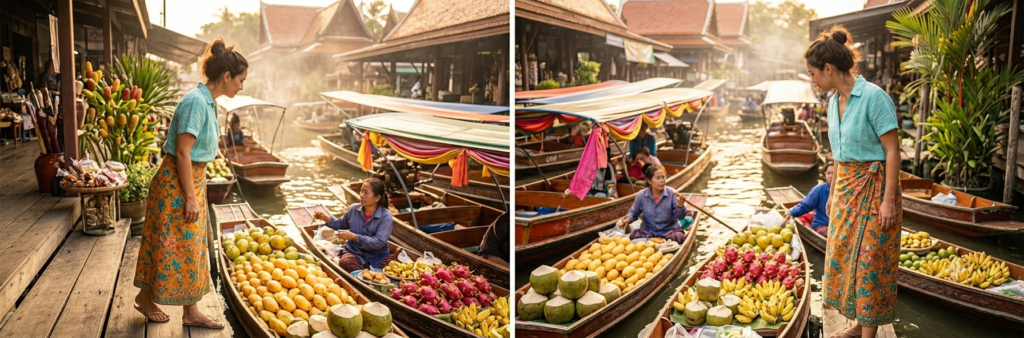
Bangkok is one of Asia’s most dynamic capitals — an extraordinary density of Buddhist temples, world-class street food markets, luxury shopping malls (Siam Paragon, CentralWorld), vibrant nightlife, and the floating markets of the canals. In Bangkok, the dress code spans extremes: temple visits require modesty, but the city’s upscale Sukhumvit restaurant and bar scene is surprisingly fashion-forward. A good Bangkok approach is a modest sundress you can accessorise up for evenings, paired with a lightweight cardigan for the city’s intensely air-conditioned indoor spaces.
Chiang Mai: Temples, Trekking & Night Markets
Chiang Mai in northern Thailand has a cooler, slightly more relaxed atmosphere than Bangkok — a city of moat-surrounded temples, elephant sanctuaries, hill tribe trekking, and the famous Saturday and Sunday Night Markets. Temperatures are cooler than the south (especially November to February when evenings can drop to 15°C), so pack a light jacket. Trekking activities require more practical clothing: lightweight moisture-wicking trousers, good walking shoes, and insect repellent are essential. The Night Bazaar and Sunday Walking Street are wonderful for shopping in comfortable casual clothes.
Phuket, Krabi & Phi Phi Islands
Thailand’s Andaman coast is famous for its turquoise water, limestone karsts, and beach club culture. Phuket’s Patong Beach has lively nightlife; Ao Nang in Krabi is quieter and more family-friendly; Phi Phi Islands (accessible by ferry from Phuket or Krabi) have some of Thailand’s most beautiful beaches. Beach packing here is essential: swimwear, cover-ups, a beach bag, and sun protection. Beach clubs (Café del Mar Phuket, Catch Beach Club) have casual dress codes but expect you to be properly dressed away from the pool area. Island evenings are casual — sundresses and flat sandals suit the beach town atmosphere.
Koh Samui, Koh Phangan & Koh Tao
Thailand’s Gulf of Thailand islands have a different character: Koh Samui balances luxury resorts with backpacker culture; Koh Phangan is legendary for the Full Moon Party (pack a festival-ready beach outfit if visiting during one); Koh Tao is the dive capital of the region. The island atmosphere is relaxed — beachwear, cover-ups, and light casual clothing rule the day. Koh Samui has some excellent upscale restaurants where a nice sundress or linen set is appropriate for dinner.
Sukhothai & Ayutthaya: Ancient Capitals
Thailand’s ancient capitals are outdoor archaeological parks — extensive temple complexes best explored by bicycle or tuk-tuk. Modest clothing covering shoulders and knees is required throughout, and the sites are exposed with minimal shade. Lightweight, breathable trousers and a long-sleeved sun shirt offer both modesty and sun protection. Visit early morning (before 9am) to avoid the worst heat and to experience the sunrise light over the ruins.
Common Packing Mistakes in Thailand
- Bringing too much: Thailand has some of the world’s best and cheapest shopping — excellent lightweight clothing, beautiful scarves, and stylish beach gear are all available at markets. Pack light and supplement your wardrobe locally.
- Not packing a temple layer: Forgetting modest clothing means buying or renting a temple sarong at the entrance. Pack your own lightweight cover-up to avoid this.
- Wearing dark, heavy fabrics: Black jeans and dark denim in 35°C humid heat are genuinely uncomfortable. Light colours and natural fabrics make a significant quality-of-life difference.
- Ignoring insect repellent: Dengue fever is present in Thailand and transmitted by Aedes mosquitoes that bite during the day. DEET-based repellent is essential, especially in northern Thailand and during wet season.
- Not carrying cash: While Bangkok’s malls accept cards, markets, street food stalls, tuk-tuks, and smaller establishments are cash-only. Always carry baht.
Thailand Packing FAQ
Is Thailand safe for solo female travellers?
Thailand is generally very safe for solo female travellers and is one of Southeast Asia’s most popular solo travel destinations. Common sense precautions apply: be cautious accepting drinks from strangers, use reputable transport (Grab app is the Thai equivalent of Uber and is reliable), and research accommodation carefully. Thai culture is generally friendly, hospitable, and respectful towards visitors.
What is the dress code at Thai temples?
Shoulders and knees must be covered at all Buddhist temples. Sleeveless tops, shorts, and short skirts are not permitted. Most temples will turn you away or offer a sarong to borrow/buy at the entrance. Women should also remove footwear before entering temple buildings. At some temples (particularly Doi Suthep in Chiang Mai), the dress code is enforced strictly by attendants at the gate.
Can I buy clothing in Thailand?
Thailand is excellent for buying lightweight, inexpensive clothing. Bangkok’s Chatuchak Weekend Market, Chiang Mai’s Night Bazaar, and beach markets everywhere sell reasonably priced linen trousers, beach dresses, cover-ups, and cotton tops. Sizing tends to run smaller than Western standards — try before buying if possible. Thai cotton and silk products make excellent purchases: lightweight, beautiful, and genuinely useful for the climate.
What currency is used in Thailand and how much should I carry?
Thai Baht (THB). Exchange rates are generally best at in-country ATMs or licensed exchange booths (SuperRich or Vasu exchange booths in Bangkok offer excellent rates). Avoid airport exchange counters for large amounts. Carry ฿500–1,000 per day for markets, street food, transport, and tips; more if shopping. Most ATMs charge a ฿200–220 foreign transaction fee per withdrawal, so withdraw larger amounts less frequently.
Pingback: Thailand Packing List for Women: What to Pack for Thailand - Vacation Style Guide
Pingback: What to Wear in Cambodia: Angkor Wat, Phnom Penh & Beach Outfit Guide - Vacation Style Guide
Pingback: Solo Travel Outfits for Women: The Complete Packing Guide - Vacation Style Guide