
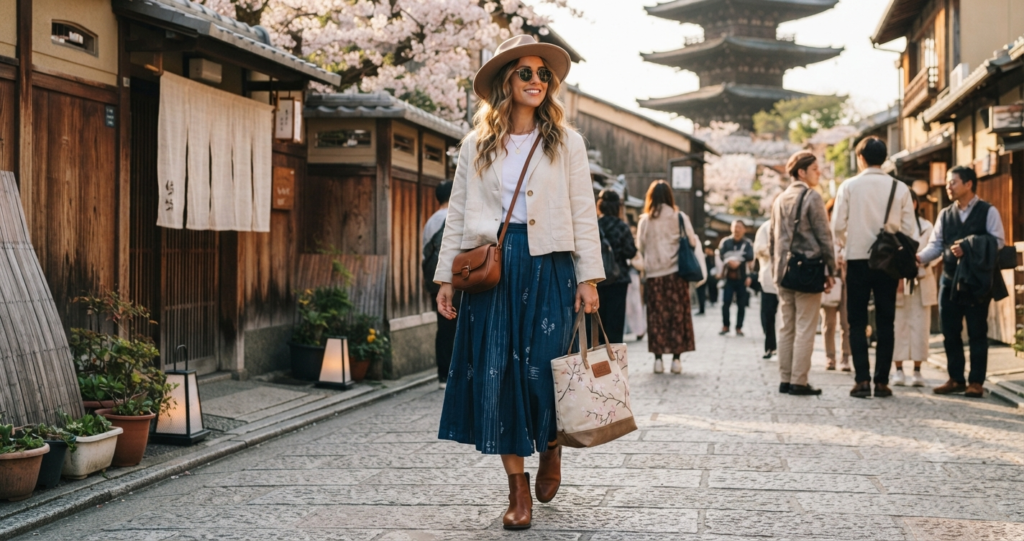
Japan is one of the most style-conscious countries on Earth. What you wear matters — for cultural respect at temples and shrines, for comfort navigating 30,000 daily steps, and for not standing out as the obvious tourist in a country where locals dress with extraordinary care.
Japan Dress Code Rules: The Non-Negotiables
At Temples and Shrines
- Shoes off at certain indoor temple areas — wear clean socks (no holes)
- No bare feet indoors — socks are expected when shoes come off inside tatami rooms, temples, and many traditional restaurants
- Very revealing clothing (short shorts, crop tops) will draw stares at traditional sites like Fushimi Inari or Kinkaku-ji
At Onsen (Hot Springs)
- No swimwear — public baths are entered nude
- Most traditional onsens ban tattoos; private onsens usually allow them
- Many ryokans provide a yukata (lightweight cotton kimono) to wear between room and baths
What to Wear by City
Tokyo
Tokyo is a city of fashion extremes. The rule: simple, clean, well-fitted basics elevated with one interesting element. Oversized, neutral, or monochromatic outfits are extremely popular with Tokyo locals. Shibuya/Harajuku: experiment with bold outfits. Asakusa (Senso-ji): more conservative dress is appropriate.
Kyoto
Japan’s most traditional city. Linen or breathable trousers/maxi skirt, simple top, comfortable walking shoes. Renting a kimono for a day in Kyoto is quintessential — rental shops are everywhere around Higashiyama for 1,000–2,000 yen.
Osaka
Japan’s most casual, outgoing city. Casual, comfortable, practical. Comfortable shoes are essential — Osaka’s food-stall streets require constant walking.
What to Wear by Season
Spring (March–May) — Cherry Blossom Season
10–25°C. Layering is essential. A light jacket or cardigan for evenings. Comfortable walking shoes for hanami (cherry blossom viewing) park walks.
Outfit formula: Lightweight trousers or midi skirt + simple top + light cardigan + ankle boots
Summer (June–August) — Hot and Humid
30–38°C with 80–90% humidity. Loose-fitting clothing, a folding fan, a packable umbrella, moisture-wicking everything. Buildings are heavily air-conditioned — carry a cardigan for indoors.
Autumn (October–November) — Best Season
15–25°C, beautiful koyo (autumn foliage). Slim jeans or tailored trousers + knit top + structured blazer or denim jacket + ankle boots.
Winter (December–February)
0–10°C in Tokyo. Coat, scarf, gloves. Thermal base layers for Hokkaido or ski areas.
Complete Japan Packing List
- 3–4 × simple, neutral tops (white, black, navy, grey)
- 2 × comfortable trousers or jeans
- 1 × midi skirt or dress (temple-appropriate)
- 2–3 × light layers (cardigan, blazer, lightweight jacket)
- 1 × compact umbrella (or buy a Japanese one for under $5)
- Multiple pairs of clean socks with no holes
- Comfortable walking shoes — 15–20km daily
- Small, structured bag that closes securely
What NOT to Wear in Japan
- Loud logos or heavy branding — Japanese fashion strongly favors subtle, minimal branding
- Flip flops in the city — sandals with a heel strap are acceptable; bathroom-style flip flops are not
- Dirty or scruffy footwear — Japan is obsessively clean; dirty shoes get noticed
- Shoes you can’t slip on and off quickly — laced hiking boots in traditional restaurants mean blocking the entrance
Exploring more of Asia? See our Asia travel style guide for outfit ideas across the continent.
Frequently Asked Questions
Can I wear shorts in Japan?
Yes — shorts are worn by Japanese people and tourists alike in summer. There’s no cultural prohibition. In very traditional settings like tea ceremonies, slightly more formal clothing is appreciated but not required.
What shoes should I wear in Japan?
Clean, comfortable, easy-on-and-off footwear. Clean sneakers (minimally branded, in good condition) work everywhere. Slip-on shoes save time and frustration when visiting traditional spaces.
🗺️ Plan Your Japan Trip
Ready to go? Find the best tours, activities, and cheap flights below.
We may earn a commission at no extra cost to you. Disclosure
✈️ Trip Essentials
Affiliate links — we may earn a small commission at no extra cost to you.
Find ryokan guesthouses, Tokyo skyscraper hotels, Kyoto machiya stays and Osaka boutiques — compare hotels across Japan.
Skip the tourist traps — book top-rated tours, day trips and experiences in Japan with instant confirmation.
📌 Related: Tokyo deserves its own special attention when it comes to fashion. Read our dedicated Tokyo outfit guide with seasonal recommendations and Japanese fashion tips.
Japan 2026 Packing List
Japan is one of the world’s most extraordinary travel destinations — a country where ancient temples exist in harmony with bullet trains, where cherry blossoms carpet centuries-old castle grounds, and where every region has its own food, craft, and cultural identity. A Japan packing list for women needs to account for serious walking distances, frequent shoe removal at temples, Japan’s four distinct seasons, and the country’s quietly high standards for personal presentation. Here’s everything you need.
Japan Weather & When to Visit
Japan has four clear seasons — and each requires different packing. March to May (Spring): cherry blossom season (late March to mid-April) is peak travel time. Temperatures range from 8–22°C; pack layers. June to July: rainy season (tsuyu) — warm (22–28°C) with persistent rain. Pack a compact umbrella and quick-dry fabrics. July to August: hot and humid (30–36°C), especially in cities — breathable fabrics only. September to November (Autumn): spectacular autumn foliage, comfortable temperatures (12–24°C) — the second-best time to visit. December to February (Winter): cold (0–10°C in Honshu, much colder in Hokkaido) — pack a proper coat, thermals, and gloves.
Japan Packing List: Clothing
- 3–4 stylish, versatile outfits (Japan is fashion-conscious — dress a step above your usual travel casual)
- 2–3 smart-casual tops or blouses in elevated basics
- 1–2 pairs of well-fitting jeans or quality trousers
- 1 versatile dress that works for sightseeing and a nicer dinner
- Lightweight cardigan or layer (temples, air-conditioned trains and shops)
- Season-specific layers: light jacket for spring/autumn; breathable linen for summer; warm coat + thermals for winter
- Comfortable, stylish walking shoes that can be slipped on and off easily
- Compact umbrella or packable rain jacket (Japan is rainy — preparation is everything)
Shoes
- Comfortable walking shoes or cushioned trainers — broken in before the trip (20,000 steps daily is normal)
- Slip-on loafers or easy-on sandals (you remove shoes at temples, ryokan, many restaurants, and traditional homes constantly)
- 1 pair of nicer shoes for upscale restaurant evenings (optional but appreciated in cities like Tokyo and Kyoto)
Essentials
- IC card (Suica, Pasmo, or ICOCA) — pre-loaded for seamless train and bus travel across Japan
- Japan SIM card or pocket wifi (navigation is essential)
- Cash in yen (Japan is significantly cash-based; many of the best restaurants, temples, and rural shops are cash-only)
- Portable power bank
- Small daypack or stylish tote (large backpacks are inconsiderate on packed trains)
- Packable reusable shopping bag (for konbini hauls, Uniqlo and Muji purchases)
- Compact umbrella (always — Japan’s weather changes fast)
- Hand sanitiser and pocket tissues (not all public toilets provide paper)
- Travel insurance
What to Wear in Japan: By Destination
Kyoto: Temples, Geisha Districts & Arashiyama
Kyoto is Japan’s cultural heart — Fushimi Inari’s thousand torii gates, the geisha district of Gion, Arashiyama’s bamboo forest, and Kinkaku-ji’s golden pavilion. Modest, stylish dress is most appropriate here. Many visitors rent kimono or yukata for a day in Gion or Arashiyama — it’s beautiful, cultural, and available at countless rental shops for ¥3,000–¥8,000. Comfortable walking shoes are essential; Fushimi Inari’s summit is a two-hour uphill hike. Gion is best explored early morning before tourist crowds arrive — wear a light layer for the cool morning air.
Tokyo: Fashion, Street Style & City Energy
Tokyo is a world fashion capital — from Harajuku’s creative extremes to Ginza’s refined luxury to Shimokitazawa’s vintage-cool aesthetic. Every neighbourhood has its own style culture; dressing intentionally is noticed and appreciated. Comfortable trainers for the metro and sightseeing, a stylish outfit for evenings in Shinjuku or Roppongi, and slip-on shoes for temple visits cover your Tokyo wardrobe requirements. See the dedicated Tokyo packing list for neighbourhood-by-neighbourhood detail.
Osaka: Food, Markets & Castle
Osaka is Japan’s foodie capital and the most energetic, outgoing of Japan’s major cities. Dotonbori’s neon food district, Kuromon Ichiba market, and Osaka Castle are the main draws. Casual, comfortable clothes work well here — jeans and a nice top for the food alleys; walking shoes for the castle grounds (significant uphill walking). Osaka’s nightlife in Namba is lively and casual-to-smart; a sundress or jeans with a nice blouse covers most evening plans.
Hiroshima & Miyajima Island
Hiroshima’s Peace Memorial Park and Museum are deeply moving; dress quietly and respectfully. Miyajima Island (a short ferry ride) has the famous floating torii gate of Itsukushima Shrine — wear comfortable walking shoes for the island’s hilly trails and comfortable clothing for the shrine complex. Deer roam freely on Miyajima — they’re harmless but will investigate bags and food.
Hakone & Mt. Fuji
Hakone is the classic base for Mt. Fuji views — open-air art museums, ryokan onsen, and Owakudani volcanic zone. Pack walking shoes for the Hakone Open Air Museum and lake area, and a warm layer even in summer (altitude makes the area significantly cooler). If you’re climbing Mt. Fuji (July to mid-September only), you need proper hiking boots, thermal layers, a waterproof jacket, and altitude preparation.
Hokkaido (Sapporo, Niseko, Shiretoko)
Hokkaido is Japan’s northern island — dramatically different from Honshu. Winters are extreme (−15°C in Sapporo, world-class powder skiing in Niseko); pack thermal base layers, a heavy waterproof ski jacket, ski pants, and proper winter boots. Summer in Hokkaido (June to August) is Japan’s most pleasant — lavender fields in Furano, hiking in Daisetsuzan National Park — pack layers and waterproofs for unpredictable mountain weather.
Common Packing Mistakes for Japan
- Shoes that require effort to remove: Japan demands constant shoe removal — at temples, ryokan, many restaurants, and traditional homes. Lace-up shoes that take five minutes each time become genuinely exhausting. Pack at least one pair of easy slip-ons.
- Dressing too casually: Japan is a fashion-conscious society that values personal presentation. Worn-out travel clothes look out of place in upscale shopping districts and nice restaurants. Bring your best casual wear.
- No cash: Japan is still heavily cash-based. Many excellent small restaurants, temple entry fees, and rural shopping is cash-only. Always carry ¥5,000–¥15,000 in cash.
- Overpacking: Japan Post’s takkyubin luggage forwarding service lets you send your suitcase ahead to your next hotel (from convenience stores, hotels, or airports) for ¥1,500–¥2,500. Pack light and use this service between cities — it’s liberating.
- Forgetting a compact umbrella: Japan has unpredictable rain — especially in rainy season (June to July) and typhoon season (August to October). A compact umbrella lives in your bag at all times.
Japan Packing List FAQ
What is the dress code at Japanese temples and shrines?
Japan’s temples and shrines rarely impose strict dress codes for foreign visitors, but modest, respectful clothing is appreciated — avoid very revealing tops or very short shorts at major religious sites. Remove shoes when indicated (a sign or row of shoes at the entrance marks this). At some temple inner halls, shoes are removed as a matter of course.
Should I bring a Japan Rail Pass?
A JR Pass is worth buying if your itinerary spans multiple cities (Tokyo–Kyoto–Osaka–Hiroshima, for example). For a single city, an IC card is sufficient. Calculate your specific Shinkansen costs — the pass pays off on longer multi-city trips. Purchase the pass before arriving in Japan; it cannot be bought within Japan at the same price.
What’s the best time to visit Japan?
Cherry blossom season (late March to mid-April) and autumn foliage season (mid-October to mid-November) are the most beautiful times — but also the most crowded and expensive. For a balance of good weather and manageable crowds, aim for early March or late November. Summer (July to August) is hot and humid but offers festivals, fireworks, and fewer foreign tourists.
Can I use my credit card in Japan?
Major credit cards are accepted at department stores, convenience stores (konbini), chain restaurants, and hotels. However, many of Japan’s most beloved small restaurants, izakayas, ramen shops, and rural businesses are cash-only. Always carry cash — ¥10,000–¥20,000 is comfortable for a day of independent exploration.
Is Japan safe for solo female travellers?
Japan is widely considered one of the safest countries in the world for solo female travellers. Crime rates are extremely low, public transport is safe and efficient, and solo dining (“ohitorisama” culture) is completely normal and accommodated everywhere. Women-only train carriages are available during rush hours on major lines in Tokyo and other cities.
Pingback: Japan Packing List for Women: What to Pack for Japan - Vacation Style Guide
Pingback: What to Wear in Nepal: Kathmandu, Trekking & Temple Outfit Guide - Vacation Style Guide