
Vietnam stretches 1,650km from north to south — and that distance means dramatically different climates, cultures, and dress codes. What works in beach-casual Da Nang is wrong in conservative Hanoi.
Vietnam’s Climate by Region
- North Vietnam (Hanoi, Sapa, Halong Bay): Four distinct seasons. Hot and humid May–September. Cool and sometimes cold October–April.
- Central Vietnam (Hoi An, Da Nang, Hue): Hot and sunny February–August. Heavy rain September–December.
- South Vietnam (Ho Chi Minh City): Two seasons only — hot dry (November–April) and hot wet (May–October). Always warm (28–35°C).
Vietnam Dress Code
Temples and Pagodas
- Shoulders covered
- Knees covered
- Shoes removed before entering interior shrine areas
Major sites like the Temple of Literature (Hanoi) and Thien Mu Pagoda (Hue) appreciate modest dress.
What to Wear by City
Hanoi
Vietnam’s capital — more conservative and traditional than HCMC. Linen trousers or a modest midi dress + lightweight top + flat sandals. In cooler months (November–March) add a light cardigan — Hanoi winters can be genuinely chilly (15°C).
Hoi An
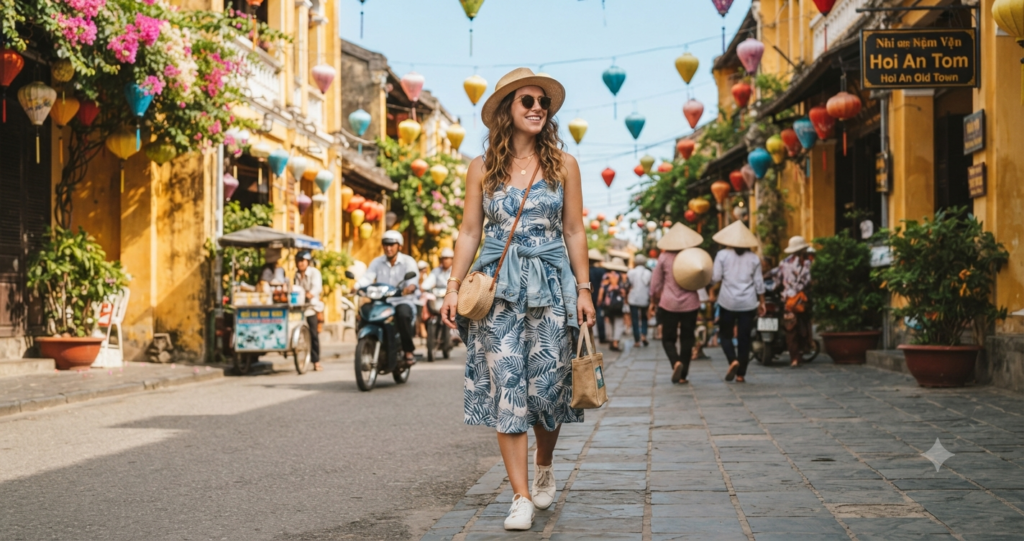
Vietnam’s most photogenic city. The Old Town’s cobblestone lanes and ochre walls are extraordinarily photogenic — what you wear matters for photographs.
Best Hoi An outfit: A linen or silk flowy dress in a soft colour (dusty pink, sage, cream, terracotta) + flat sandals. Warm tones photograph beautifully against the yellow walls.
The Hoi An tailor opportunity: Custom tailoring in 24–48 hours for $20–$60. Arrive with reference photos and allow time for two fittings.
Ho Chi Minh City
HCMC is modern and energetic — light, breathable clothing for the heat (30–35°C year-round). Casual sundresses, linen shorts and tops, comfortable walking shoes.
Halong Bay / Cruise
- Swimwear for kayaking and swimming stops
- Casual daywear for the boat deck
- One slightly smarter outfit for included dinners
- A light layer — evenings on the water can be cool
- Sandals you’re comfortable getting wet (cave visits)
Sapa (Northern Highlands)
At 1,500m elevation — dramatically cooler than the rest of Vietnam. Many visitors are badly underdressed.
- A fleece and waterproof jacket are essential
- Long trousers and hiking-capable shoes
- Rain gear — near-constant mist and frequent rain
Complete Vietnam Packing List
- 3–4 × lightweight linen or moisture-wicking tops
- 2 × loose linen trousers
- 2–3 × lightweight dresses (linen or rayon)
- 1 × swimwear
- 1 × thin cardigan or linen shirt (temples, cool evenings)
- Comfortable flat sandals with a heel strap
- Lightweight trainers (Sapa treks)
- 1 × pair flip flops (beach)
- A packable umbrella
- SPF 50 sunscreen
- DEET insect repellent
What NOT to Wear in Vietnam
- Revealing clothing near temples and pagodas
- Heavy jeans in southern Vietnam
- White or pale colours on motorbike tours — exhaust and dust immediately visible
- Flip flops for everything — Hanoi and Hoi An’s uneven streets need structure
Pairing Vietnam with a Cambodia stop? Our Cambodia outfit guide has everything you need for Angkor Wat, Phnom Penh and the coast.
Frequently Asked Questions
What is the best fabric to wear in Vietnam?
Lightweight linen. Vietnamese markets sell beautiful linen clothing cheaply. Moisture-wicking synthetic fabrics work well for active days. Avoid heavy cotton.
Can I get clothes made in Hoi An?
Yes — Hoi An is one of the world’s best places for affordable custom tailoring. A well-made dress or suit in 24–48 hours for $20–$60. Bring reference photos and use shops with good recent reviews.
Is Vietnam conservative about dress?
Less so than Cambodia or Thailand. Main requirements are covered shoulders and knees at religious sites. In beach towns (Da Nang, Mui Ne, Phu Quoc), casual beach wear is completely normal.
🗺️ Plan Your Vietnam Trip
Ready to go? Find the best tours, activities, and cheap flights below.
We may earn a commission at no extra cost to you. Disclosure
✈️ Trip Essentials
Affiliate links — we may earn a small commission at no extra cost to you.
Find hotels in Hanoi’s Old Quarter, Hoi An’s lantern-lit streets and Ho Chi Minh City — compare hundreds of options across Vietnam.
Skip the tourist traps — book top-rated tours, day trips and experiences in Vietnam with instant confirmation.
Ready to start packing? See our complete Vietnam packing list for women for everything you need to bring.
📌 Related: If you’re combining Vietnam with a Bali stop — which many Southeast Asia itineraries do — see our detailed guide to what to wear in Bali including temple dress codes.
Vietnam Packing List
Vietnam is one of Southeast Asia’s most rewarding destinations — a country of extraordinary contrasts stretching 1,650km from the misty mountains of Sapa in the north to the tropical beaches of Phu Quoc in the south. Ancient temples, UNESCO World Heritage towns (Hoi An, Hue, Ha Long Bay), motorbike-filled streets, the world’s most photogenic rice terraces, and a cuisine that’s widely considered among the finest in Asia. Packing for Vietnam means preparing for a country that spans multiple climates, requires temple modesty, and where the best experiences often involve getting off well-worn tourist paths. This Vietnam packing list for women covers everything.
Vietnam Weather: A Country of Three Climates
Vietnam’s length means the north, central, and south have different monsoon patterns:
- North Vietnam (Hanoi, Ha Long Bay, Sapa): Cool and sometimes cold December–February (Sapa can see snow). Hot and humid May–September with typhoon risk. Best months: October–April. Sapa’s rice terraces are most spectacular in late September–October (harvest) and May–June (terraces flooded with water).
- Central Vietnam (Hue, Hoi An, Da Nang): The most complex climate. Dry October–August; heavy rains September–November. Typhoon risk September–November. Best months: February–August.
- South Vietnam (Ho Chi Minh City, Mekong Delta, Phu Quoc): Tropical — hot year-round. Dry season November–April; monsoon May–October. Best months: November–April.
Vietnam Packing List for Women
Temple & Pagoda Dress Code
Vietnam has thousands of Buddhist pagodas, Cham temples, and Confucian shrines — many of which require covered shoulders and knees. The Perfume Pagoda near Hanoi, the Thien Mu Pagoda in Hue, the Cao Dai Temple near Ho Chi Minh City, and countless local pagodas all expect modest dress. A lightweight shawl or sarong that covers shoulders and knees is the essential Vietnam travel accessory — it folds into nothing and is on in seconds.
Clothing
- 3–4 lightweight tops (cotton or linen — synthetics are uncomfortable in Vietnam’s humidity)
- 2–3 loose trousers, harem pants, or wide-leg linen pants (comfortable in heat, appropriate for temples)
- 2–3 lightweight dresses or midi skirts (versatile for beach, temple visits with shawl, and evenings)
- 1–2 lightweight shawls or sarongs (temple coverage + beach wrap + hammock shade)
- 2–3 swimsuits (for Phu Quoc, Ha Long Bay overnight cruise, and Hoi An’s beach An Bang)
- 1 packable rain jacket (essential for northern mountains, central Vietnam, and unexpected downpours anywhere)
- 1 warm layer (for Sapa — genuinely cold; for Ha Long Bay overnight cruise cabin air conditioning; for northern Vietnam December–February)
Hoi An Tailoring Note
Hoi An is Vietnam’s tailoring town — hundreds of tailors can make almost any garment in 24–48 hours at remarkable prices. Many travellers arrive in Hoi An with a nearly empty suitcase and leave with a full wardrobe of custom-made pieces. If you’re planning to take advantage of Hoi An’s tailors, pack light and leave room in your luggage budget. Bring reference photos and allow time for at least one fitting.
Shoes
- Comfortable flat sandals with slip-on/off ease: You remove shoes at every temple. Flat sandals with a back strap (so they don’t fall off on temple steps) are the most practical choice.
- Walking shoes or trainers: For Sapa trekking, the My Son Cham temples, Hue’s Citadel, and longer city exploration in Hanoi and Ho Chi Minh City.
- Flip flops: Phu Quoc, An Bang Beach, and beachside guesthouses.
Health Essentials
- DEET insect repellent (dengue risk; malaria risk in some highland and border areas)
- Anti-diarrhoea medication and rehydration sachets (food is excellent but stomach issues are common)
- Water purification tablets or filtered bottle
- SPF 50+ sunscreen
- Vietnam uses Type A/C plugs — check your device requirements; most European devices need adaptors
Vietnam Activity Guide: What to Wear
Ha Long Bay Overnight Cruise
Ha Long Bay (and the quieter Lan Ha Bay, preferred by many experienced travellers) is best experienced on a 2-night overnight cruise — kayaking through limestone karsts, swimming in emerald water, and watching sunrise from the boat deck. Pack a swimsuit and cover-up for kayaking, comfortable but smart-casual clothing for onboard dinners (jungk boats typically have a dress code of “resort casual” for evening meals), and a warm layer for cool evenings on the water. Suncream is essential — the bay’s reflected UV is intense.
Hoi An Ancient Town
Hoi An’s UNESCO-listed Ancient Town is one of Southeast Asia’s most beautiful — lantern-lit streets, Japanese merchant houses, Chinese assembly halls, and the famous Yellow Walls that make every photo look like a painting. The Assembly Halls (Fujian, Chaozhou, Cantonese) and Quan Cong Temple require covered shoulders and knees. Evenings in Hoi An are magical — the town is lit entirely by lanterns for the Full Moon Lantern Festival (monthly) and the general evening atmosphere is extraordinary. A sundress with a shawl handles both daytime temples and evening ambiance perfectly.
Sapa Rice Terraces
Sapa in the Hoang Lien Son Mountains of northern Vietnam is famous for its cascading rice terraces and ethnic minority villages (Hmong, Red Dao, Tay peoples). Trekking between villages involves muddy mountain paths, stream crossings, and significant elevation change. Wear proper walking shoes or trail runners (not sandals), quick-dry hiking trousers or leggings, a moisture-wicking long-sleeved top (for both cool temperatures and sun protection at altitude), and always bring a rain jacket. Sapa can be cold even in summer — pack a warm mid-layer.
Common Vietnam Packing Mistakes
- Packing synthetic fabrics: Vietnam’s coastal humidity and heat make synthetic fabrics genuinely uncomfortable. Natural fibres (cotton, linen) breathe and feel significantly better. A few good-quality linen pieces are worth more than a larger number of synthetic garments.
- Not leaving room for Hoi An tailoring: If you’re visiting Hoi An, pack lighter than you think you need to — you’ll almost certainly buy clothing.
- Forgetting northern cold: Many visitors plan Vietnam as a purely tropical trip and are surprised by Sapa’s cold (and the north’s cool winter). Pack at least one warm layer if your itinerary includes Sapa or Hanoi December–February.
- Not checking weather by region: Vietnam’s three climatic zones mean it’s possible to be in sunny Phu Quoc while central Vietnam is in the middle of typhoon season. Check weather for each region you’re visiting independently rather than assuming one Vietnam weather forecast applies.
Vietnam Packing FAQ
How long should I spend in Vietnam?
Two weeks allows a classic north-to-south (or south-to-north) route: Hanoi (2 days) → Ha Long Bay overnight cruise (2 days) → Hue (1–2 days) → Hoi An (3 days) → Ho Chi Minh City (2 days) with flights between major sections. Three weeks allows Sapa (the rice terraces) and Phu Quoc or the Mekong Delta. Internal flights are inexpensive (VietJet, Bamboo Airways) and save significant travel time on a country this long.
Is Vietnam safe for female solo travellers?
Vietnam is one of the safer Southeast Asian destinations for solo women. The main concerns are motorbike bag snatching in Ho Chi Minh City (wear your bag across the front), scam taxis at airports (use Grab — the Southeast Asian equivalent of Uber — instead), and persistent vendor pressure at tourist sites (firm but polite refusals work). Violent crime against tourists is rare. The guesthouse and hostel network is excellent, and solo female travellers are very common in the main tourist circuits.
What is Vietnam’s visa situation?
Vietnam introduced an e-visa system in 2023 that allows most nationalities 90-day single or multiple-entry visas, applied for online. UK, EU, US, and Australian passport holders are among those eligible for the e-visa. The process takes 3–5 business days and costs around $25 USD. Some nationalities (including UK, several EU countries) receive 45-day visa exemptions without an e-visa. Check the current policy for your specific passport before travelling — visa policies can change. Apply well in advance of travel.
Pingback: Vietnam Packing List for Women: What to Pack for Vietnam - Vacation Style Guide
Pingback: What to Wear in Cambodia: Angkor Wat, Phnom Penh & Beach Outfit Guide - Vacation Style Guide
Pingback: Solo Travel Outfits for Women: The Complete Packing Guide - Vacation Style Guide