
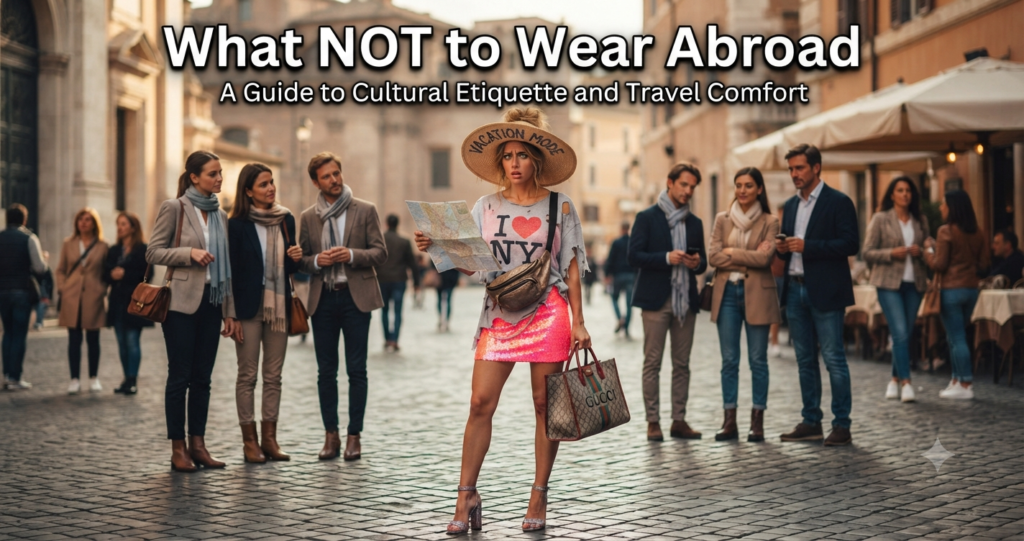
Every year, tourists are turned away from temples in Bali, refused entry to cathedrals in Rome, fined on beaches in France, and asked to leave restaurants in Paris — all because of avoidable clothing mistakes. Here are the dress code rules for 25 countries every traveler needs to know.
The Global Rules That Apply Almost Everywhere
- Shoulders covered in all houses of worship
- Knees covered in all houses of worship
- Remove shoes before entering mosques and many Hindu/Buddhist temples
A lightweight scarf in your bag solves all of these with one item.
Asia
Bali, Indonesia
Every major Balinese Hindu temple requires a sarong — not just recommended. Guards at Tanah Lot, Uluwatu, Besakih, and Tirta Empul check at the entrance. Most temples provide a rental sarong for a small fee.
Thailand
The Grand Palace in Bangkok is where tourists most commonly get turned away. Sleeveless tops, shorts, and short skirts are banned. Most Thai temples sell or rent temple-appropriate clothing at the entrance. Also: clothing with images of the Buddha is deeply disrespectful.
Japan
Onsens are used nude — swimwear is banned. Many onsens exclude people with tattoos. In traditional Japanese restaurants, remove shoes and have clean socks without holes.
India
Remove shoes inside all Hindu temples, mosques, and Sikh gurdwaras. Shorts or miniskirts at temples are inappropriate. At the Golden Temple (Amritsar), head must be covered — free scarves are provided at the entrance.
Cambodia (Angkor Wat)
Shorts or sleeveless tops at Angkor Wat and major temple complexes will get you turned away. The Cambodian government enforces this strictly.
Middle East
UAE (Dubai, Abu Dhabi)
Very short shorts, bikini tops, or revealing clothing outside beach/pool areas can result in fines — this is a legal issue, not just cultural. At Sheikh Zayed Grand Mosque, women must cover hair, arms, and legs (abayas are provided). Swimwear on designated beaches is perfectly legal.
Morocco
Shorts, miniskirts, or sleeveless tops in medinas (Fez, Marrakech, Chefchaouen) will attract significant harassment. International resort beaches (Agadir) are more relaxed.
Europe
Italy
Every major Italian church — Vatican, Florence Duomo, Santa Maria Maggiore — enforces shoulders and knees covered. Guards check at the entrance. Venice has fines of up to €250 for people walking through the city in swimwear.
France
Same church rules as Italy. Parisians dress with effort — athleisure or overly casual clothing at an upscale Paris restaurant gets noticed.
Spain
Sagrada Família, Barcelona Cathedral, Seville Cathedral — all require covered shoulders and knees.
Africa
Kenya / Tanzania (Safari)
Camouflage clothing is banned in both Kenya and Tanzania. Bright colors disturb wildlife. Blue and black attract tsetse flies.
Egypt
At mosques, full coverage required — women need a head covering. Outside Cairo’s tourist areas, revealing clothing in conservative neighborhoods generates significant unwanted attention.
The Americas
Dress codes are less religiously strict across Latin America and the Caribbean, but plenty of local rules still apply: camouflage-print clothing is illegal for tourists in several Caribbean nations (including Barbados, St. Lucia, Trinidad, and Jamaica), and beachwear worn off the beach reads as disrespectful in most Latin American cities, where daily dress leans more polished than North American casual. Church visits throughout Catholic Latin America expect the same shoulders-and-knees coverage as European churches.
The Universal Carry-On Fix
One large lightweight scarf (modal, silk, or thin cotton) solves almost every cultural dress code situation worldwide. It covers shoulders, wraps as a skirt, drapes as a head covering, and folds to nothing.
Turkey
Istanbul’s mosques — the Blue Mosque and Hagia Sophia especially — require shoulders and knees covered for everyone, and women need a headscarf; both are handed out free at the entrance if you arrive without one. Shoes come off before entering, and plastic bags are provided to carry them. Outside religious sites, Istanbul and coastal resort towns are dress-code relaxed and similar to southern Europe.
Sri Lanka
Buddhist temples (Kandy’s Temple of the Tooth, Sigiriya) require shoulders and knees covered, and shoes and hats come off before entering — this applies even walking on the outer platforms, not just inner shrine rooms. Beachwear is fine at coastal resort towns but should be covered up for the walk into any nearby town or temple grounds.
Peru
Cusco’s churches and monasteries expect shoulders and knees covered, similar to the rest of Catholic Latin America, and shorts are frowned on at Machu Picchu’s more formal viewpoint areas even though there’s no strict enforcement. High-altitude sun is intense despite the cool air, so sun protection matters as much as modesty here — a common mistake is dressing for the cold and forgetting how strong the UV exposure is at elevation.
Frequently Asked Questions
What happens if I dress wrong at a temple?
You’ll be denied entry — usually politely. At major sites like Angkor Wat, Bali’s temples, and Bangkok’s Grand Palace, guards check at the entrance. Some sites offer rental clothing; most don’t.
Do men have dress code requirements too?
Yes — shorts are banned in many mosques, temples, and churches for men. Men visiting mosques must have long trousers. Enforcement is often less strict for men, but the requirements exist.
Is it ever okay to negotiate a temple dress-code rule as a tourist?
Essentially never — these rules are enforced consistently regardless of how the trip is timed or how far someone has traveled, and guards at major sites see the same requests daily. Carrying a scarf solves the problem before it starts.
Do dress codes apply differently to children?
Rules are generally more relaxed for young children but still apply to anyone who reads as a teenager or adult — a 10-year-old in shorts is rarely stopped, but the same isn’t true for a 15-year-old.
🗺️ Plan Your Worldwide Trip
Ready to go? Find the best tours, activities, and cheap flights below.
We may earn a commission at no extra cost to you. Disclosure
✈️ Trip Essentials
Affiliate links — we may earn a small commission at no extra cost to you.
Compare millions of hotels worldwide — boutique stays to luxury resorts. Best price guarantee.
Skip the tourist traps — book top-rated tours, day trips and experiences in What Not To Wear Abroad with instant confirmation.
Is camouflage clothing actually illegal to pack? In several Caribbean and a few African nations, yes — it’s enforced at customs, not just a cultural preference, so leave it out of the suitcase entirely rather than risk confiscation.
What’s the single most versatile item for covering multiple countries’ dress codes? A large, lightweight scarf — it covers shoulders for temples and churches, works as a head covering for mosques, and doubles as a light layer on cool evenings or over-air-conditioned transit.
>
Pingback: What to Wear in London: The Season-by-Season Style Guide (2026) - Vacation Style Guide