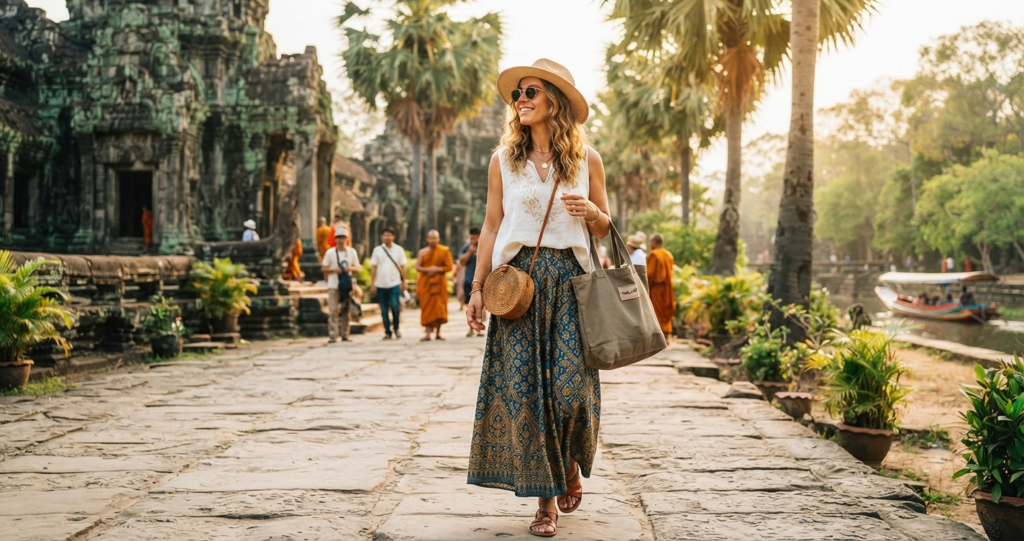
Most Southeast Asia packing guides tell you to pack light, breathable clothing. That’s true — and wildly insufficient. Here’s what nobody tells you about dressing for Thailand, Bali, and Vietnam.
The Southeast Asia Climate Reality
- Cotton feels great in dry heat; it’s miserable in humidity. Wet cotton clings, smells, and takes forever to dry.
- You will sweat through everything. Every day. Plan for multiple clothing changes and fabrics that dry quickly.
- Light colours get dirty faster — dust, tuk-tuk exhaust, street food splatter.
Temple Dress Code: The Truth by Country
Thailand — Stricter Than You Think
The Grand Palace in Bangkok: shoulders and knees must be covered. Tight-fitting clothing technically violates the spirit of the code. Dress code office at the entrance will assess your outfit. Major temples with strict codes: Grand Palace, Wat Suthat, Wat Benchamabophit.
Bali — Sarong Required, No Exceptions
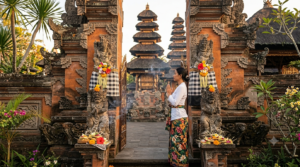
Every major Balinese Hindu temple requires a sarong. Guards at Tanah Lot, Uluwatu, Besakih, and Tirta Empul check at the entrance. Buy your own sarong at a market on day one ($1–3) — it doubles as a beach cover-up, picnic blanket, and airplane blanket.
Vietnam — More Relaxed, But Respect Matters
More relaxed than Thailand or Bali — you won’t typically be turned away for shorts. However, covering up at pagodas and the Hoi An Old Town is respectful. Northern provinces (Hanoi) lean more conservative than beach areas (Hoi An, Da Nang).
What Actually Works: The Fabrics
Linen is the ideal Southeast Asia fabric: breathes better than cotton, drapes beautifully, looks intentionally relaxed when wrinkled. Build your wardrobe around linen.
Moisture-wicking synthetics are superior for hiking and active days in heat.
Cotton-linen blends give the best of both.
Avoid heavy cotton denim — miserable in heat and takes 24+ hours to air dry.
The 11 Things Tourists Pack But Never Use
- A heavy denim jacket “for air conditioning” — a thin cardigan works better
- Three or more pairs of jeans
- Fashion heels — cobblestones, temple stairs, beach sand make them impractical
- Formal evening clothing — a nice sundress is the most formal you’ll need
- Heavy sweaters — Southeast Asia nights rarely drop below 22°C
- Multiple pairs of full-length trousers — one or two is plenty
- A full rain jacket — a packable umbrella works better for tropical downpours
- Brand-new white clothing — see: dust, tuk-tuks, street food
- Multiple luxury pieces — humidity and activity will stress them
- Heavy hiking boots — lightweight trail runners handle most terrain
- Matching pajamas — lightweight sleep set maximum
What to Buy There Instead
- Bali: Hand-stitched linen dresses for $5–15 that cost $80 in Western boutiques
- Thailand: Thai silk in Bangkok’s Chatuchak Weekend Market
- Hoi An, Vietnam: Custom tailoring in 24–48 hours for $20–50. Order early in your visit for alterations time.
Complete Southeast Asia Packing List
- 4–5 × lightweight linen or moisture-wicking tops
- 3 × loose linen or harem-style trousers (temple-appropriate)
- 2 × lightweight sundresses
- 1–2 × swimwear
- 1 × large sarong (Bali temples + beach + everything)
- 1 × thin cardigan (for AC / evening / temple shoulders)
- 1 × pair comfortable sandals with a heel strap
- 1 × pair lightweight trainers or trail runners for hiking
- 1 × pair flip flops (hostel showers, beach, pool)
- A packable umbrella (not a rain jacket)
Adding Cambodia to your Southeast Asia route? Our Cambodia outfit guide covers temple-appropriate dress for Angkor Wat plus beach and city looks.
Frequently Asked Questions
Is there a dress code for beaches in Southeast Asia?
No — bikinis and swimwear are completely acceptable on tourist beaches throughout Thailand, Bali, and Vietnam. At Muslim areas (parts of Malaysia, Lombok), more coverage is appreciated on public beaches.
What’s the best bag for Southeast Asia sightseeing?
A small, secure daypack or crossbody bag with a zipper closure. Markets and crowded streets have pickpockets. A waterproof daypack is worth the small extra cost — tropical rain is sudden and heavy.
🗺️ Plan Your Southeast Asia Trip
Ready to go? Find the best tours, activities, and cheap flights below.
We may earn a commission at no extra cost to you. Disclosure
✈️ Trip Essentials
Affiliate links — we may earn a small commission at no extra cost to you.
Find hotels across Bangkok, Bali, Chiang Mai, Hoi An and Singapore — compare hundreds of options across Southeast Asia.
Discover top-rated tours and experiences worldwide. Instant booking, free cancellation on most activities.
Southeast Asia Packing List
6+ — Countries commonly included in a single Southeast Asia trip requiring one cohesive packing list
Linen/cotton — The only two fabric categories worth packing for the entire Southeast Asia region
Required — Modest temple dress code enforced across Thailand, Bali, Cambodia, Vietnam, and Myanmar
7kg — Typical budget airline carry-on weight limit across Southeast Asian low-cost carriers
Local markets — The best and cheapest place to fill packing gaps across every Southeast Asian country
Southeast Asia Packing Works Differently Than Any Other Region
Southeast Asia trips are uniquely challenging to pack for because a single itinerary commonly crosses six or more countries — each with their own climate nuances, cultural dress expectations, and activity types — while low-cost airline hopping between countries often means working within 7kg carry-on restrictions. The packing approach that works for Southeast Asia is therefore more capsule-focused and more fabric-specific than packing for any other major travel region.
The Climate Reality Across the Region
Heat and humidity are the constants across virtually the entire Southeast Asian region throughout the year. Even during the so-called cooler season, daytime temperatures across Thailand, Bali, Vietnam, Cambodia, and the Philippines rarely drop below 25°C in most areas visitors focus on. The variable is rain — monsoon timing shifts by country and by region within each country, but the heat itself is a consistent factor that dictates fabric choice absolutely.
The Fabric Rule That Covers the Whole Region
Pack only linen and cotton. This is not a stylistic preference — it is a practical requirement for comfortable travel across Southeast Asia’s climate. Every other fabric category fails in the region’s combination of heat, humidity, and frequent sweating that comes with walking through ancient temple complexes in 33°C heat. Linen and cotton both breathe, both absorb moisture, and both dry fast enough to hand-wash in a hotel sink overnight — a genuine necessity on longer trips through the region.
The Core SEA Temple Wardrobe
Every Southeast Asian country with significant cultural heritage has temple dress codes — Thailand’s Grand Palace and Wat Pho, Bali’s Hindu temples, Cambodia’s Angkor Wat complex, Myanmar’s Shwedagon Pagoda, and Vietnam’s imperial city temples all require modest dress. The formula that works everywhere: a midi-length cotton or linen skirt or trousers, a sleeved top, and slip-on shoes. This combination handles every temple encounter across the entire region without needing destination-specific pieces.
The Complete 12-Piece SEA Capsule
| Item | Quantity | Function |
|---|---|---|
| Linen midi skirt | 1 | Universal temple coverage + evening wear |
| Cotton linen trousers | 1 | Temples, travel days, cooler highland areas |
| Sleeved cotton tops | 2 | Temple tops + everyday wear |
| Sleeveless cotton tops | 2 | Beach and city casual |
| Swimsuits | 2 | Island and beach days |
| Cover-up / sarong | 2 | Beach cover + temple wrap |
| Maxi dress | 1 | Complete evening outfit in one piece |
| Slip-on sandals + trainers | 1 pair each | Temples + walking tours |
Southeast Asia Packing List: Men
- 3–4 lightweight shirts (linen or breathable cotton)
- 2–3 pairs loose-fitting trousers (linen is ideal)
- 2–3 pairs shorts (for beach and casual areas)
- 2 swim trunks
- 1 long-sleeved light shirt for temples
- Comfortable sandals + flip-flops + trainers for cities
- Light rain jacket
- Sunglasses, hat
The Local Market Strategy
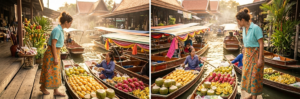
Every Southeast Asian country has excellent local markets selling lightweight clothing at prices far below what you’d pay at home. Many experienced SEA travellers pack lighter than they think they need, knowing they can fill gaps at Chatuchak in Bangkok, the Hoi An tailors in Vietnam, or Bali’s local clothing markets. This strategy also allows buying authentic local pieces rather than importing generic travel clothing from home.
Southeast Asia Packing List FAQ
How do I handle different temple dress codes across multiple countries?
Pack one universal temple outfit — a midi-length skirt or trousers plus a sleeved top — that meets the requirements of every country’s temples. This single combination works for the Grand Palace, Angkor Wat, Bali’s Hindu temples, and Vietnam’s imperial sites without needing country-specific pieces.
How do I keep clothes fresh across a long multi-country trip?
Hand-wash linen and cotton in the hotel sink with travel laundry soap — both fabrics dry overnight in Southeast Asia’s humidity. Use laundry services (available cheaply at most guesthouses) every 5–7 days for a deeper clean. Packing light enough to rotate properly is more effective than packing more.
Should I pack for the rainy season specifically?
A packable rain poncho and quick-dry sandals are the only rainy-season additions worth making. Avoid heavy waterproof gear — Southeast Asian rain is warm and typically short-lived, and heavy rain gear creates more discomfort from heat than it solves from rain.
Can I do Southeast Asia with just a carry-on?
Yes — many experienced SEA travellers manage months of multi-country travel with a single 7kg carry-on by applying strict capsule principles and relying on local markets for any gaps. The key is limiting shoes to two pairs and accepting that you’ll wear certain pieces multiple times.
Which Southeast Asian country requires the most careful dress planning?
Bali has the most pervasive cultural expectations around dress — temples are everywhere and the expectation to dress appropriately applies broadly, not just at major tourist sites. Myanmar (if visiting) has the most formal temple attire requirements. Thailand’s Grand Palace is strictly enforced but applies mainly to that specific site.
Pack Less, Wear Better
Southeast Asia consistently rewards travellers who pack the minimum quality pieces over those who overpack generic holiday clothing. A tight capsule of breathable natural fabrics, one universal temple outfit, and the knowledge that local markets fill gaps at a fraction of home prices is the most effective Southeast Asia packing strategy available.
✈️ Trip Essentials
Affiliate links — we may earn a small commission at no extra cost to you.
✈️ Trip Essentials
Affiliate links — we may earn a small commission at no extra cost to you.
Hotels across Bangkok, Bali, Chiang Mai, Hoi An and Singapore.
Discover top-rated tours and experiences worldwide. Instant booking, free cancellation on most activities.